
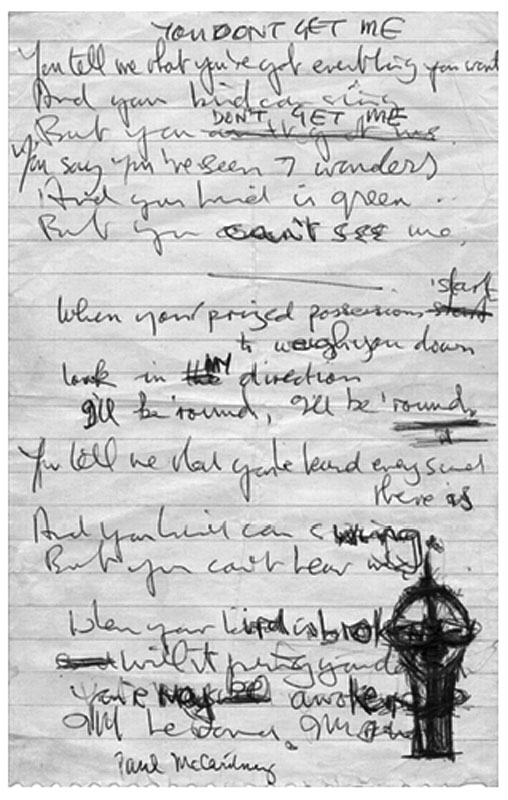
Written primarily by John Lennon, ‘And Your Bird Can Sing’ is notable mainly for its cryptic lyrics and the twin guitar riffs – played by Paul McCartney and George Harrison – that drive the song.
While Lennon never revealed the inspiration behind the song, it is believed to refer to the rivalry between The Beatles and The Rolling Stones. Although the two groups were friends, Lennon saw the Stones as Beatles copyists, and the titular ‘bird’ may have been Marianne Faithfull.
Like ‘Rain’, ‘And Your Bird Can Sing’ hinted at knowledge denied to all but the enlightened, showing the influence of LSD. It is also likely that the oblique lyrics were an attempt at writing something akin to the wordplay of Bob Dylan, whose songs Lennon greatly admired.
Lennon was later dismissive of ‘And Your Bird Can Sing’, describing it as “a horror” and “throwaway”. Paul McCartney claims to have helped Lennon write the song.
‘And Your Bird Can Sing’ was John’s song. I suspect that I helped with the verses because the songs were nearly always written without second and third verses. I seem to remember working on that middle eight with him but it’s John’s song, 80-20 to John.
Many Years From Now, Barry Miles
‘And Your Bird Can Sing’ was the theme song of The Beatles’ US cartoon series during its third season.
In the studio
On 20 April 1966 The Beatles recorded two takes of ‘And Your Bird Can Sing’, beginning with a rhythm track of guitars and drums. They then overdubbed three lead vocal tracks from John Lennon, harmonies from Paul and George, and tambourine and bass.
This version of the song was rejected, but was eventually released – complete with hysterical laughter from John and Paul – on Anthology 2.
On 26 April 1966 they recorded takes 3-13, with take 10 being the best. To this they overdubbed vocals and further instrumentation, and the song was complete.
The ending of ‘And Your Bird Can Sing’, however, was from take six. The two takes were edited together on 12 May, when mono mixes were made. Stereo mixes were made on 20 May 1966. Further mono mixes and edits were made on 6 and 8 June.


no mention of Paul playing ‘lead’ with George on this one? pretty big fact to leave out methinks.
Was it definitely McCartney with Harrison? Ian MacDonald suggested it may possibly have been Lennon. As I couldn’t confirm it either way I didn’t put in the info. I admit it’s more likely to have been McCartney and Harrison, though it could have been Harrison double-tracked. Confirmation from a reliable source would be helpful if anyone has it.
There’s an edit war on Wikipedia about this. Apparently, Mark Lewisohn says John played lead.
George said it was John and Paul doing the little solo.
That’s not what Ringo says.
I heard from sombody that Paul multi-tracked 2 different lead parts that can be heard on the solo.
I heard it was the grassy knoll shooter…..
It is absolutely Harrison and McCartney. Paul has said so, as well as Ringo. George at first might not have recalled who played the harmony solo with him (he never said it was John and Paul), but later commented that he believed it was Paul. John was very talented, but not for such an intricate solo as this.
This song is really not that difficult to play. It’s pretty straight forward actually. I am certain John could play this, but if he did not it would have been for the sake of economy on studio time usage and not throught lack of ability.
Totally agree. I can almost play it and I’m a rhythm guy, not a lead guitarist. I’m not so sure it is two guitars either (listen to the guitars isolated on Youtube). The harmony part is simplly a 2-finger pattern that sounds really nice but is not that difficult.
It absolutely IS two guitars .. Probably Paul & George (according to what Ringo *supposedly* said) but there are two people playing. Rumor has it that Joe Walsh tried to learn it for hours one afternoon at Ringo’s house before Ringo told Joe that it was Paul and George. And the intimation that George “thinks” he remembers? How do you not remember if you played something on a song?
Putting in a good word for Paul & John: Paul also for the great bass work & John for the lead vocals…love Paul’s
voice too but John’s vocals have more of an edge which helps with this song
“How do you not remember if you played on a song?”
Drugs…drugs.
They worked very quickly, putting down parts as quickly as possible… and at times their schedule was so packed that considering they probably made time to have a personal life, stay up late with friends/lovers or whatever, it is also possible that they were physically exhausted during and after sessions. I know a lot of musicians who don’t remember all the details of a recording session that happened just a few years ago. Remember, the Beatles didn’t think of every moment in their lives as history being made, they were quickly recording their songs so they could get on to writing the next one.
I saw an interview with Joe Walsh where he recounted asking Ringo how George played that lead? He said Ringo told him: he overdubbed it, If Joe is remembering that conversation with Ringo correctly, I would take it that, “he,” refers to George, but it is possible he meant that it was George’s riff but Paul played a second guitar part along with George.
Joe made the comment that he learned to play the solo himself without another guitar playing along so he guessed he was the only one at that time who could play it all by himself.
At any rate, it is an excellent riff and absolutely perfect for the song. For me it was always exhilarating and I still to this day crank it up when I listen to the song.
I find this an enormously complex solo – if you can play as a two finger harmony pattern- you are good, am .!
Done correctly its not easy. The guitar intro and lead is a challenge to do correctly at the correct tempo.
I know this is an old post of yours, but I am a guitarist as well with years of classical, rock and jazz. It is two guitars. Not only because it is difficult to play and nearly impossible to get it right twice is a row, but there are places where there is a bend on what would have to the first string while keeping unbent on the second. As well as another place where the first is bent at the 12th fret to the 14th while the third string is bent from 13th fret to fourteenth fret which is physically impossible. Not even Jerry Donahue could do it
George clearly claimed he played it with someone and Paul said he played it with George. John gave an indepth description and never claimed he played it. John would never pass up a chance like that. He didn’t play it
Yeah, Right! John, or practically ANY decent lead man could easily handle each part separately. The Trib Bands 1964, The Fab Four, The Return, (and many others, including myself) play both leads simultaneously on ONE Guitar! THAT changes things a “bit”, ‘eh Wot?
Couldn’t one conceivably tune a twelve string to thirds and have one person play it?
How would you get the minor thirds?
Yes, it definitely changes things a bit. The different tonalities of two guitars playing harmony is completely different from one guitar playing double stops. It’s VERY obviously the former, on the original recording.
Yeah. But they don’t play it correct.
agree — John could not have pulled this solo off technicaly
I belive it was George and Paul.
John is definitely capable of doing it. I think that he’d be too impatient and lazy to figure it out.
It’s not difficult. It’s pretty straight forward.
The decending minor in the middle eight is right their in the chord. One guitar starts on the 5th string from the top. The other gtr 4th string from the top.
Couldn’t one conceivably tune a twelve string to thirds and have one person play it ?
No.
Paul also played lead on Paperback Writer.
I have a friend who figured out how to play both parts simultaneously. He’s pretty good–but not THAT good, so it can’t be that hard.
Here’s a tip for guitarists who want to play both solo parts simultaneously: Tune the D string a whole step up to E. It will ring sympathetically throughout. The double-stop solo is played on the G and B strings, playing 3rds and descending from the 9th position. By tuning the D to E, the middle 8 is more easily played by starting at the 4th fret barring the top 4 strings, then descend the D (now E) string and high E string simultaneously while keeping the G and B strings at the 4th position. Unusual fingerings but sounds good. And when you play the final chord as a typical A chord in open position, it sounds exactly like the record!
Thanks Joe Walsh.
I heard or read an interview with John and he said it was all him(John) playing all the guitar work
I think it was rolling stone or something
As a guitar player I am not sure this sounds like too lines. As I can play the line alone, the distortion of the notes come most likely from playing the thirds alone rather then just the amp distortion (or fuzz box). Paul was incredible on most instruments but lead guitar, well there is a lot of credit he has taken for himself.
Including TAXMAN?
Sorry I’m a bit late to the party.
When I met George back in the 80s, I asked him about this song since it had just come out on CD. He told me he liked that song a lot. I told him I’d been trying to learn how to play the guitar part for years but couldn’t do it. He said, “Paul played one part and I played the other” or something like that (it’s been a while). I laughed and said something like, “Now you tell me – it took two of you guys to do it!” We both laughed. But anyway, according to George, it was definitely Paul and him.
I love Ian McDoughnut’s book, book, but he has enough detail errors on the music, seeing as he is a journalist not a musician, such as calling the fretboard of a guitar as a keyboard, getting personnel wrong on tracks, guitars wrong, keys or stuff I can’t remember after 15 years, to doubt his credibility to have this book regarded as a serious musical critique
The sections on social history, I find engaging any convincing, but he makes too many mistakes on the detail, in my opinion
McCartney & Harrison play dual lead. It says so in Beatle books and just today, July 22, 2018, Geoff Emerick had a live Q&A online, and he said Paul & George played lead. I wonder if Paul wrote the lead part? Trying to find that out.
John would read for ideas for songs, so if you were to read H.C. Andersons “The Nightingale” you could see how he might have used the concept for a song, and placed himself as the nightingale in the song.
Didn’t the “seven wonders” lyric of the song come from an tripped out paul on lsd and he wrote down “life is in seven layers”
Hi Grace. You’re close – it’s said to be about “There are seven levels”, which was Paul’s conclusion about life on the night he first tried marijuana. Some links:
https://www.beatlesbible.com/features/drugs/3/
https://www.beatlesbible.com/1964/08/28/bob-dylan-turns-the-beatles-on-to-cannabis/
Whether or not the line does actually refer to that, I don’t know. It’s possibly just a line about seven wonders, y’know.
you guys have never heard of the ‘seven wonders of the ancient world’? this is almost definitely what he is referring to.
to my personal (and admittedly not confirmed with anyone, anywhere) interpretation of the song, it just seems like he is singing about people who brag in general about material things like gathering material possessions (which i assumed the ‘bird’ symbolised), going on expensive holidays, etc, to which he retorts ‘but you don’t have understanding, or spiritual depth’.
i could be completely off but sometimes the simplest interpretation turns out to be the right one..
Yeah, the “spirituality vs. material possessions” theme seems to be the most likely interpretation to me too. As for the “seven wonders”, he’s not referring to the literal (ancient) Seven Wonders, of course – you’d have to have lived thousands of years ago to have seen them! But from time to time, mankind has compiled lists of the seven wonders of the modern world, and the engineering world, etc., and “seven wonders” just became kind of a standard catch-all term. I don’t think there’s any way John had Paul’s “seven levels” theory in mind.
The seven layers refer to “the seven veils of truth” in Hindu philosophy/religion. The concept is that “real truth” is covered by seven veils (or layers) which one must uncover one by one. Each time you think you have “found the truth” you conclude that there are still other veils/layers to uncover.
THANK YOU. That’s always what I got from it. And somebody not being able to see true and simple things behind all that (“but you can’t see me, you can’t see me.”). And thinking they know everything and having heard it all and all that. I really like that song…wonder why John disowned it later.
Exactly. A bird in a cage.. That was the illusion.
Not very likely since the song was recorded in April 1966 and Paul took his first LSD trip in “late 1966”.
I think someone is mixing up Paul on weed with Paul on LSD, which, as you said, didn’t happen until late 1966; in the company of Tara Browne, who died in a car crash on 18th of December that year…which leads me to believe that Paul’s first LSD experience must have been before that…and certainly not in 1967.
But still — according to George — about 18 months after the other three had first tripped.
[Spring/summer of 1965…yes, that adds up!]
Regarding the original question, I think Joe pretty much summed it up.
I’ve read conflicting quotes from McCartney about his first time on LSD. He’s said he first took it with Tara Browne, but also that his first trip was when he took Lennon home after the infamous accidental experience in the studio. Given that the latter was during the Sgt Pepper sessions, it’s likely that he first took the drug in late 1966. Memory can do funny things.
He was on pot when he wrote about that.
Not LSD. He smoked pot for the first time with Bob Dylan in 1964. That is where he asked the universe about the meaning of life and got that answer that there are seven layers. The coindence for me is that, in the same year I also asked the universe about the meaning of life. I wrote it on my note book. I was fifteen. February 1964. So it was some months before Paul asking. My answer was not the same, though. I got it next day without any drugs. In the same day I was invited to spend the week end in a country club with some girls to study the gospels. Only teenagers. And one of them suddenly started talking about why we are born. According the her there was a time we were all united. But we fell and since then duality was created giving birth to the good and the evil. Our mission is to restore the broken unity. Why? With love. However, to learn how to practice love the way Jesus meant is not so easy. There is a lot to learn yet. We have to forget forever all kinds of prejudice and see all creatures are equal. We are only one, everybody and everything connected. Possibly…it is important to remove seven layers till we learn how to love. By the way, that is all we need. Love.
You shoulda tried the acid route.
Harrison said himself (i cant find where i read it) that him and mccartney did the harmonized lead guitars, although im not sure who did what key…but it was definitly mccartney. Lennon did the chords in the background.
Great – thanks for that. I’ve changed the line-up now.
Just watched anthology again last night. You’re right. He was with mal and wrote it down on a piece of paper while smoking marijuana. I said lsd. My bad! I wish paul went into more detail about the “layer” thing
Also, I wish I knew why paul and john are laughing so hard on the anthology 2 track. I want to laugh too…but I don’t know what’s funny.
You know my name (look up the number) is the greatest anthology track. With a JAZZ jam session at the end, I mean there’s nothing better than that!
Hi Grace, I thought I remembered someone asking what they were laughing at – I’m not saying this is some kind of revelation or anything, but I noticed when listening to the Anthology version of the track today that you can just about hear John (I guess accidentally) “smack” his lips just as he goes to sing the opening line – he does it again several times shortly after, and I suspect this is what cracked him up – being from Liverpool myself, I can attest that this is just the sort of silly thing that appeals to my sense of humour, so I’m going to assume it would to John’s as well.
I love the anthology version of this track – it’s a great song anyway, but I always have a huge smile on my face when I hear them cracking up – I hope you enjoy it a little bit more armed with this “new” info.
Thanks for pointing this out. I’ve always really liked this song because of the laughter but never knew why (or noticed the lip smacking).
Manic laughter is associated with LSD use. Perhaps this was one of the few times the Beatles were tripping in the studio?
A bit early for that. The LSD use (particularly by John) blossomed during the Sgt. Pepper era. Besides, Ringo says in the “Anthology” that they wouldn’t even smoke weed at the sessions, because it would slow their productivity down.
Julian, Ringo might have said that, but it is pretty well-documented that it’s not quite true. There were many studio sessions where they (one or more of them) were high on something.
In various interviews, they admitted that after being introduced to marijuana, they would often dip into the bathrooms at the studio and get high while trying to hide it from George Martin. Also, during the recording of Ob-La-Di Ob-La-Da Lennon came in and bragged about how high he was and how the others have ever been that high and never will be that high, etc. So, yeah, it definitely happened.
On that take John deliberately sings “and your bike is broken” instead of “and your bird is broken” that is what breaks McCartney up. They were more than likely high on weed.
I think it’s just a matter of them getting the giggles. Not inappropriate if cannabis was a part of the inspiration for this!
For me, the best thing to come from the Anthology is its version of Across the Universe. I don’t think any of the released versions of this song are the best this song could be (and it says something that there are so many), but the Anthology version must come close.
I’m pretty sure John plays tambourine on this one as well.
Actually, it was most likely Ringo, and even this page – https://www.the-paulmccartney-project.com/song/and-your-bird-can-sing/ – indicates as such. Ringo is very capable of playing drums and percussion, like most rock drummers, including tambourine, maracas, congas
Given that John had high regard for Ringo as a drummer, I see no reason why he wouldn’t entrust Ringo to do drums and nearly all of the percussion parts on his own songs in The Beatles’ years – not every song of course, but I mean in general.
I never understood why none of the songs from “Revolver” were performed live on their final tour, as they could’ve easily done “Here, There and Everywhere”, “She Said She Said”, “Dr. Robert”, “I Want to Tell You”, “Taxman” and “And Your Bird Can Sing” live, even if it meant recruiting a keyboardist to augment them on the tour for certain songs onstage as well as having to just improvise onstage a bit. It wasn’t like they had to perform “Revolution 9” onstage, which would’ve been literally next-to-impossible to reproduce live onstage with all those tape loops and tape machines.
I’d like to offer up what I’ve learned regarding Lennon’s inspiration for writing what is one of my favorite Beatle songs, And Your Bird Can Sing. This explanation, which I’ve heard through the years, was finally confirmed in Jonathan Gould’s illuminating Beatle book, Can’t Buy Me Love. I urge anyone who hasn’t, to read this book.
The song’s cryptic lyrics weren’t induced through the ether of Lennon’s drug use, nor a dig at The Rolling Stones. Rather it was a sharp but concealed rebuke of none other than…Frank Sinatra! Yeah, Sinatra, strange but true.
First, at the time the Beatles were writing songs for Revolver, they were harboring low-level resentment towards Sinatra because his album, September Of My Years, was a big Grammy winner for the 1965 awards and Rubber Soul wasn’t even nominated. But what really inspired John’s acid lyrics was what he read in March/April 1966. That month Esquire Magazine published a Sintra profile by the author, Gay Talese.
The article, well-known and remembered by Sinatra aficionados, extensively portrayed Sinatra’s sybaritic life-style and his myriad possessions. Talese wrote, “Sinatra is the embodiment of the fully emancipated male, perhaps the only one in America. The man can have anything he wants.”
Then Talese reports Frank’s dim view of contemporary music and throws a verbal swing at the Beatles, belittling their music, and their mop-top hair. (Sinatra may have been acting out some jealousy here, considering his reliance on toupees!)
This is, without a doubt, what inflamed John to write the song that April. “You don’t get me,” should be viewed as Lennon telling Sinatra that you may think you’ve heard and seen it all, but you don’t understand me, the Beatles or the tremendous changes transpiring with rock ‘n’ roll or society at large.
One more item which clarifies the lyrics: In the article, Talese mentions Sinatra’s frequent use of the term, “bird.” And no, Frankie didn’t use the term as slang for a young woman, as John had done recently in Norwegian Wood. Rather, Talese reports, through implication, that Sinatra uses the term to refer to the male sex organ, particularly his own. Now the convulsive laughter between Lennon and McCartney on the Anthology track is readily understood. When Lennon slyly changes the line mid-song from “And your bird can sing” to “and your bird can SWING,” that’s funny! (Sinatra was widely reputed to have a larger-than-average sized member.)
Clearly, the reason for the Beatles’ subterfuge through the years regarding the meaning of this song was due to this sexual reference. It would have been tough to explain that the song used as the theme for the Beatles’ cartoon show was actually all about Sinatra’s…er…bird.
That’s fascinating, Frederique. Many thanks. I’ve got a copy of the Can’t Buy Me Love book, but haven’t had a chance to read it properly yet – I have a lot of Beatles stuff to read at the moment! It looks like a very well-written and well-researched book though.
Absent Gould’s naming any source, I’m extremely skeptical about that claim. In fact, I don’t believe it at all. Lennon was always an open book regarding the real-life origins and inspirations (if any) behind his songs. If AYBCS had anything to do with Sinatra (or Marianne Faithfull, for that matter), surely he’d have admitted as much long ago.
Having just read the Talese article, I did not see any reference to Sinatra’s use of the term “Bird.” I will read it again. I like Gould’s book a lot, but would be disappointed if he got this wrong.
It’s a funny story, but it’s not the case.
Here’s the relevant part of the Sinatra article:
Frank Sinatra was on the beach in the next situation, supposedly gazing up at the stars, and Virna Lisi was to approach him, toss one of her shoes near him to announce her presence, then sit near him and prepare for a passionate session. Just before beginning, Miss Lisi made a practice toss of her shoe toward the prone figure of Sinatra sprawled on the beach. As she tossed her shoe, Sinatra called out, “Hit me in my bird and I’m going home.”
Virna Lisi, who understands little English and certainly none of Sinatra’s special vocabulary, looked confused, but everybody behind the camera laughed. She threw the shoe toward him. It twirled in the air, landed on his stomach.
“Well, that’s about three inches too high,” he announced. She again was puzzled by the laughter behind the camera.
https://www.esquire.com/news-politics/a638/frank-sinatra-has-a-cold-gay-talese/#ixzz21fhVqmka
Wow, this was a great read! I thought I knew a lot about Beatles music, but I had no idea! I looked this song up to try to figure out what it was about. Thank you for taking the time to write this out.
Enjoyed your analysis.
Where would the 70s have been if George & Paul hadn’t come up with the harmony lead guitar parts on songs like this and Dear Prudence? Think Allman Bros, etc, etc. (assuming you want to)!
Harmony lead guitar part by McCartney on “Dear Prudence”? It was Lennnon and Harrison.
I had read years ago that John and George played Dear Prudence finger picking style together in unison possibly over dubbed again, and again later in Abbey Road George and John played unison guitars and many times overdubbed on the ending repeats of I want You, She’s so Heavy…
Terrific song, no matter what Lennon said about it later. George’s guitar work shines, as usual. Great song on a great album!
Everett’s take:
We have drums, John’s rhythm guitar, and an unusually intricate Casino duet by George and Paul. Paul says “We wrote it at the session and learned it on the spot – but it was thought out. George learnt it and then I learnt the harmony to it, than we sat and played it”.
Paul then dubbed a busy, octave-rich Rickenbacker bass part.
A third track has rich-laden three-part vocals and heavily compressed handclaps treated with ADT. A fourth track has tambourine and Ringo’s added cymbals. The added singles include the crash at the start and just before the bridge (0:33 – 0:51).
A splice at 1:54 allows the nontonic ending – with Paul’s bass – to be chosen from an earlier take.
Someone add this to the list of questions to ask Paul about Beatles songs. “Paul, do you have any idea what the song And Your Bird Can Sing is about? You were with John in the studio when he presented it to the band and you participated in creating the recording. Is there any truth to the story that John directed the lyrics at Frank Sinatra?”
That’s the only way I’ll accept that interpretation: confirmation from a credible source. (Gould provided NO source at all in his book!)
However, there’s no question that “Dear Prudence” WAS written about Sinatra! (Or, at least his then-sister-in-law.)
‘Dear Prudence’ is about Prudence Farrow
(Mia Farrow’s sister). She was at India with the Beatles but she was all the time at her bungalow, meditating……’come out to play’….
Yep…and Mia Farrow was married to Sinatra at that time! (Or maybe he’d just recently divorced her by that time, I’m not certain. She was served with divorce papers while filming “Rosemary’s Baby”, which would’ve been around 1967-68.) So my point stands: “Dear Prudence” was written for Frank Sinatra’s ex(?)-sister-in-law.
Strange that John died in building used for her rated x movie.
and your bird can sing is written about some rolling stones girlfriend i think
Yes, that’s mentioned in the article. Marianne Faithfull was her name.
Marianne Faithfull was a great singer and artist in her own right. Years later, she recorded an acclaimed album title “Broken English”, about her relationships with the Stones.
“You Can’t Always Get What You Want,” one of the greatest rock & roll songs ever recorded, was about her.
Broken English also contains her version of John’s Working Class Hero.
According to Graham Nash, the Hollies’ song ‘Carry Ann’ is about her too.
What’s your game? Can anyone play?
She did a wonderful version of “I’m into Something Good”. Not sure, but off the top of my head I think it’s on her “Sex with Strangers” album.
Thanks! Until this mention, I was thinking Maryanne Faithful was another nickname of Sinatra’s “member”. Lol
About the amazing double lead guitar work…I always thought one of the two guitars sounded like George’s 12 string Rickenbacker. Was George still playing the electric 12 string when they cut And Your Bird Can Sing?
That’s definitely a 12-string Ricky on the “Anthology” version of the song (the one with John & Paul cracking up throughout), but I’m not sure about the Revolver version. There’s a LOT of guitars on that track, but none of them sound particularly Rickenbacker-like to my ears. Still, I could be wrong about that.
Brilliant. Exhuberant. Ebullient. This song soars like no other. It takes flight. It lifts off. There’s just something about it. Everything’s perfect in it. The chiming guitars. The stunning vocal harmonies. The emotion in John’s voice. Yes, there’s emotion in everything he sings, but here, when he sings, “But you don’t get me,” and “You can’t see me,” and “You can’t hear me,” it’s like he’s grabbing you by the lapels, trying desperately to get you to understand. Only John could sing like this. (I won’t get into the whole John/Paul thing, but John was the more gifted singer, by light years.) I know John later called it a throwaway but on many days this is my favorite Beatles song (and in my defence, George said it was his favorite song on Revolver). Oh, and they invented power pop here, too, let’s not forget, four, five, six years before Big Star, et al.
In fairness, John was extremely flaky when it came to analyzing his work. Some days, he’d disparage a song, while in another interview a few years later, he would praise it.
John was a weird guy, so I try not to take to heart his feelings on Beatles songs. He was too self-and-Paul-critical to take seriously, especially since he seemed to (admittedly) base his critiques on how he felt about a Beatle on a given day.
Yes.
To me, AYBCS along with “Rain” are the most quintessentially “Beatles” songs (maybe along with “She Said, She Said.”) The band is firing on all cylinders, capturing both their youthful exuberance and their more mature, “experienced” selves. They’re just effusively musical and exuberant.
John’s condemnation of the song really bothered me in high school. Now, I just scoff affectionately, “Oh, John. Please. Give me a break.”
I’ve always been keen to the idea that this was the first song to use 2 lead guitars to replace rhythm guitar. It is essentially a different sound altogether, but Les Paul had done similar things. It doesn’t detract from this track one iota. This is one of those ‘remember when’ moments. I recall exactly the first time I heard this. We were preparing to walk out the door on a trip. The TV was on and this song came on. My sister and I looked at each other and our eyes widened. WOW! Only a few measures into the track and we were already ‘rocking out’ (a term not really in use or defined at the time). All during the trip we kept trying to sing the song. Naturally we had the wrong lyrics, but that didn’t matter, we wanted to hear this song again. A fantastic listen.
Lol, love how you say you won’t get into the whole John/Paul thing, right before you go into it.
I believe that George & Paul play harmonized lead guitars, it’s not John’s style.
Am I the only one who hears the similarity with the lead guitar (especially on the anthology version)on this song and the group “THE BYRDS” signature sound? I thought is was a tribute to Roger and the boys.
You’re definitely not the only one to recognize that signature electric 12-string Rickenbacker sound, no. Somewhere in the Forum, I remember making a terrible pun along the lines of “And Our Byrds-Guitars Can Ring” or something equally awkward!)
But apparently not too awkward to bring up twice!
I hear more similarities to other guitar songs on “Revolver” (Dr. Robert).
The Byrds were more “twangy”, it I’m not mistaken.
I can’t believe Paul plays guitar on this! Is Paul the lead guitarist of the Beatles? He plays lead guitar on Ticket Ride, Another Girl, Drive My Car, Taxman, Paperback Writer, And Your Bird Can Sing, Strawberry Fields Forever,Sgt. Pepper, Good Morning, Helter Skelter etc. The list goes on and on.
Maybe 20 occasions. However, George played about 180 LG pieces. Paul mostly did these things on his songs, where he felt he knew a great piece to use. So, George either played bass (Bathroom Window), rhythm, or didn’t play on the backing track.
To further answer your question with my own opinions, Julio, I’ve long thought that Paul, while not at all to be considered the Beatles lead guitarist, was the most talented guitar player of the bunch. If you think about the amazing things this guy could play on bass, it adds a lot of credence I believe to this line of thinking. Often his bass parts were much more complicated and difficult to play than the guitar parts in many, many Beatles songs. This coming from someone who has played both instruments for years. It’s simply harder to play a bass with the same speed and dexterity of a guitar bc of the thickness of the strings, amongst other things. Then you add in some of the amazing lead parts he did play(Taxman may be most impressive to me), makes a strong argument that he had the best lead chops in the band. Remember, they started w all three playing guitar in the very early days
I agree Travis. Paul was certainly the best guitar player in The Beatles, and most talented overall musician in the band as well. And I’m a guy who relates to John (and George) far more than Paul. Quite simply, all of the Beatles were self-taught musicians. Natural talent seemed to reside in Paul from the very beginning – the other two had to really work to develop their skills. Arguably, Paul was also an even better drummer than Ringo, but that’s a whole other story! His musicial talent was simply a gift. His curse was that he all too often tended to lapse into “schlockiness” when writing lyrics, but he grew up in an era where everything you heard in popular music was written by the “Tin-Pan Alley” crowd (who McCartney himself, along with Lennon, put out of business). Working with Lennon as long as he did sharply curtailed his tendency toward sloppy lyric-writing and even after the Beatles broke up, Lennon’s snide attacks and criticisms kept him from straying too far into lyrical naivete or stupidity. He wanted to be more, much more, than “Engelbert Humperdink” furiously cranking out one piece of “Muzak” after the next. LOL. It all worked out pretty well in the end.
Eh George played a few nice bass parts as well.Paul is a good guitarist but not as inventive or versatile as George was back then. Certainly not as precise, a bit sloppy but way more aggressive. He did the leads on the Band on the run album and they’re good but not really memorable. Georges guitar parts are memorable.
Not Strawberry Fields but yes he played all or some lead on all those and a handful of others but they had like 200 songs published so I think George would be considered lead guitarist. there were a lot of songs where George played lead with John or paul or, george would play lead but Paul or John would add an extra lead part.
Yes, Paul DOES play the little electric guitar “flavours” at the end of “Strawberry fields”.
The laughing in the middle of And your bird can sing is explained by George Martin as “boys having fun with play on words” John would sing “look at my erection, I’ll be around I’ll be around”
Instead of “Look in my direction” This version only shows up on the Anthology takes. Apprently, according to Martin John was providing the theatrics to the naughty lyrics.
“MOJO: There’s something I’ve been curious about for 45 years. On And Your Bird Can Sing, is that you or George playing the guitar riff?
PAUL: I think it’s me and George playing in harmony. That was one of the things we used to do. It’s a harmony riff. I remember talking to Rusty [Anderson], my guitar player. He’d go, Ahhh, that’s how you do it! George and I would work out a melody line, then I would work out the harmony to it. So we’d do it as a piece. And Your Bird Can Sing – that’s what that is. That’s me and George both playing electric guitars. It’s just the two of us, live. It’s a lot easier to do with two people, believe me. It’s another one of our little tricks!
I think Baby’s comment shows why John’s claims and comments can be misleading. No doubt that the original idea behind AYBCS was his, probably nearly all the words and the melodic line. But the most memorable part of the track is the guitar duo; without it, it’s just not the same song. From what I’m reading here, Paul and George worked it out together, but I’d be inclined to think it’s Paul’s “composition” (there is a “baroque” element to this running countermelody which he may have picked up at the Asher’s house.) Similarly, for “Tomorrow Never Knows”, it’s definitely John’s song, but the tape loops were Paul’s idea. Ditto “A Day in the Life”, where (according to Geoff Emerick) Paul not only had the idea of the orchestra swell, but played the active part in getting it recorded. John’s contributions to Paul’s songs are easier to track down (middle 8s, as in “Michelle” for ex.) but I’m sure a lot of the harmony vocals (“Eleanor Rigby”, “Getting Better”, “Hello, Goodbye”) were his ideas.
So I cringe when I see songs strictly divided as to authorship. After all, none of them wrote (or performed) this quality music after the divorce, so the evidence of real collaboration on “composing” is hard to dispute.
Totally agree. It is a pity John started this division of authorship, which couldn’t be stopped after that.
I have been reading this site for a while, and just wanted to drop in and agree with this assertion. It’s the best I have seen it explained, and rather obvious if you ask me. There is a reason they shared writing credits. They may not have sat down and written every song together, both their influence on each others work is widespread. Moreover, if you look at the albums as a whole, they were clearly collaborative efforts, rather than collections of individual songs.
I believe on the Revolver album liner notes George Martin gives credit to George Harrison for the guitar work on AYBCS. He may have even used the term “inspired”. Maybe this was due to George being considered the de facto lead guitarist of the Beatles and he didn’t want to muddy that up by including Paul’s contribution. Careful listening confirms there are two guitars being used and they are being played with extreme precision and timing. Double tracked? Certainly possible, but not probable. Enough Beatle interviews exist that give credence to two guitars being played simultaneously. The next question for me though, is who came up with the idea and melody line. What a melodic hook! That was a master stroke and I would love to know where the inspiration came from and how it evolved.
I agree that without the guitar part(s) AYBCS is not the same song but that can be said about A LOT of tunes, Beatles or otherwise. I perform this live, simply strumming the chords and it’s very well received, even amongst some of the younger peeps (under 30) in the audience who’ve never heard the song. It’s a great song with or without the guitar solo(s).
One of the greatest guitar riffs of the Beatles. Paul and George played the dual lead guitars for this song.
The Beatles were known for their harmonies and this song has John singing lead with Paul and George singing backing vocals and switching to three part harmony vocals for the last verse. Although very brief, from 1:20-1:33, in my opinion, is the greatest three part harmony the Beatles ever put on record and this includes songs such as This Boy, Yes It Is, Nowhere Man, The Word(during the last verse), and Because.
What if they sang three part harmony the entire song? One can only wish, but John vocals were superb.
I have tried various ways to play AYBCS on guitar, and for you guitarists out there, the lick can be played by one person, double-stopping, but you need to retune the D string to an E, which is unusual. I doubt very much the Beatles did this, of course. After listening to outtakes and early versions, I believe the Beatles played the song in D, where the lick make sense from a guitar-playing standpoint, and then the recording was sped up to the key of E, to be faster and higher. Any corroboration of my theory would make my day.
At least the rhythm guitar sounds very much like it is played in the D position. It may have ended up in the key of E the same way the “Nowhere Man” chord positions were transposed up D from to E, by using a capo.
I recall reading a Joe Walsh interview. When he was young, he loved the guitar solo from “And Your Bird Can Sing.” And at that time, he didn’t know that it had been played by two of the Beatles, or double-tracked. So he forced himself to learn to play the whole guitar solo with the harmony notes, all by himself with just one guitar. He said he finally conquered it, but it took a long time and nearly drove him crazy. Or crazi-ER.
And of course he later played on the double guitar lead ‘Hotel California’. Maybe this was his inspiration.
I’ve read where John referred to “Run For Your Life” as a throwaway song, but I can’t imagine
him not liking AYBCS ! Growing up listening to the U.S. Capitol version of “Yesterday And Today”, I always anticipated that first track with a smile on my face, knowing it was going to
knock my socks off every time ! What an excellent rocker-feel-good song ! Great vocals, driving harmony guitars, inspired bass work, rock-solid Ringo. After all these years it still has
the same effect, but I still can’t get used to it being on Revolver !
i saw an interview with ringo where he mentioned talking to joe walsh and walsh told ringo that he was trying so hard to figure out the lead parts to this song and just couldn’t get it right, Ringo responded to him well you know its triple tracked that why.
The twin guitar work would have been no technical stretch for John, who was highly skilled at generating guitar riffs, but George and Paul developed and played the two thrilling guitar leads. John focused on his vocal and the production, and laid in the rock-solid rhythm guitar track. John later hated this song, but the heavy guitars, particularly the twin leads, were quite influential on later rock bands. “And Your Bird Can Sing” reminded their competitors that the Beatles were the rivals of anyone as a guitar-driven rock and roll band. Those two guitars are like a tidal wave of sound rolling into shore.
Anyone agreeing with me that the guitar sound on the Anthology version is more beautiful than on the released version? For sure the released version fits the overall sound of Revolver better, and also suits the lyrics, but still…
no anthology was sloppy and unfinished. maybe if George polished it up a bit
It’s a great song!
Yeah, originally it was “Raunchy”, or “Twenty Flight Rock” that got you a seat in the “BeaTle-bus”, but now it’s AYBCS that’ll almost assuredly land you in any BeaTles Trib Act!! I, (like Joe Walsh) I finally got this down, but not before a LOT of Head Bangin’, (and Ibuprophen, LOL) ! If Ya wanna learn both parts at once, the O N L Y place I’ve ever found it is on a Japanese Video on youtube that shows one way to do it, (not mine) with a capo on the 4th fret, and no special tuning. You can’t get the very bottom “E” open note, but the rest of it sounds great!! Several Trib bands (the ONLY 4 members variety) do this one live, (minus capo), i.e : The Fab Four, 1964 The Tribute, to name only two. If ya need other “challenges, try duplicating some of Andy Gold’s work, like “You’re No Good”, “That’ll Be The Day” (both by L. Ronstadt), or my fav, “I Can’t Hold On”, (by Karla Bonoff). Andrew was also a “BeaTles freak”.—–Gb—bg
2 guitars on the solo… amazing…. good job Geoff Emerick
I always thought this song was a envious taunt by John toward Phil Spector. In Ronnie Spector’s autobiography, she claims that the Ronettes were in the UK in January 1964 (before The Beatles had come over to America) and that John was infatuated with and tried to hook up with her. She let things go only so far before not letting it go all the way. In February 1964 in New York, John tried again to hook up with Ronnie and she wouldn’t let things go there. She claims in the book, “Be My Baby” (pages 68-81), that she was still a virgin at the time. Phil Spector tried to keep Ronnie away from The Beatles as much as he could. In Keith Richards’ book, Life (page 163-164), he claims he slept with Ronnie in June 1964 during the Stones first tour of the U.S.
So I think the original idea of the song basically was directed toward Phil Spector saying in effect Ok, I didn’t get to sleep with your bird, but you don’t get to produce The Beatles. And your bird can sing (Ronnie was the lead singer of the Ronettes). And your bird is green (Ronnie claiming she was a virgin, green being not experienced or good at sex). The rest of the lyrics don’t fit this theory that well, but could be lyrics just to flesh out the song. Additionally, John’s decision not to go into the meaning of the song when interviewed in 1970/71 is explained by the fact that by that time, Spector re-produced Let It Be, and was producing John’s solo music. He had a working relationship with Phil Spector at this time, so he wouldn’t go into the meaning of the song so as not to offend or embarrass him, if my theory is correct.
Typical for Lennon music is that it can age. The older, the better. Nowadays I think it is the best song in the Revolver album from 1966, especially the middle part. Lennon sings in quarter intervals and the middle part consists of three variations of the same melody! That creats a feeling of desperation. As usual Lennon underrated his music. I think he lost his self confidence in music composing after McCartney´s Yesterday from 1965, and only good lyrics could give him confidence. The song ought to have been released as a single, instead of Paperback Writer. I have always been sceptical to McCartney´s unreasoned laughter. Was it an attempt to sabotage?
Couldnt agree more. Lennons songs on Revolver have been criminaly underated, not least by Lennon himself.G
Sabotage? That’s ridiculous. Lennon was giggling on that demo version too.
Of COURSE you’re skeptical, johan. Anything you can find (real or imagined) to take a silly swipe at McCartney is like gold to you.
BTW, much of Paul’s, like much of Lennon’s. music ages just fine. This song was never that great to begin with – a good listen, but not much more. The guitars are more interesting than the song itself, and ……let me think……I believe it’s been established that Paul played one of them.
Hmmmmmmm……there goes that assinine “sabotage” theory.
For all those wanting to include PM in the mix of songs that were created by Lennon, honestly give up. None of these songs would have existed without Lennon. Yes, there are certain parts of TNK, ADITL, AYBCS, etc. that are nice embellishments to the original melody and verses, but please stop with this insane notion that these songs would “nothing without PM”. Just as PM embellished John’s songs it worked the same way with John embellishing PM’s songs. But he would no more take credit for “Here There and Everywhere” than would PM for “Tomorrow Never Knows”. Again, stop with this idiotic notion that John’s songs were not his from the start. He created them out of thin air.
Fair enough. But get it right about ADITL at least, which some people like yourself still think is JL’s song. It isn’t. It’s 50/50 full songwriting, as acknowledged by JL himself, and not merely embellished by Paul.
No. Lennon wrote the song and it would have been great without the “woke up” bit, perhaps better. Macca already had that “song” written and tacked it on to the song that Lennon had written. It’s absolutely not 50-50. The idea for the song was Lennon’s from the start.
Couldn’t agree more. Lennon’s songs on Revolver have been criminaly underated, not least by Lennon himself. Guess this is a result of his desire for ego death.
There has been a lot said about the genius of Sir McCartney but he relied heavily on the Beatles as has shown from his less then average production of music after the Beatles. And your bird can sing is ONE guitar, any guitarist will hear the natural distortion caused by a pick and two notes played together. McCartney did NOT play the second guitar it was one guitar by Harrison. Here is the transcription: https://www.guitarworld.com/lessons/exactly-whats-going-beatles-and-your-bird-can-sing
Nope. Two guitars, one played by George, one played by Paul. Anyway, that’s what George told me.
All of them relied on each other and all of them had less than average music production after the Beatles. Why the endless comparisons for crying out loud? This applies to some of the other childish posts I’ve read on this site.
“less than average” is a comical statement as what is meant is “less than Beatles” and everyone knew, including the Beatles, that they were never going to be able to top what they had achieved as the Beatles. Less than average my ass! We got great music from all 4 of them after the split. We also know that the Beatles were greater than the sum of their parts, in fact that expression perfectly describes them. They were magic together. But their follow-on music was also very good and in some cases quite exceptional.
I just listened to the Anthology 2 version of this song (Take 2). It is giggle therapy, lol. They were so silly =)
I think John and George used their Stratocasters and Paul used his Casino.
I always felt this song was about Frank Sinatra because it says “your bird can sing but you don’t get me”. “Bird” meant genitals in the Rat Pack group. Low and behold, today I read wikipedia: “According to Gould, the song was directed at Frank Sinatra after Lennon had read a hagiographic article on the singer, in Esquire magazine, in which Sinatra was lauded as ‘the fully emancipated male … the man who can have anything he wants’.”
I have assumed that this song was a dig at David Crosby and the Byrds ( your bird, getting, he, he) generally. This was the time when they were hanging out together a lot, She Said.. was from an acid trip together on tour in America; Crosby was around backstage at press stuff which you can see in clips. I think Lennon got a bit pissed of with the apparent condescension from the know it all Americans (well, Crosby, who seems to have annoyed everybody,eventually), who exposed Beatles to raag, bluegrass, pot, acid, strange religions(McGuinn) and we’re a huge influence on Harrison and Lennon who regarded them as their main rivals/contemporaries at the time. Interestingly, McCartney wasn’t at the acid party and was much more a beach boy. I believe he didn’t even play on She Said… after an argument about something. Must be a unique track if he’s not singing on it!
Anyway, for me , the song is saying “You have all this knowledge of different cultures, blah, blah but I’m a genius and you don’t get it– you can’t keep up with me, you don’t understand”
He has said in interviews in the ’70s that, looking back, Liverpool was very parochial in comparison. But he also strongly valued that particular culture, knew he and the guys were not the idiots that everybody expected a “boy band” to be and resented being dismissed without due consideration.
Note the interview he did with George with church leaders etc discussing the acid experience and them being so patronising about an experience they have no knowledge of.
A long message to say the song is about the Byrds, I don’t know why no one else has mentioned them!
In the Anthology 2 version if you listen carefully the very first second (especially with headphones) you can hear John Lennon’s munching sound (yum, yum, yum) maybe that’s what starts the laughter
Excuse me while I invent power pop.
“Michelle (too fast, I know) ~ And Your Bird Can Sing” (starts at 1:36) This is how I worked it out, playing both lead lines using the most economical phrasing. Most YouTube “Tribute” versions jump all over the fretboard to play the correct notes. I’m not amped, so the sound isn’t as good as it could be. Also, I slide (instead of bend) -hard to bend 2 strings accurately.
I’ve been playing guitar in bands for 45 years. I’ve accurately worked out both lead parts to AYBCS to the best my ability…just can’t play them simultaneously! I’m positive it’s George and Paul on their Epiphone Casinos, or George playing that Gibson SG he played in early ’66. One of the best thought-out double leads ever in the history of Rock. I’m sure George Martin had a hand with the Baroque-ish feel for those 2 separate part movements.
And your bird can sing…
Okay, this is a very old Liverpool expression, “An’ your bird can sing an’ all, I suppose?” Or “You’ll be tellin’ me your bird sings next …” Commonly used in a situation where someone was bragging, but more importantly, greatly exaggerating. In other words, you didn’t believe them. The Beatles often used common everyday local expressions in their songs. The ‘You don’t get me’ line means ‘you don’t fool me.’ Another frequently used expression.
The ‘seven wonders’ are literally the Seven Wonders of the World. No drugs. Just everyday language.
Hope that helps.
Helpful! I love any information about scouse/Liverpool expressions.
My theory is John wrote the song in April 1965 about Frank Sinatra because of the Esquire article “Frank Sinatra Has a Cold” published in April 1965 and that the “bird” was Mia Farrow.
In the Steve Turner book A Hard Day’s Write, he is definitive in proposing that this song is actually a veiled dig at Paul McCartney by John Lennon. Hence, the ‘Bird’ is Jane Asher, the reference to ‘seven wonders’ a typically muddled reference to Paul’s ‘seven levels’ remark and Paul’s weariness at having ‘everything he wants’ at a still young age and yearning for new sounds. Turner also posits that it would not be unusual for John to tell Paul that he simply did not ‘get’ him (ie understood him). Pattie Boyd in her memoirs ‘Wonderful Tonight’ noted that while John & Paul were great old friends, they could get on each other’s nerves.
OMG…another book by those silly people trying to make money using the Beatles names. I never read books about them. Usually there is not respect to them. Lots of people seems to get a kick spreading negative stories. They love to say Paul and John hated each other. What a strange hate…that makes Paul sing this song trashing him full of joy and laughing. By the way, Jane was not a singer. The truth is that nobody knows what was inside John’s head when he composed this song. Maybe it was for me. After all I used to have a bird, a real one, that could sing the National Anthem. He visited me in a dream, fell in love with me, got a little upset because I didn’t see him, I didn’t get him and wrote me that song. Thank you, John. Sorry I could not see you in that dream. I love you, baby. Something else. One of you here ( sorry I forgot his name) said that he loves Paul’s voice too but John’s vocals have more of an edge which helps with this song, I see here the nonsense competition again. As if we had to keep choosing who used to sing better. Gosh, The Beatles were a quartet. When will people ever learn? All of them were equaly important. And in this song three of them made it vocally precious. John starts with that style we all love. Then Paul and George joing him…and they all takes us to heaven. They were always complementing each other. And the best part of this song for me is exactly when they are singing together.
I actually agree that it’s a song to Paul. This is John’s depressed period out at Kenwood, and Paul, his best friend since ’57, has abandoned the other Beatles (though they actually abandoned him by moving to the suburbs; Paul just didn’t want to and who can blame him?). Paul is running around London with his arty bird Jane, doing arty things and hearing new sounds and calling John to brag and John is, in his words, “dead jealous.” Also, John wants Paul to do LSD to have that spiritual connection with each other and Ringo and George, and Paul won’t. I think it’s John being hurt by Paul’s absence, and trying to give his buddy a wake-up call, and also whining jealously over what Paul has, all at the same time. Seven wonders is a callback to Paul’s first joint, too, as others have noted.
I’ve felt the same: this was a veiled dig at Paul for not wanting to take acid. The “bird” is Jane Asher, and Paul may have everything he wants (apparently his cake and eating it too, since he was a serial cheat on Jane), but he doesn’t get (see, hear) John because he hasn’t tripped on acid yet. “When you’re bird is broken” (when he and Jane finally break or when Paul is ready to take LSD) John will “be ’round”.
It’s kind of weird Paul’s reluctance to take a drug made John feel like it created such a distance between them, but John always thought whatever was the next great thing to turn him on (meditation, Yoko) should make others feel as enthusiastic about it as him.
John and George didn’t choose to take acid. It was slipped to them by a dentist at a party. So much for the great spiritual quest. They then used the experience to collude with each other to alienate Paul. If John and George had to actually think about taking it, like Paul did, they may have been just as reluctant. After all they were pretty taken back when they discovered Paul had used cocaine. I think Lennon was jealous of the artistic experience Paul found with Jane and her family. Paul had caught up to John, who’d gone to art school and had his artsy fartsy friendship with Stu Sutcliffe and the other exis’ in Hamburg.
From what you can hear of the anthology 2 version it might be even better, I really like the sound of the 12 string and pauls bass. John and paul were clearly pretty cooked doing the vocals though 😉
Can’t prove it but I read on the internet John said AYBCS was based on a comment made by nouveau riche Mick Jagger boasting about Marianne faithfull buying expensive junque
I’ve always thought the song was underrated but that comment devastated me because I didn’t think song was based on something so mundane but instead was simply more in line with John’s disdain for the delusion that possessions will make folks happy as in the song imagine in spite of Norwegian Wood I didn’t make the AYBCS connection the bird was a girlfriend
But it’s not unusual for what seems to be a deep philosophical idea to be based on a mundane experience as is the case of strawberry Fields which I assume everyone knows the origin of or across the universe which John said was inspired inadvertently by Cynthia’s mundane ramblings which led John to words are flowing out like endless rain into a paper cup
As for John devaluing the song I think that’s simply John not being impressed with literal lyrics such as a simple description ala Penny Lane instead of strawberry Fields surrealism
John heard And Your Bird Can Sing as And Marianne Can Sing but because John was a complaining critical whiner he didn’t see that as much effort if John would have kept his big mouth shut and kept us ignorant of the inspiration of the song it would come across as profoundly deep
in spite of the fact the lyrics are not inexplicably abstract Don McLean has kept quiet about American pie to everyone’s benefit
perhaps no one has mentioned that in this song the Beatles reached the epitome of filling and engarce of the voices of the three singers that was characteristic of their first era. Perhaps those three harmonizing voices never sounded so tuned afterwards (except in “Because” perhaps). Especially noticeable in the part where they sing “You tell me that you’ve heard every sound there is…”
You can see in this remarkable example that playing the harmony runs in one guitar will necessarily lack the legato of the original.
I was shocked to learn that the entire “Revolver” album was all finished and released before John met Yoko, because up until I thought that in this song Yoko was speaking to John.
Hi… I’ve been a hardcore Beatles fan since their appearance on Ed Sullivan Show February 9th, 1964 and my eyes were opened to a new and wonderful world around me.
And Your Bird Can Sing has long been among my top favorite Beatles tunes… I think it got into my head when the song was used as the intro to the 3rd season of The Beatles cartoon series.
I’m listening to the Revolver 2022 Giles Martin remix of Revolver and the guitar work, which always amazed me, absolutely blew me away.
For all these years I never knew that the unique guitar sound was the result of a two guitar lead with George and Paul.,I always thought it was just George playing it all.
But listening to the remix made me realize that Paul and George must have really been on the same astral level or something when they recorded it because the playing is just so damn tight, especially realizing they did it live.
John may not have liked it… but I think the song has to be among the top underrated and underappreciated Beatles songs, along with Hey Bulldog.
I always loved this Song. I am amazed at the endless speculations
about the lyrics. Didn’t anybody ever
read A.C. Andersen’s The Emperor’s
Nightingale about a mechanical Bird
replacing a live one and breaking down, causing the monarch to be
near death until the Nightingale comes back and restores his health
with natural non predictable sounds? Maybe John threw other stuff in, but that’s the core: untrained
creative music vs a cold machine.