
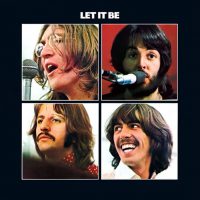
 Recorded: 4, 8 February 1968
2, 3, 6, 7, 8, 9, 10, 21, 22, 23, 24, 25, 26, 27, 28, 29, 30, 31 January 1969
30 April 1969
3, 4, 8 January 1970
1 April 1970
Producers: George Martin, Phil Spector
Engineers: Glyn Johns, Martin Benge, Ken Scott, Peter Bown, Phil McDonald, Jeff Jarratt
Released: 8 May 1970 (UK), 18 May 1970 (US)
Personnel
John Lennon: vocals, acoustic guitar, electric guitar, lap steel guitar, bass guitar, organ, whistling
Paul McCartney: vocals, acoustic guitar, bass guitar, piano, electric piano, Hammond organ, maracas, whistling
George Harrison: vocals, acoustic guitar, electric guitar, tambura, maracas
Ringo Starr: drums, percussion, svaramandal
George Martin: Hammond organ, shaker
Billy Preston: Hammond organ, electric piano
Linda McCartney: backing vocals
Uncredited: 18 violins, four violas, four cellos, harp, three trumpets, three trombones, two guitarists, tenor saxophone, 14 choristers
Tracklisting
‘Two Of Us’
‘Dig A Pony’
‘Across The Universe’
‘I Me Mine’
‘Dig It’
‘Let It Be’
‘Maggie Mae’
‘I’ve Got A Feeling’
‘One After 909’
‘The Long And Winding Road’
‘For You Blue’
‘Get Back’
The Beatles’ last album to be released, Let It Be was mostly recorded in early 1969, prior to Abbey Road. The music was produced by George Martin, and was then prepared for release in 1970 by Phil Spector.
Following the often fractious sessions for the White Album in the summer of 1968, Paul McCartney realised The Beatles were in danger of fragmenting further if they continued to work independently of each other. Since the death of Brian Epstein on 27 August 1967 he had worked hard to keep the group motivated, and towards the end of 1968 he hit upon the idea of filming a television special in front of an audience.
We started Let It Be in January 1969 at Twickenham Studios, under the working title Get Back. Michael Lindsay-Hogg was the director. The idea was that you’d see The Beatles rehearsing, jamming, getting their act together and then finally performing somewhere in a big end-of-show concert. We would show how the whole process worked. I remember I had an idea for the final scene which would be a massive tracking shot, forever and ever, and then we’d be in the concert.The original idea was to go on an ocean liner and get away from the world; you would see us rehearsing and then you’d finally see the pay-off. But we ended up in Twickenham. I think it was a safer situation for the director and everybody. Nobody was that keen on going on an ocean liner anyway. It was getting a bit fraught between us at that point, because we’d been together a long time and cracks were beginning to appear.
Anthology
The effort was to be a continuation of the back-to-basics ethos the group had adopted since ‘Lady Madonna’ in February 1968. That single had marked a move away from The Beatles’ elaborate studio experimentation of 1966 and 1967, with a return to more straightforward rock and roll, and much of the White Album and the Yellow Submarine soundtrack had followed in a similar vein.
Reconvening in January 1969 at Twickenham Film Studios, The Beatles began work on what was initially known as the Get Back project: the concept was a chance for the group to get back to their roots, with perhaps a return to live performance for the first time since 29 August 1966.
In a nutshell, Paul wanted to make – it was time for another Beatle movie or something, and Paul wanted us to go on the road or do something. As usual, George and I were going, ‘Oh, we don’t want to do it, f**k,’ and all that. He set it up and there was all discussions about where to go and all that. I would just tag along and I had Yoko by then, I didn’t even give a s**t about anything. I was stoned all the time, too, on H etc. And I just didn’t give a s**t. And nobody did, you know. Anyway, it’s like in the movie where I go to do ‘Across The Universe’, Paul yawns and plays boogie, and I merely say, ‘Oh, anybody want to do a fast one?’
The plan, vague as it was in the early stages, was to perform one or more live shows, but with an added dimensions of a television show and record release. The January 1969 sessions began as rehearsals for a concert which was to be filmed, which they hoped would yield enough suitable material for an album.
The rehearsals were filmed at Twickenham by Michael Lindsay-Hogg, who had previously directed promotional films for ‘Paperback Writer’/‘Rain’ and ‘Hey Jude’/‘Revolution’. Although none of it was intended to be released on record, on snippet of dialogue was included on Let It Be: John Lennon’s announcement that “Queen says no to pot-smoking FBI members” prior to For You Blue.
Nonetheless, many hours of rehearsal and performance were filmed at Twickenham from 2–14 January 1969. The audio was captured by the camera crew on mono Nagra reel-to-reel machines, as it was expected to be used on the film soundtrack. It is due to these Nagra reels, which were also rolling at the Apple Studios sessions from 21–31 January, that so much of The Beatles’ works in progress from the Let It Be sessions survives.
Paul had this idea that we were going to rehearse or… see it all was more like Simon and Garfunkel, like looking for perfection all the time. And so he has these ideas that we’ll rehearse and then make the album. And of course we’re lazy f*****s and we’ve been playing for twenty years, for f**k’s sake, we’re grown men, we’re not going to sit around rehearsing. I’m not, anyway. And we couldn’t get into it. And we put down a few tracks and nobody was in it at all. It was a dreadful, dreadful feeling in Twickenham Studio, and being filmed all the time. I just wanted them to go away, and we’d be there, eight in the morning. You couldn’t make music at eight in the morning or ten or whenever it was, in a strange place with people filming you and coloured lights.
Lennon Remembers, Jann S Wenner
Once they started work on the Get Back project, it became clear to The Beatles that their collective enthusiasm was low. John Lennon was addicted to heroin and rarely enthused by the sessions, and arguments among the group eventually led to George Harrison temporarily leaving the band.
At the time The Beatles were exhausted after spending five months recording the White Album, and had also worked on Apple projects by James Taylor, Mary Hopkin, Jackie Lomax, and solo works. At Twickenham they were forced to keep to film industry schedules, which involved starting work at 8.30am each day.
The cameras were kept rolling at all times, and captured the strains and tensions of this fragile period. However, there were many moments of true inspiration, and The Beatles’ humour and warmth for one another was often evident.
There was some amazing stuff – their humour got to me as much as the music, and I didn’t stop laughing for six weeks. John Lennon only had to walk in a room, and I’d just crack up. Their whole mood was wonderful, and that was the thing, and there was all this nonsense going on at the time about the problems surrounding the group, and the press being at them, and in fact, there they were, just doing it, having a wonderful time and being incredibly funny, and none of that’s in the film.
The Record Producers
Let It Be is a concept album.
Unfortunately, it’s not a good concept. And its execution further betrays it.
After Brian’ Epstein’s death, Paul’s zeal was a double-edged sword.
Right before that tragedy, starting with Pepper, Paul started looking for these grand frameworks. Pepper isn’t really a concept album, but it’s a cool notion. And while not as highly regarded now as upon its release, its art school pretentiousness perfectly suited the Summer of Love.
With Magical Mystery Tour, we got an undercooked film that was their first real failure. If not for the U.S. release cobbling together an album from the British E.P. and various singles, it would have been worse. But the boys seemed to have an ok time making it. No harm, no foul.
Collectively, they wanted The Beatles to be more back to the basics. And for the most part, it was. While Paul’s perfectionism yielded some good things, his increasingly growing number of takes started to take some of the wind out of the sails of the others.
This is where the “Pushy Paul” theme starts to fray the band, followed by John’s growing disinterest/resentment of the monster he helped create and George’s ongoing frustrations in his role as a secondary writer/partner.
Let it Be was to be even more stripped back with a big concert serving as the bow to wrap it all up. Not a terrible concept, but painfully misguided in execution. And while most bands would kill for an album of this quality, Paul & Hogg really missed the boat.
The early morning Twickenham sessions were not back to the basics. The endless rehearsals were not back to the basics. Playing a live show was back to the basics, but Paul couldn’t accept that John & George were over it. Not resolving these issues before getting underway, cast a pall over the whole production.
Especially problematic were the increasing number of takes, especially on songs like Maxwell’s Silver Hammer. And it certainly didn’t help that like Ob-la-di,Ob-la-da before it, MSH was not a song the other 3 had much heart for. (I couldn’t even bother to write it out.)
It all backfired. Squeezing out the very spontaneity at the heart of the concept!
This rendered the original tapes pretty lifeless. And by releasing very polished singles of Get Back and then Let it Be, the band seemed to say that they weren’t totally sold on the “live”/”live-ish” approach in the first place.
The final result? While it has many a great song, Let it Be is neither fish nor fowl. Only exacerbated by Phil Spector’s contribution. (Though I do like a few things he did, and don’t think Naked is markedly better, if any better at all. The exclusion of Don’t Let Me Down on the other hand is near-criminal.)
Paul’s big framework proved both unnecessary and unproductive.
That said, Paul’s big framework for the Abbey Road “Big One” medley was a masterstroke, especially considering that minus George’s stellar contributions, John & Paul had not delivered a cornucopia of great new songs. (Let’s be honest, when it comes to the medley, the sum is greater than its parts.)
As Wings further proved, Paul wasn’t meant to be a leader of a band of equals. Considering his talent, laser focus and vision, it’s surprising he ever got involved in such a band in the first place! For the most part, he has the mentality of a solo artist. I believe it was the highly unlikely pairing of two equals of the magnitude of John & Paul that allowed either one to accept less than total control. And this humility allowed both of them bring out the best in the other.
To conclude this looooong post, you have to appreciate Paul’s post-Brian energy and commitment to the band. Though can we relax on the over-amplification of Ringo’s old chestnut remark that without Paul, the band would have produced fewer albums?
It seems to me, Ringo’s remark is easily disproven. Until their agreement with Capitol was completed, Brian Epstein and George Martin made sure the boys fulfilled their very robust contractual obligations. And in the early days, John wrote more songs than Paul, and remained fully engaged through the White Album. After that, maybe Abbey Road doesn’t get made? I don’t know, immediately afterwards, John was talking about making a new album. So, I don’t really buy it. (No offense meant, Ringo!)
After all that, don’t think that this a total condemnation of Paul’s attempts to lead after Brian’s death. John’s abdication of his more pronounced role from 1957-1966 played a major part in the unraveling of the Beatles. With his power of personality, John could have continued to maintain the delicate balance of the band, but instead, he willingly got distracted by Yoko and Allen Klein. (Though thinking that your bandmates should accept your father-in-law as their manager was as bad an idea as John’s favored candidate, or bringing his wife to the studio every session.)
Sure, they all could have done better. But damn, what they did give us was as good as it gets!
And in a way, we’re greedy for wanting more, or even thinking that they owed us more.
Their 1970-71 solo releases showed each ex-Beatle still had something in the tank, but individually, you had a car with four wheels all headed in different directions.
And in the end… by leaving us wanting more, the end story of the Beatles is imperfectly perfect… and the love they did take was far less than the love they would make.
Thank you John, Paul, George & Ringo. And you, if you stuck this out ’til the end.