
A lighthearted song written by George Harrison, ‘Savoy Truffle’ was inspired by his friend Eric Clapton’s gluttonous love of chocolate.
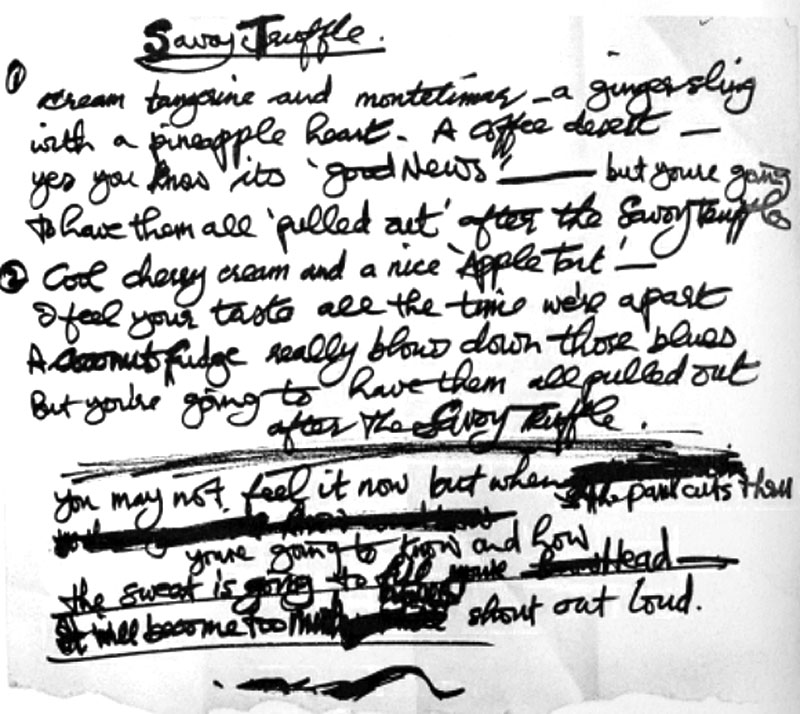
‘Savoy Truffle’ on the White Album was written for Eric. He’s got this real sweet tooth and he’d just had his mouth worked on. His dentist said he was through with candy. So as a tribute I wrote, ‘You’ll have to have them all pulled out after the Savoy Truffle’. The truffle was some kind of sweet, just like all the rest – cream tangerine, ginger sling – just candy, to tease Eric.
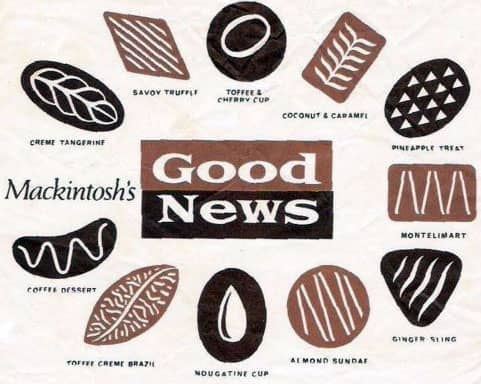
In his autobiography I Me Mine, Harrison explained that the song was inspired by a box of Mackintosh’s Good News chocolates. Many of the lines came directly from the varieties of chocolate in the boxes, although Cherry Cream and Coconut Fudge were Harrison’s own inventions.
With its reference to ‘Ob-La-Di, Ob-La-Da’, ‘Savoy Truffle’ was one of two White Album songs to refer to different Beatles tracks – the other being ‘Glass Onion’. Further inspiration came from Apple’s press officer Derek Taylor, who suggested to Harrison the name of a 1968 film, You Are What You Eat.
‘Savoy Truffle’ is a funny one written whist hanging out with Eric Clapton in the ’60s. At that time he had a lot of cavities in his teeth and needed dental work. He always had a toothache but he ate a lot of chocolates – he couldn’t resist them, and once he saw a box he had to eat them all. He was over at my house, and I had a box of Good News chocolates on the table and wrote the song from the names inside the lid. I got stuck with the two bridges for a while and Derek Taylor wrote some of the words in the middle – ‘You know that what you eat you are’.
I Me Mine, 1980
In the studio
The Beatles – minus John Lennon, who didn’t play on the song – began recording ‘Savoy Truffle’ on 3 October 1968. In London’s Trident Studios they recorded the basic track of lead guitar, bass and drums in one take, although it is likely a number of rehearsals had previously been recorded and wiped.
Two days later, also in Trident, George Harrison taped his lead vocals, and on 11 October the saxophone overdub was recorded at Abbey Road. This was arranged and scored by George Martin’s assistant Chris Thomas. “I must say that I found it a real chore”, he told Beatles historian Mark Lewisohn.
The session men were playing really well – there’s nothing like a good brass section letting rip – and it sounded fantastic. But having got this really nice sound George turned to Ken Scott and said, ‘Right, I want to distort it.’ So I had to plug-up two high-gain amplifiers which overloaded and deliberately introduced a lot of distortion, completely tearing the sound to pieces and making it dirty.The musicians came up to the control room to listen to a playback and George said to them, ‘Before you listen I’ve got to apologise for what I’ve done to your beautiful sound. Please forgive me – but it’s the way I want it!’ I don’t think they particularly enjoyed hearing their magnificent sound screwed up quite so much but they realised that this was what George wanted, and that it was their job to provide it.
The Complete Beatles Recording Sessions, Mark Lewisohn
‘Savoy Truffle’ was completed at Abbey Road on 14 October 1968. A second electric guitar, organ and tambourine were added. Ringo Starr wasn’t present, however – he flew to Sardinia early that morning for a two-week holiday with his family.

The horns from Savoy Truffle are used in the love version of Drive My Car/The Word/What You’re Doing
Thank you for this. “Savoy Truffle” is probably the jazziest song the Beatles recorded and I’ve always attributed the stellar horn part to George Martin. The song is one of my favorites; I’m a keyboardist who knows every note.
“Mea culpa,” Chris Thomas! “Mea maxima culpa!” The fluidity, the fit, and the musicianship of that horn part is a hallmark in the annals of music on its own. It may have been a chore, but it is an artistic triumph.
Dhani Harrison has an interesting cover of this song on YouTube.
This song has always been my favorite of the “white album”, the heavy brass work and the biting fuzzy guitar solo still make me chill after so many years. The story of it is very funny. Thanx!
WHAT? Harrison told the engineer to distort the brass parts? Thats why it sounded so annoying to my right hear. I dont like much of harrisons work. But this song is quite good, despite the distorted brasses.
It sounds a lot more like Lennon’s.
The sax lines have always sounded somewhat fuzzy to me, but I’d attributed it to microphone overload, or some sort of overload in the mix. When I first read that the parts were “distorted,” I was under the assumption that they were eventually returned to their normal sound, as the tracks have never sounded so “bad” that George would need to apologize for it. Am I crazy?
Isn’s Pual singing some high harmonies on “But you’ll have to have them all pulled out…” towards the end?
Possible but not likely. George would typically do all of his own vocal overdubs – especially on his solo works.
And yet Paul does sing in this track. It is written here in the page. Paul McCartney: harmony vocals, bass guitar, tambourine, bongos.
There’s no doubt to my ears Paul’s vocal harmonies are evident throughout this song. Quite clearly you can hear him in the second half of the line, “Coconut fudge really blows down those blues”.
I agree
Sorry, I can’t hear any 2nd voice in the Coconut Fudge line.
There definitely is a harmony vocal on “…really blows down those blues”.
Un-missable. Absolutely sounds like Paul.
I love this website. I grew up in the 60’s and I don’t really know much about how these songs were put together. This is one fantastic tribute to the best band in history.
Interesting that this is another Harrison composition that John Lennon avoided having any involvement with…
I’ve always wondered about this, I really don’t know if John avoided having involvement or George just didn’t need him on some of his tracks…who knows?
How many Harrison songs did John not appear on?
Lennon couldn’t make the Here Comes The Sun session because of his car crash in Scotland.
all the white album songs by George for starters (no Lennon)
I thought Lennon contributed to Piggies with a line or two as well as tape loops and played on While My Guitar Gently Weeps.
John was always almost absent from George’s songs. He sang some vocals Think For Yourself and is even heard complaining that he’s “useless in these sessions” on an unofficial recording of the session.
He’s also absent from ‘Only A Northern Song’, from ‘Taxman’ & ‘Old Brown Shoe’. On ‘Something’ he played piano but apparently he put so little effort into it that only a couple of phrases actually made the last mix.
When Harrison brought out his triple solo album Lennon confessed to the Rolling Stone magazine interview that it’s not his kind of music, and that he considered Harrison to be a lesser talent in comparison to himself and to Paul.
It is interesting that Lennon complained that Harrison didn’t pay much attention to him in “I Me Mine.” It sounds like a bit of hypocrisy on Lennon’s part.
Once again, there is no proof to substantiate the idea that John would purposely boycott the recordings of George’s songs and I agree with ThisGuitar that this is a frequent misconception that authors like to push and propagate.
The only songs not to feature him in any capacity are “Here Comes the Sun”, because of a car accident in Scotland, “I Me Mine” because he was on holiday in Denmark, “Long, Long, Long” and “Savoy Truffle”.
I guess it never occurred to these authors and journalists that a more plausible reason for John’s absence from the sessions for a mere week was that Yoko was pregnant and don’t forget, he was also in the middle of going through a divorce from Cynthia.
That’s true – he contributed tape loops and backing vocals to “Piggies”, but he also contributed organ and backing vocals (per a YouTube isolated vocals video) on “While My Guitar Gently Weeps”.
I don’t understand why biographers come to such an irrational conclusion that John would purposely avoid the recordings of George’s songs when this is clearly not true.
Me too – so I did some investigation. I think the idea that John deliberately avoided a session for a George song is a total fallacy that some authors like to push. But it doesn’t stand up to any scrutiny if you read Lewisohn’s Recording Sessions or John Winn’s That Magic Feeling, or other books where the author actually deals in facts. There are songs – some are George’s, some are Paul’s – where John definitely did play guitar, but his contribution wasn’t included on the subsequent mix down of a backing track (e.g. I Want to Tell You) or was wiped by George and replaced (Gently Weeps, Old Brown Shoe, Something). So, if we’re looking for some sort of pattern, you could quite easily come up with one that suggests John’s contributions weren’t actually welcome on some of George’s (and Paul’s) songs … which is also rubbish, of course. Then there are songs where John was absent from ALL Beatles sessions for a period of time, anyway, such as for a full week in early October ’68 (when Yoko was pregnant and main recording for Savoy Truffle and Long Long Long took place), start of Abbey Road sessions (thereby missing Here Comes the Sun), and when he was in Denmark when a last-minute Let It Be session was held (ditto I Me Mine). Worth noting too that some authors are ignorant of John’s organ part on Blue Jay Way; that he supplied the tape loops for Piggies (and sang at the end); and was the only other Beatle present at the main session for Within You Without You (a song he loved). John supported the elevation of The Inner Light to a B-side (over his own Across the Universe) and, according to him, was the one most behind Old Brown Shoe and Something being issued on Beatles singles.
Maybe he supported the George songs because he was less fond of Paul at the time?
This is a very interesting post that you made about the often-repeated misconception about John purposely avoiding sessions involving the recording of George’s songs in the last two years of The Beatles’ career being a fallacy that some authors like to cultivate. I just want to point out a couple of errors: John is not playing the guitar on “While My Guitar Gently Weeps”, but rather, if you listen to Take 27, John is actually playing the organ while Paul is playing piano.
I’m not sure that John actually played guitar on “I Want to Tell You”, but sources do indicate that he played the tambourine on that song as well as singing backing vocals.
He actually played the piano on “Something”, not rhythm guitar, but although most of it was erased, George retained some of it in the final mix, and John is also singing backing vocals on “Old Brown Shoe”, including a vocalized falsetto impersonation of George’s guitar riff and some excited shouting (his voice is an obvious giveaway), and even George Martin’s handwritten notes implied that John played the organ alongside George on that song.
The reason why John didn’t participate in “Here Comes the Sun” was because he was recovering from his car crash in Scotland and perhaps following doctor’s orders to rest.
Mark Lewisohn himself has acknowledged the errors that he made in his books on The Beatles, but it’s unfair to just blame him for certain factual errors or misinformation, since he did his best.
Anyway, this was a really good post and I like it, as hopefully this will put this myth to rest once and for all.
Paul’s bass is spectacular (as usual) on this song. BLOWS ME AWAY!
Totally spectacular!
On the other hand, the MONO mix of this song is, to be generous, the worst thing ever. If you’ve heard it you know what I mean.
The mono mix is the worst thing ever?Are you kidding?That mix is perhaps the reason I prefer all the album in mono.
Absolutely. Brilliant bass line and sound. Probably the Rickenbacker, which he used extensively on the White Album because of the punchier sound than the Hofner.
Not the Smith or Jones?
Yes, it’s clearly Paul using his Rickenbacker bass on “Savoy Truffle” – the tone is evident – but contrary to popular belief, he actually used his left-handed Fender Jazz Bass on much of the album. I myself used to think that he used his Rickenbacker bass on much of the White Album and I’m not so sure as to how much, if any, usage the Hofner saw during the White Album sessions.
Julio, Lennon Played on Piggies and while my guitar gently weeps
He didn’t ” play” on Piggies, he added some tape loops.
John was not on I Me Mine either – not the studio version or the Let It Be movie version.
There is a chain of thought that after awhile John “conveniently” managed to not be on most of George’s songs.
I think for sure the relationship between Lennon and Harrison was strange.
Even though at the time of the breakup they were aligned (i.e., the Imagine movie scenes where George is at John’s house) during Let It Be Lennon Harrison had a fight which allegedly came to blows.
Also by the time of John’s death he and George were not on speaking terms – and not only because of John’s minimal mention in George’s book I, Me, Mine
I think they weren’t on speaking terms because of the distance between them. George has repeatedly said that John was the Beatle he was closest to, even up to his death. John was just an ego-maniac and expected George to dedicate his entire book and probably his very existence to him.
The fact that John enlisted George to play on “How Do You Sleep?”, symbolically uniting the two of them in opposition against Paul, is maybe notable. But that was 1971, and John was always changing his opinions.
Sure is, as is the fact that George actually decided to go along with it. If you haven’t checked out Joe’s article here it is, it’s very interesting.
https://www.beatlesbible.com/people/john-lennon/songs/how-do-you-sleep/
I think they were not on speaking terms because John did not appear on stage in New York during George’s 1974 concert tour. Shortly after that John delayed signing the dissolution papers concerning the Beatles which supposedly infuriated George.
I don’t believe John wanted George to dedicate his entire life or book to himself.
I was semi-joking about that comment, but really if you think about it, who would George Harrison have been without John Lennon? Maybe he would have found another band, but he certainly would not have reached the heights he did with the Beatles.
While you’re at it, who would John Lennon have been without Paul McCartney, and vice versa?
John declined to appear at the Bangladesh concert as well.
George was counting on John who had agreed to appear at The Concert for Bangladesh. He was nervous and hadn’t hosted a venue this big before. John was a no show, but fortunately Dylan played a prolonged segment which was mesmerizing. George had done a lot of favors for Lennon, and the one time he really needed him – John wasn’t there – and no apology!
George and John almost came to blows when George accused Yoko of giving off “bad vibes” when John started bringing her to the studio.
John was actually involved in all but four of George’s songs – “Within You Without You” and “Love You To” don’t qualify, as they were mostly recorded by George alone with Indian musicians per his choice.
While the Beatles have referred to their own songs in other songs before (Glass Onion and I Am the Walrus mention other Beatle songs) what’s interesting about Savoy Truffle is that by mentioning Obla-di-obla-da, it refers to a song on the VERY SAME album as Savoy Truffle.
Thus using a reference to a song that had not even been released until Savoy Truffle had been released.
I know of no other like song. Go George!
Perhaps George got the idea for that from one of his old rock n’roll idols. Fats Domino cross-referenced Ain’t That A Shame during his song Walkin’ To New Orleans.
>While the Beatles have referred to their own songs in other songs before (Glass Onion and I Am the Walrus mention other Beatle songs) what’s interesting about Savoy Truffle is that by mentioning Obla-di-obla-da, it refers to a song on the VERY SAME album as Savoy Truffle.
Maybe the first same-album-reference by *name* (unless you count the Sgt. Pepper reprise). One could argue it’s not the first same-album-reference. “I’m looking through you” references “Nowhere man” (‘I’m looking through you, and you’re nowhere’). Then there’s “Hold me tight”/”You’ve really got a hold on me” which play back-to-back on With The Beatles. In Revolver you’ve got the ‘float upstream’ on “I’m only sleeping” which pairs with the ‘relax and float downstream’ on “Tomorrow Never Knows” (the upstream-at-the-start/downstream-at-the-end thing suggests a kind of vortex motion which is very consistent with the ‘Revolver’ theme). Later on, there was the obvious Mean Mr. Mustard/Polythene Pam reference, but that might not count for obvious reasons.
Ob-LA-Di Ob-La-Da sessions were a pain in the ass…
Just a theory, but I have long believed that the Ob-La-Di reference was because George thought it was too sweet of a song and lacked substance…like candy. George certainly made no secret of his distain for the Ob-La-Di sessions.
The Ob-La-Di Bla-Da reference says to Paul: “You’re famous but you’re not cool”.
But Glass onion is also on The White Album, so….
My daughter and I love this song–have ever since she was about seven years old–and we love the story from I Me Mine.
I’d always thought this song was a veiled reference to a bad drug trip with lines likes “when the pain cuts through you’re gonna know and how” and “the sweats’ is gonna fill your head”. But there’s no reason not to believe George’s story behind it. the line “but you’ll have to have them all pulled out” tells it all. Just a great sounding song with incredible bass, the dirty sax work, and a stinging guitar solo!
I assume George played the opening solo as well?
Thank you for so much good information on this awesome song. I’ve always been a fan of George’s work and this shows that he was very good at doing diverse songs.
Who played the “second electric guitar” part? (the rythm part, I suppose) George?
I like this part…
I had always thought that George Harrison was the writer of the horns part (I guess the word “arranged” means that : writing the notes). George Martin might have done it too, but I would never have thought of Chris Thomas!
This part is so great!
Shouldn’t Paul be listed on backing vocals. I swear I hear him all over this weird but awesome track. It doesn’t really sound like any other beatle song. Ringo’s drum sound and the rest of the recording have kind of brady bunch late 60’s incidental party music grove to them. Cheezy but I love it!
Yes, you’re right – Paul is on harmony vocals. I’ve added it to the line-up.
Anyone know what high-gain amps were actually used for this sound? I’ve been trying to recreate it and haven’t quite gotten the sound right. Transistor, modern tube, and software distortions just don’t cut it.
To me a good reference is listening to Walter Horton’s Harp on “Mean Mistreater” as well as Johnny’s guitar/amp tone on “Leland Mississippi Blues” Johnny Winter’s 1st Columbia release – “Johnny Winter”. The Horns part sounds to me like POWER TUBE saturation; considering his comment “So I had to plug-up two high-gain amplifiers” Not sure if Master Volumes were used yet at the time…BUT, maybe it WAS pre-amp gain?? Over loading a vocal mic with a pre-amp gives the same effect to vocals. To get the power tubes to distort, you gotta crank the amp!
I think they were the RS61 Line-level amps. They used EF37A valves in a triode-pentode-triode configuration and had a big old 72H inductor in the output section. Would love to clone a couple of them someday.
Not sure about what was used for distortion but the soundboard itself was capable of some very nasty distortion as evidenced by John’s guitar work in Revolution.
I always guessed that by the sound of the lead guitars they were plugged directly into the board and allowed to red line into distortion. they don’t sound mic’d at all. i’ve gotten the exact same tone by going straight into the sound mixing board.
Funny how James Bond seems to have been inspiring the boys at that time (You only live twice came out ’67), since this is one of two songs featuring the famous chromatic Bond line, here in the chorus. The other one is “Glass onion”.
What Bond line are you talking about?
True. I noticed that.
Somebody know the scores of the song? Can you give me a link or something?
I got taught jazz guitar at music school with the first sax player on this song’s SON true story, art ellefson’s son Lee I was flabbergasted when I found out his dad plaid on the white album, still am!
The listing shows three tenor saxes and three baritone saxes. Having scored this tune for my own band, I know that the lowest sax notes are below the range of the bari sax. Was the pitch altered by using tape speed? Or maybe one of the sax players was actually using a (somewhat rare) bass saxophone?
There’s definitely a rhythm guitar part chugging along in addition the leads. George? That’s my assumption.
The the saxophone part follows paul’s bass line in most parts of the song, just pay atention, the genius of the song is paul, not cheia thomas
The genius of the song is Paul? Seriously?
The song is great, George showed that he could write great rock music, not only zen or psychedelic stuff. The song itself is awesome. Paul’s bassline made it sound groovy and even better. As usual, Paul always got the feeling of Bealtes songs and created amazing basslines. Of course he is a genious, but Savoy Truffle is a great song. To me it’s the best song of the tiring and sometimes boring White Album. Everybody’s Got Something To Hide and Helter Skelter are also great, but Savoy Truffle’s is very well constructed, a three minute song with a good melody, the great chorus with the distorted horns are super cool, the solo making a dialogue with the horns sounds nice, and the bassline. I’ve heard people say that the lyrics are silly, but I don’t care about lyrics. I am the walrus’ lyrics are meaningless and it’s great anyway.
The band didn’t gave George the space he deserved in the band, but in the end, both in the White Album and in Abbey Road he showed to John and Paul that he was as good as them. John said in a radio interview three months before the release of Abbey Road that Something was the best track on the album. And on the White Album, with too many songs, many of them sounding like fillers, a George’s song came to be the most famous, While My Guitar Gently Weeps. Yes, bla-di-bla-da is also well known, but it can’t be compared to While My Guitar, which is much better. The Bealtes were very prolific, recording and releasing albums in short periods of time. If they had given George more space to put more songs, maybe they would have had released even more records. Then George came up with the triple album to show that he had great songs. But I think it was a mistake. He could have released all those songs from All Things Must Pass on two or maybe even three records. ATMP is tiring, too much songs. Just like the White Album. I can’t listen to the whole double album anymore.
Anyway, Saviy Truffle is the best of White Album
I agree with you, this is the best song on the album.
A friend recently pointed out similarities between this song and Chocolate Ice, a song written by Mike Leander in 1964. The song was released as a single by ’60’s Merseyside group The Long and The Short and made the top100 (I believe). The L & S featured in a film ‘Gonks go Beat’ with (among other artistes) Lulu, she also recorded the song which is in the film and also on her album Something to Shout About. Mike Leander worked with the Beatles on the Sgt Pepper album, whether he had any input regarding this song I couldn’t say.
I never heard Chocolate Ice but it definitely sounds like it inspired Savoy Truffle.
Is it hard to imagine that the lines, “You all know what you eat you are, but what is sweet now, turns so sour. We all know Ob-La-Di-Bla-Da, but can you show me where you are,” may well be referring to the missing from the track Lennon, and his heroin issues? Just a possibility amongst all the confection. I’ve never heard a word about this, just a curiosity.
I think he is taking aim at the hollow, easy-entertainment way of live without sense that makes up for Obladi-oblada. So he is actually criticizing Paul’s take on things
I wonder what McCartney thought of the Ob-La-Di-Bla-Da line ?
Bari Sax Low A is right in the pocket for this tune. Just headed into the studio to re-record using Tenor, Bari, and Bass. Might sneak my ContraBass into the track.
“Clapton’s love of sweets” inspiration is just George being coy. Clapton’s love of heroin (and the cravings for sweets heroin addiction creates) is the REAL story behind this song.
In 1968? Is that so?
Chocolate, because heroin is not radio friendly…
Had Clapton fallen for Patty as early as 1968?
William Shears – your vivid imagination is the REAL story ….
I think that’s a gross overstatement about the saxes. They’re a bit edgey and overcompressed but it’s a rock n’ roll record. Sounds like how sax’s SHOULD sound on a rock number. What’d they expect?
The saxes on things like Little Richard’s records were quite distorted (as well as his vocals). It does, as you say, add an “edginess” to the sound. I like it on this one.
Probably my least favorite song on The Beatles. After a bit, I used to pick the needle up to skip it (vinyl). And in retrospect, knowing all the magnificent songs GH was storing up, it just seemed like an irritating, approaching snarky, throw-away. IMHO.
***Just as a side note, the maharishi sure didn’t bring this band of brothers together to make beautiful music.
I never understood before that the “them” in “you’ll have to have them all pulled out” was your teeth (or Eric’s teeth). Thanks Joe for the Harrison quote that makes it make sense.
Great song, great simple-but-perfect guitar solo, nice horn lines! And great playing all around–Chris Thomas’s electric piano, Ringo’s little intro fill, Paul’s monster bass line, George’s rhythm and lead…
Just my opinion, the solo is intended to immatate a dentist drill. Thoughts?
I think the solo is Eric screaming in pain while his teeth get filled or pulled. “When it becomes too much, you’ll shout aloud.”
I love the song, but how do you “feel a taste all the time we’re apart”? I didn’t think a taste could be felt.
“Coconut Fudge really blows down those blues”…one of the great lyrics in this song, George had really grown as a songwriter by 1968!
I can remember almost exactly listening to the White Album for the first time in 1968 and all of a sudden in the midst of this sheer greatness jumps out “Savoy Truffle”. It was as If The Beatles had been captured by invaders from outer space.
This song is SO GOOD and THAT unexpected. And it is very different from anything else on the LP.
George Harrison was about to explode with what he had to keep in during his Beatles days.
Howard Stern asked Paul McCartney recently if he ever considered continuing the band with Ringo and George after John left. He said no.
But think about what a band it could have been (and I am a strong John partisan) with a fully flowering George Harrison matching Paul song for song!
The horns on Savoy Truffle are a masterpiece. All credit to Chris Thomas and the players and to George for his vision with the sound texture. Every bit of this is genius.
I’m actually a bit disappointed to find that George lifted all those wonderful names from an actual chocolate’s box…what used to be wonderfully whimsical is replaced by something a bit more mundane.