
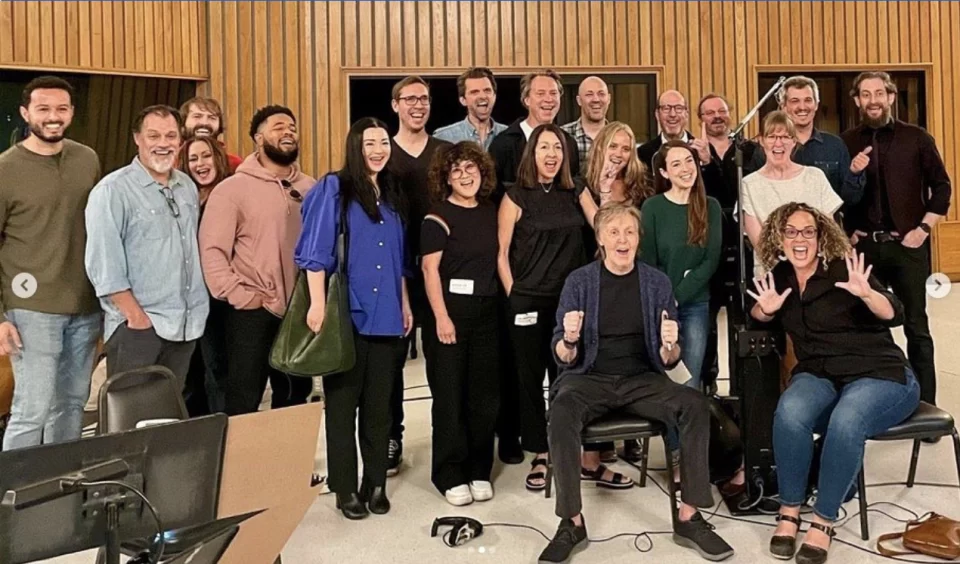
The strings for The Beatles’ final single ‘Now And Then’ were recorded on 1 May 2022.
The session took place at the Capitol Records Tower in Los Angeles. Paul McCartney and Giles Martin were the producers.
‘Now And Then’ was based on a 1979 demo by John Lennon. It was worked on by Paul McCartney, George Harrison, and Ringo Starr on 20, 21 March 1995 for potential inclusion on Anthology 3, before being shelved.
McCartney and Starr revisited the song in 2022, adding a range of overdubs. The song was also de-mixed using Peter Jackson’s MAL (machine-assisted learning) technology, which allowed greater separation of voice and instruments.
The string arrangement was written by McCartney, Martin, and Ben Foster, and the session musicians were conducted by Jérôme Leroy.
The performers were not told the song’s correct title or significance. The sheet music was headed ‘Give & Take’, and they were led to believe it was for a McCartney project.
We wanted to go to Capitol Studios, because that had been EMI, and it was sort of Beatley. Giles worked up an arrangement like Giles’s dad would have done in the old days.We had to put the music out on the stands for the musicians, but we couldn’t tell them it was a new Beatles song. It was all a bit hush hush. We pretended it was just something of mine.
‘Now And Then’ – The Last Beatles Song
Well, the orchestra didn’t know what they were playing on. They weren’t aware that this was a Beatles recording. I think they thought it was just a Paul McCartney project that I was working with him on. It’s one of those things that I didn’t really think about at the time. I’m thinking about the string arrangement, the players playing the right thing, all that stuff. But they weren’t privy to the information, so they had nothing to hide. A little knowledge is a dangerous thing. Not in this case: A little knowledge actually worked quite well. But it is funny how we finished this last year, and it hasn’t got out.Paul came and played me the track he’d been working on, and I said, ‘Maybe we should add some strings to it.’ He was like, ‘Well, yeah, we should try it, but I don’t want to make it too corny.’ Also, I think he was nervous about us collaborating away from the other Beatles, funnily enough. How much do you add without them? I just said to him, ‘Why don’t we do something, and then we can always delete it? No one will know.’ There’s no teams that hear stuff. It was just me and Paul, at that stage – and Ringo, obviously, and then Sean and Yoko and Olivia. It’s a very small network, so therefore you have that freedom to try things.
With the strings, I thought I might as well rip off my dad – which I did do. My dad was an amazing string arranger. If I’m gonna rip off my dad, you might as well do it for the last Beatles song. There were some times where Paul was like, ‘We shouldn’t do that, you’re going a bit too far,’ or ‘We should try and do this.’ Because, even with my dad, even with ‘Yesterday’, the first string thing (with The Beatles), Paul would have very, very strong ideas about how you want things to sound. And generally, obviously, it’s The Beatles – he’s right. I’m pleased we added the strings. I just wanted it to be as Beatles as possible, basically. I wanted people to listen to this and go, ‘Yeah, this is a Beatles record.’
Variety
Conductor Jérôme Leroy only discovered it was a McCartney session on the day. He was drafted in after Ben Foster was unable to fill the role due to visa restrictions.
In late April 2022, I received an email from my friend, British composer, arranger and conductor extraordinaire Ben Foster. Ben and I go way back: I first met him remotely in 2012 when Bill Ross and I were partners. At the time, he was conducting a recording session at Abbey Road Studios for a film we were working on, and we kept in touch over the subsequent years. Until this point, he had never hired me for a project, and the last thing I expected was to receive an email from him inquiring about exactly that – especially one under such strange circumstances.Ben was working on a strings chart to be recorded at Capitol Studios in the next few days. The only problem was that the suddenness of the gig meant that he couldn’t get a work visa in time, and even though he was making the trek across the pond to attend the session, he unfortunately had to delegate the conducting duties. The project and session were so confidential that he couldn’t tell me what it was for nor who the recording artist was. The only element he shared was that it was ‘a massive record for an iconic British artist.’ I honestly didn’t really dwell much on that: I would have said yes to Ben for anything anyway. Additionally, being fairly ignorant when it comes to popular music, the only two people that crossed my mind in that instant were Mick Jagger and Elton John.
In my days with Bill Ross (between 2006 and 2015), going to the famed Capitol Studios was a fairly regular occurrence. Countless artists recorded there and Bill often arranged for them. It’s also where we would rehearse and pre-record material for the multiple Academy Awards ceremony he was music directing, and where I got to work indirectly with singers such as Barbra Streisand, Céline Dion, or Beyoncé. So although I was attending a session there for the first time in my solo career – and I was about to conduct there for the first time as well – arriving at Capitol felt, at first, a bit like ‘a day at the office,’ not unlike when I get to record at other famous studios like Abbey Road or the Fox Newman Scoring stage. It’s always a privilege, of course; but over time it somewhat loses its shine and newness and you have to purposely remind yourself of how lucky you are to be there at all.
That morning, my main thought was that I hadn’t seen the chart yet and hoped it wouldn’t be too difficult to conduct. While I’m a decent conductor when it comes to my own material, I don’t conduct a lot of music from other people, and I usually get to at least glance at it before the session. Not so this time: the arrangement was kept under wraps and, furthermore, it was only completed the day before. I was secretly hoping for a lot of ‘footballs’ (whole notes that last a full measure), a steady tempo, and time signatures in basic meters (3/4 or 4/4). As often, I was feeling the psychological mix of impostor syndrome, and knowing that I wouldn’t be there if I didn’t somewhat fit the bill.
Maybe all of this explains why, as I walked down the Capitol hallways, the artist I was about to conduct for was the least of my worries. But as I saw the security detail down the hall waiting to filter me in, I suddenly remembered that this was no ordinary session. I pushed the heavy door leading into the mixing booth – not knowing who would be there so early before the session’s downbeat – and the first person I saw was turning their back on me, lost into a deep conversation with producer Giles Martin (whom I had met on another project for Bill Ross years before) and Ben. Upon hearing me enter, the man turned around to see who was coming in, and I then realized who I was about to conduct for that morning: none other than Sir Paul McCartney.
Paul looked at me, a bit startled, not knowing who I was. Thank goodness I didn’t have to introduce myself as Ben joyfully said, ‘And here’s Jerome, who will conduct for us this morning!’ Paul suddenly smiled and extended a hand. And, this being soon after the COVID pandemic, we fist-bumped. (I fist-bumped Paul McCartney!)
They explained what the project was all about. As I understood it at the time, Paul had gotten access years ago to the demo version of a Beatles song written by John Lennon that had never yet seen the light of day. More importantly, that demo had vocals from Lennon himself, and thanks to machine learning, they had been able to fully isolate John’s vocal. Paul was now in the process of finishing the song, which is what we were about to record strings for. The completed track would be released at a later date.
The session in itself was uneventful, which is always good. The song was great, the chart was fantastic (and, much to my relief, not too complex to conduct) and the players, contracted by Gina Zimmitti, where top-notch. Realizing how important and a one-in-a-lifetime experience it was, we were all having a wonderful time.
Every now and then (ha!), Paul would walk on the scoring stage to listen to the music being played live, and go back to the booth to confer with Giles and Ben. At one point during the session, he decided to stay for a little longer, and sat down a bit behind the players – right in front of me. And he started intensely watching everything that was happening. Looking at the players… looking at me. Back at the players… then at me. And at me again…. and again. I suddenly became very self-conscious. ‘Paul McCartney is watching me,’ I thought. ‘I better not f**k up this 4/4 bar or it’s the end of my career. Focus. Don’t look at Paul-freaking-McCartney looking at you… look at the score… focus… you may have conducted much more complex music in the past, but you better not screw up that one. Just look at the following measures and… keep conducting no matter what.’