 Written by: Paul McCartney
Recorded: 2, 3, 4 May; 25 October 1977
Producer: Paul McCartney
Released: 27 March 1978 (US), 31 March 1978 (UK)
Available on:
London Town
Personnel
Paul McCartney: vocals, bass guitar, percussion
Linda McCartney: vocals, organ, percussion
Denny Laine: vocals, electric guitar, percussion
Jimmy McCulloch: electric guitar, percussion
Joe English: drums, percussion
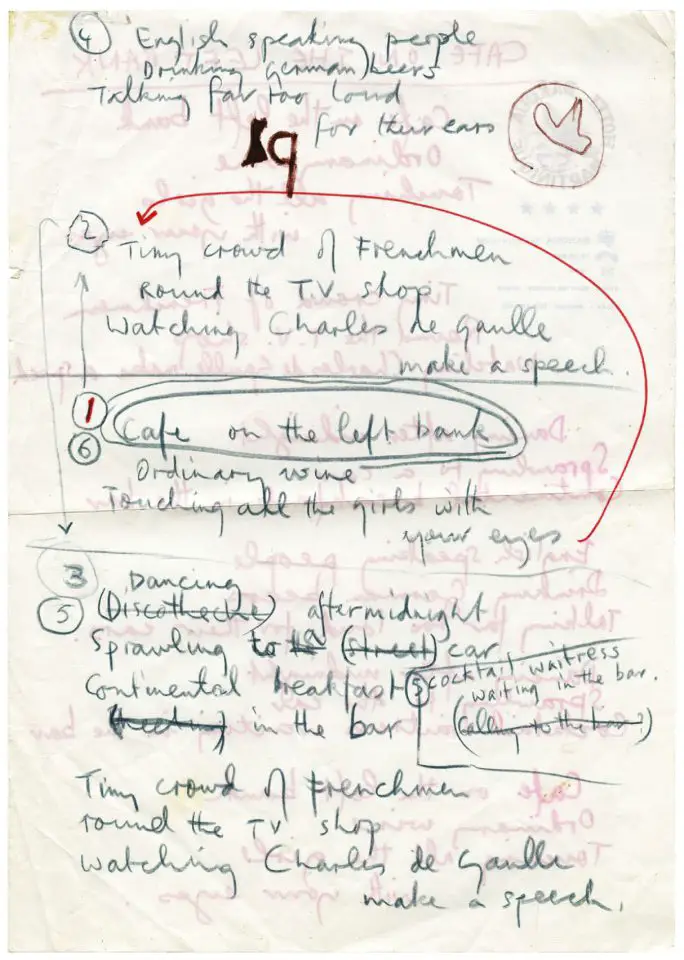
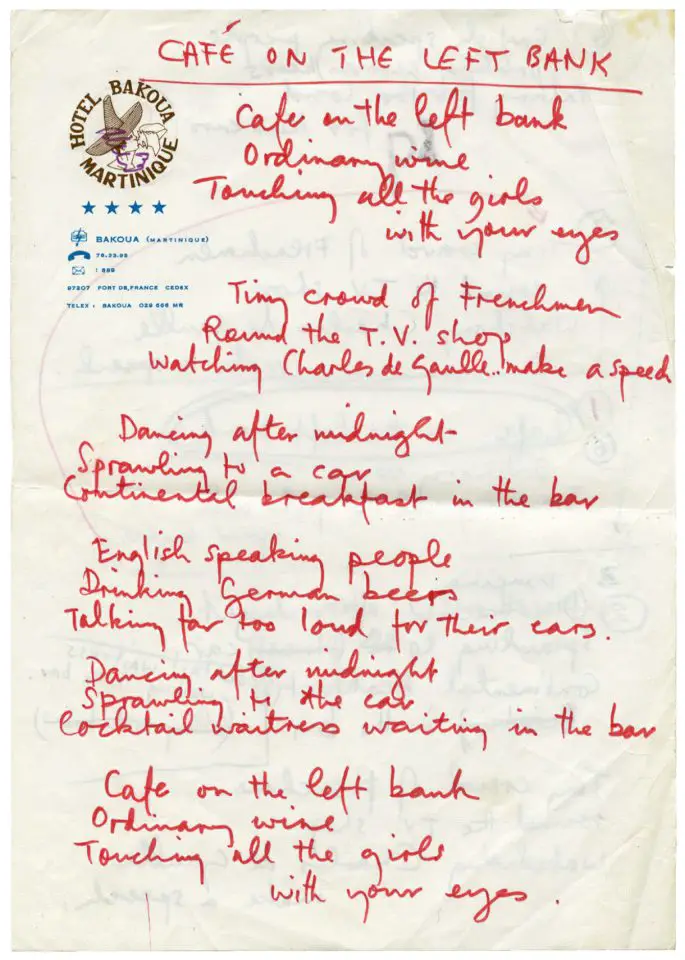
‘Café On The Left Bank’ is the second song on Wings’s penultimate album London Town.
The song was partly inspired by a trip to Paris taken by John Lennon and Paul McCartney in October 1961.
Vin ordinaire was the only kind of vin we knew about in those days. I couldn’t understand why people liked wine; anytime I tasted it, it was terrible. When John and I hitchhiked to Paris in 1961, we went to a café on the Left Bank, and the waitress was older than us – easy, since John was turning twenty-one and I waws nearly twenty. She poured us two glasses of vin ordinaire, and we noticed she had hair under her arms, which was shocking: ‘Oh my God, look at that; she’s got hair under her arms!’ The French would do that, but no British – or, as we would later learn, American – girl would be seen dead with hair under her arms. You had to be a real beatnik. It’s such a clear memory for me, so it was in my head when I was setting this scene.I’m actually quite a fan of ‘ordinary’. I hope in many ways it defines me, and so also many of the songs I’ve written. Don’t get me wrong; I like extraordinary people and things, but if people can be great and ordinary at the same time, that to me is kind of special. So my Liverpool family – my parents, all the aunties and uncles – they were great and ordinary, and I think the fact that this combination can be easily dismissed makes it even more special. So many people would dismiss my Liverpool family, but they’re actually a lot smarter than the likes of Maggie Thatcher, say. Their attitude to life was not as uptight as many people I’ve encountered since. They were always up for a song around the pub piano, for example. SO you can choose to be highly sophisticated but very uptight//, or you can be not so sophisticated but at peace with yourself. I try and be a bit of a mixture, and I draw very strongly on that ordinariness.
I remember seeing TVs in a shop window – they were still in black and white (it’s hard for younger generations to imagine television without colour) – and people were standing around watching Charles de Gaulle in his kepi hat. That’s a scene we don’t see much these days. In fact, we don’t see it at all these days. It was, and is, a very striking image.
The Lyrics: 1956 To The Present
In the studio
The basic track was recorded on 4 May 1977 in Francis Bay in the Virgin Islands, where Wings’ motor yacht the Fair Carol was stationed during part of the creation of London Town. It was the first song recorded on the boat, laid down partly to rest the equipment.
I have a strong recollection of recording the song with a mobile studio on a yacht moored in the US Virgin Islands. The studio had twenty-four tracks – keep in mind that Sgt Pepper had been done with four tracks – so it was the next best thing to being in Abbey Road. The classic Wings line-up was involved, with Denny Laine and Jimmy McCulloch on guitars, Joe English on drums, Linda on keyboards and vocals, and me on bass and vocals. I also produced the track. That’s a bit like being in a café on the Left Bank and being guest and garçon at the same time.
‘Café On The Left Bank’ was completed on 25 October 1977 at Abbey Road Studios. Paul McCartney double-tracked his lead vocals, and added backing vocals with Linda McCartney and Denny Laine. McCartney then recorded a cowbell overdub.
To create a suitably Parisian mood, the decor of Abbey Road’s Studio Two was changed, and remained so for several weeks.
To get the atmosphere down at Abbey Road Studios, we had the whole place done out with like potted plants, and little café umbrellas, and little stripes, to make it look like a café on the Left Bank. And there was some visiting bloke from an American record company, and he kind of walked in all serious. It was half a joke to us really, having a big café in the studio, but it was nice, the atmosphere and everything. Anyway, this fella came in and he said, ‘This is very interesting, Paul. What temperature do you keep it at?’ So I said, ‘Oh a constant 68, constant, absolute constant 68.’ So I think he must have gone away and done a string of them up and down the West Coast.
BBC Radio 1, 31 March 1978