
Record Plant, New York City
Producers: John Lennon, Yoko Ono, Jack Douglas
Engineer: Lee DeCarlo
A mixing session for Yoko Ono’s song ‘Walking On Thin Ice’ took place on 8 December 1980.
The song had been started on 14 August, with more recording taking place on 3 and 4 December.
This mixing session began at 6pm. As they left the Dakota Building, Lennon was photographed by Paul Goresh as he gave an autograph to Mark David Chapman.
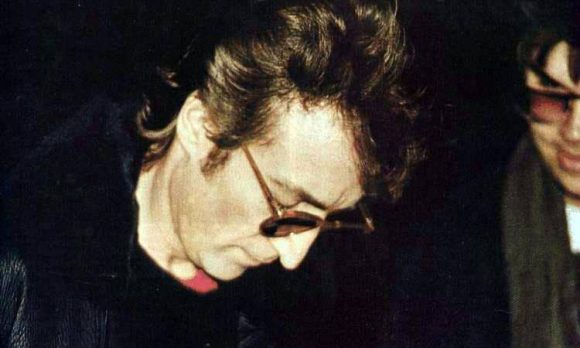
We nearly became late for the studio. I rushed into the car and saw John still signing an autograph for a guy in front of the Dakota. ‘John, we’ll be late!’ I remember being a bit irritable. ‘Why one more autograph?’ I thought. John said something like, ‘OK,’ and rushed into the car, sat next to me and held my hand as usuaL The car drove off.I know I speak of his hands a lot. I loved his hands. He used to say he had wanted hands like Jean Cocteau – long and slim fingers. But I grew up surrounded by cousins with those aristocratic hands. I loved John’s, clean, strong, working-class hands that grabbed me whenever there was a chance.
The studio work went until late at night. In a room next to the control room, just before we left the studio, John looked at me. I looked at him. His eyes had an intensity of a guy about to tell me something important. ‘Yes?’ I asked. And I will never forget how with a deep, soft voice, as if to carve his words in my mind, he said the most beautiful things to me. ‘Oh’ I said after a while, and looked away, feeling a bit embarrassed.
In my mind, hearing something like that from your man when you were way over 40… well… I was a very lucky woman, I thought. Even now, I see his piercing eyes in my mind. I don’t know why he decided, at that very moment, to say all that as if he wanted me to remember it forever. Did it matter that the whole world hated you if your guy loved you that much? Who cares if you had to live in hell with him? Some couples might be lucky to live in heaven. John and my heaven was in Hell. And we loved it. We would not have wanted it any other way.
Rolling Stone, December 2010
From the studio Lennon called his assistant Fred Seaman, requesting that he bring recordings made by Ono in 1973 and 1974. Seaman arrived at the Record Plant and encountered David Geffen, who had recently released the Double Fantasy album. They took the elevator together to the tenth floor and entered Studio C, where Lennon and Ono were working on the mixes with producer Jack Douglas.
Lennon enthused to Geffen about ‘Walking On Thin Ice’, calling it a smash hit and wanting to rush-release it before Christmas. Geffen told him it would be better to wait until the new year, when it could be marketed properly with an advertising campaign.
The day that John died, I was doing some vocals and then we were mixing ‘Walking On Thin Ice’. I remember when we were mixing it John and I were in the next room and he said, ‘From now on, we’re just gonna do this, it’s great!’ He really liked the way I put ‘Walking On Thin Ice’ together. He said, ‘Yoko, this is your first number one!’
Starting Over, Ken Sharp
The mixing session ended at around 10.30. Lennon and Ono said farewells to Rabiah Vincent, the switchboard operator at the Record Plant. She asked for an autograph. Lennon wrote: “For Ribeah [sic], love, John Lennon” and drew a self-portrait caricature. Ono wrote her signature and added a caricature of her own. When Vincent told Lennon he had spelt her name wrong, he told her: “That’s the way it sounds to me.”
Lennon and Ono planned to stop for food at the Stage Deli, but chose instead to check on their five-year-old son Sean. They arrived at the Dakota Building just after 10.45pm.
Less than thirty minutes later the phone rang and it was David Geffen. He asked if John and Yoko were still there. I told him that they’d left. He said a woman had called him, claiming she was a friend of Yoko’s and that John had been shot and was en route to Roosevelt Hospital. I told him, ‘Hang on, I’ll call the hospital.’ So I put him on hold, called the hospital, and they told me they couldn’t release any information. When I got back on the line, there was a woman on the phone and she said David was already on his way to the hospital and that John was dead.Everyone at the studio loved John and we all felt a sense of panic and deep, deep sorrow. We were all crying and the phones were ringing off the hook. Then people started showing up at the studio and they were trying to take the front door off its hinges, which was frightening. Jay Dee Daugherty, one of the musicians who was working at the studio on a Willie Nile session, told me, ‘You have the last autograph John ever signed.’
Starting Over, Ken Sharp