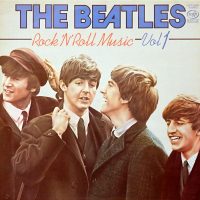
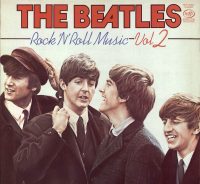
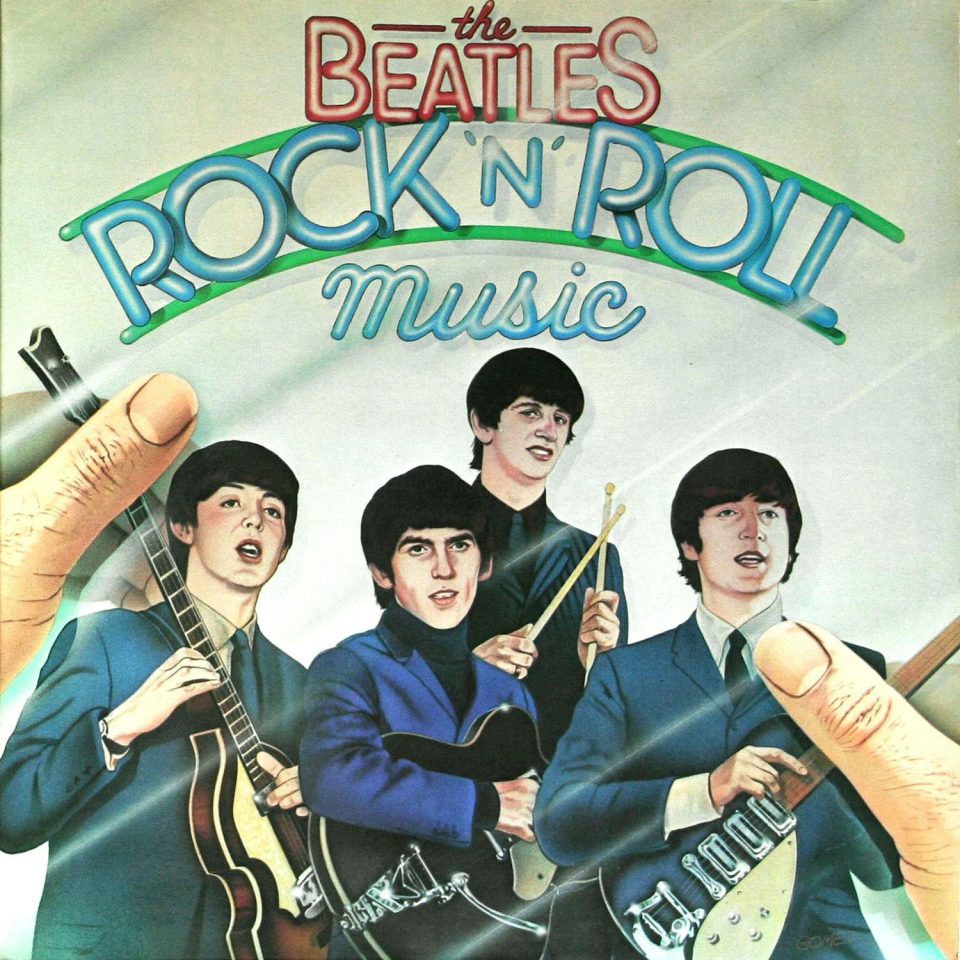
The Beatles compilation album Rock ‘N’ Roll Music was released in the US on 7 June 1976.
The double album contained 28 songs, including 15 written by Lennon–McCartney and one by George Harrison. It was the first time the ‘Help!’ b-side ‘I’m Down’ had been released on an album.
Bhaskar Menon had become the president of Capitol Records in America. As a student and trainee he had spent a while with me at Parlophone, learning my end of the business. In 1976 he phoned me (I was living in Los Angeles at the time) to say that he was proposing to issue an album called Rock ‘N’ Roll Music, using some of the early Beatles numbers. He asked me if I would approve the tapes before they went out, since they couldn’t get hold of any of The Beatles, and I was the only other person of whom they could think who had been involved. So I went along to listen – and was appalled.EMI were terrified of The Beatles, who had issued an edict that the tapes must not be touched in any way. No one was to ‘mutilate’ them, and if they were reissued it had to be exactly as they were recorded. EMI had taken this absolutely literally. They had put the tapes on a transfer machine and were going to issue them just as they were – but in stereo! The effect was disastrous. Where I had made the original recording using one track for rhythm and the other for voices, we had put the rhythm track down in volume in order to avoid distortion. The result was that the voices sounded terribly forward. Not only that, but when they stopped singing there was an awful lot of ‘dirt’ coming up on the vocal track, because when we recorded live we had left the mikes open – which of course hadn’t mattered in mono. But in stereo – ugh! And, of course, all the voices were on one side, and all the backing was on the other.
‘You can’t let that go out!’ I said.
‘We daren’t touch it,’ they said, ‘because The Beatles wouldn’t like it.’
My response was: ‘Stuff that for a lark. Let’s do something about it.’
I spent two days re-dubbing the tapes, aided by the sophisticated new equipment which had never been available in those early days. I filtered out the sound of the bass from the rhythm track, and brought it into the centre. I brought the rhythm track as a whole away from the edges. I brought the voices to the centre, raised the volume of the rhythm, and compressed the whole lot so that it sounded more of an entity. With a bit of echo to bring them up to date, they really sounded quite tolerable.
Of course, it wasn’t really my job. I’d long since left EMI, and I wasn’t getting paid – since they were early records, I was not even receiving and royalties on them; I just wanted to make sure that our work didn’t get mutilated. But that didn’t prevent fierce rows breaking out with the people in England. Roy Featherstone, head of EMI Records, said that I shouldn’t do it, and that they would have terrible trouble with The Beatles. ‘Well, get hold of The Beatles, and tell them I’m here at Capitol, and see what they say,’ I told him. But they wouldn’t, or they couldn’t. The Beatles all had pretty heavy protective shields around themselves anyway. At least the record went out in America in its modified form, so that it was acceptable, but I have a nasty feeling that it went out in England in the original version, which is horrifying.
All You Need Is Ears
George Martin reversed the left and right channels for each song, and narrowed the stereo field on ‘Twist And Shout’, ‘I Saw Her Standing There’, ‘I Wanna Be Your Man’, ‘Boys’, ‘Roll Over Beethoven’, ‘Drive My Car’, and ‘I’m Down’.
The UK edition did not use Martin’s modifications. It included stereo mixes of five songs that had not previously been released in that country: ‘Long Tall Sally’, ‘I Call Your Name’, ‘Slow Down’, ‘Matchbox’, and ‘I’m Down’.
In October 1980 Rock ‘N’ Roll Music was reissued as two single albums in the US and UK. The UK reissue contained Martin’s reworked tapes.