
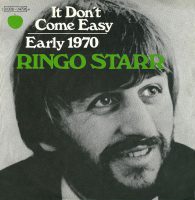
 Written by: Starkey
Recorded: 18 February; 8, 11 March; October 1970; February 1971
Producer: George Harrison
Released: 9 April 1971
Available on:
Photograph: The Very Best Of Ringo Starr
Personnel
Ringo Starr: vocals, drums
George Harrison: vocals acoustic guitar, electric guitar
Gary Wright: piano
Klaus Voormann: bass guitar
Pete Ham, Tom Evans, Nanette Newman: vocals
Ron Cattermole: saxophone, trumpet
Mal Evans: tambourine
Jim Keltner: maracas
‘It Don’t Come Easy’ was a standalone single released by Ringo Starr in 1971.
The single was a critical and commercial success, and topped the Canadian singles chart.
I thought I was so hip with that line, ‘Got to pay your dues if you want to sing the blues.’ I do not spend weeks and months writing a song. I just try to get whatever is coming out at the moment. I don’t get tired of that song. I don’t get tired of any of them really. I remember shouting at different artists when I wasn’t touring, like, ‘Are you still doing ‘Layla’?’ Now I laugh every night I’m onstage singing ‘With A Little Help From My Friends’. Here we go again, but there are important songs in your career that make you what you are.
Photograph – The Very Best Of Ringo Starr
Although Starr received the sole songwriting credit, in 1998 he said, during an appearance on VH1 Storytellers: “I wrote this song with the one and only George Harrison.”
Klaus is teaching me guitar. It’s interesting, because I played in E for the past 10 years, and now I can play all the other chords, and with not knowing I just jump into strange chords that no one seems to get into. Most of the stuff I write is 12 bar, anyway. Then I take it to George who puts in five more chords and you all say, ‘God, look at that, see the way he wrote that song with all those chords?’ Ha, ha, ha. But I usually write it in three.
Melody Maker, 31 July 1971
In the studio
Starr began recording ‘It Don’t Come Easy’ during the sessions for his debut album Sentimental Journey.
The first session was on the night of 18 February 1970 at Abbey Road. It was recorded under the working title ‘You Gotta Pay Your Dues’, and featured Starr on vocals and drums, Harrison on acoustic guitar, Klaus Voormann on bass guitar, and Stephen Stills on piano. They recorded 20 takes of the backing track with George Martin producing and Geoff Emerick engineering.
That was a gas. There was Ringo, me, George Harrison and Klaus, plus George Martin. George said the session was for Ringo’s ‘surprise single’, and I guess that could be right. Ringo came in with this little tune – that is, he sat down and played eight bars and said, ‘That’s it.’ So we all made suggestions, like how about adding a bridge here, and playing this little intro, and this little tag, and it came along very. nicely.I could see why George Martin has been so important to The Beatles – particularly in the form of the songs, in the more sophisticated elements. I thought he was tremendous.
Melody Maker, 28 February 1970
The session was tense in places, with Stills finding Harrison difficult to work with.
George was friendly at first… and then we played together. I’ll never forget it. We had a session with Ringo, and George would start a solo as the playback was going by, and then make a mistake and start over again, even though the changes were different. Which drove me absolutely out of my mind. I finally had to put my guitar down and say: ‘When you’re done…’ I don’t know how he took it. Apparently it was like: ‘Oh, okay. Everyone has their own way.’ I just had to let it go. I didn’t say: ‘You’re driving me mad’ – it’s George f*****g Harrison, already – but it was. So I just waited, and when he was done I went zoop-zoop-zoop and did my bit. I played something neat. I didn’t work on it that long.And then he came and heard me, David and Graham [Nash] sing the entire CSN album because we thought we’d go to Apple. It didn’t happen for some reason or another, But he’s a lovely guy. He’s what everybody said. He was much more opinionated than anyone knows. He could be tough.
Louder, 8 February 2025
Starr added more vocals on 19 February, before deciding to re-record the song from scratch. Ten more takes were taped, with take 30 considered the best.
‘It Don’t Come Easy’ lived up to its name, however, and a third version was recorded on 8 March 1970 at London’s Trident Studios. The line-up was broadly the same as the first session, but also featured Mal Evans on tambourine, and Ron Cattermole on saxophone and trumpet. An early mix of the sessions, featuring Harrison on lead vocals, has appeared on bootlegs.
More overdubs were added to the third version on 11 March, again at Trident. The song was then left until October 1970, when Starr recorded his lead vocals at Abbey Road, and Badfinger’s Pete Ham and Tom Evans added backing vocals. A new piano part by Gary Wright was also added, as was a horn section.
The song was completed at Trident in February 1971 with the addition of maracas played by Jim Keltner.
Starr performed ‘It Don’t Come Easy’ at the Concert For Bangladesh, at New York’s Madison Square Garden on 1 August 1971. The band included Harrison, Voormann, Keltner, and Badfinger.
‘It Don’t Come Easy’ was referenced in two later Starr songs. 1992’s ‘Don’t Go Where The Road Don’t Go’ featured the lines: “Well I said it don’t come easy/Well I sure know how it feels”. 2003’s ‘Eye To Eye’ began with the couplet: “Remember when I said it don’t come easy/That seems so long ago”.
The release
‘It Don’t Come Easy’ was issued as a single on 9 April 1971, with ‘Early 1970’ on the b-side. It was Starr’s first single outside North America since the break-up of The Beatles.
The single was a commercial success, topping the Canadian chart and the US Cash Box Top 100 Singles, and making the top ten in Australia, Austria, Belgium, Ireland, the Netherlands, New Zealand, Norway, South Africa, Switzerland, the United Kingdom, and West Germany. It peaked at number four on the US Billboard Hot 100.
‘It Don’t Come Easy’ briefly established Starr as the most successful former Beatle, since it outsold John Lennon’s ‘Power To The People’, Paul McCartney’s ‘Another Day’, and George Harrison’s ‘Bangla Desh’.
A live version by Starr opened side three of the 1971 album The Concert For Bangladesh.
The studio recording was first released on an album in 1975, when it appeared on the compilation Blast From Your Past.
Both sides of the single were bonus tracks on the compact disc edition of Starr’s 1973 album Ringo.