
‘We Can Work It Out’ was released as a double a-side single with ‘Day Tripper’ in December 1965. It was recorded during the sessions for the Rubber Soul album, and released on the same day.
In ‘We Can Work It Out’, Paul did the first half, I did the middle eight. But you’ve got Paul writing, ‘We can work it out, we can work it out’ – real optimistic, y’know, and me impatient: ‘Life is very short and there’s no time for fussing and fighting, my friend.’
All We Are Saying, David Sheff
Recorded over two days in sessions amounting to 11 hours – The Beatles’ longest time spent completing a song to date – ‘We Can Work It Out’ bore the distinctive hallmarks of both its songwriters.
Paul McCartney wrote the upbeat verses and chorus, reportedly after a disagreement with Jane Asher, while John Lennon had the idea for the pessimistic “Life is very short” counterpoint.
It was 1965. Things were not going so smoothly between Jane Asher and me. Everyone has mild arguments where you think, ‘God, I wish they could understand where I’m coming from’ or ‘I wish they could get it.’ They obviously don’t; they think I’m some kind of idiot or tyrant or something. It was just normal boyfriend-girlfriend stuff where she’d want it one way, I’d want it another way and I would try to persuade her, or she would try to persuade me. Most of the time we got on really well, but there would be odd moments where one or other of us would get hurt.Time has told me that millions of people go through these little squabbles all the time and will recognise just how common this is, but this particular song was not like that; it was, ‘Try to see it my way.’ When you’re a songwriter, it’s a good thing to just go off and get your point of view in a song, and with a Beatles song, if it’s going to be heard by millions of people, you can spread a good message: ‘We can work it out’. If you wanted to say it in one line, it would be, ‘Let’s not argue’. If you wanted to say it in two lines: ‘Let’s not argue/Listen to me’. Obviously that is quite selfish, but then so is the song.
I started writing the song to try to figure my way out of feeling bad after an argument. It was really fresh in my mind. You can’t write this kind of song two weeks later. You have to do it immediately. Writing a song is a good way to get your thoughts out and to allow yourself to say things that you might not say to the other person.
The Lyrics: 1956 To The Present
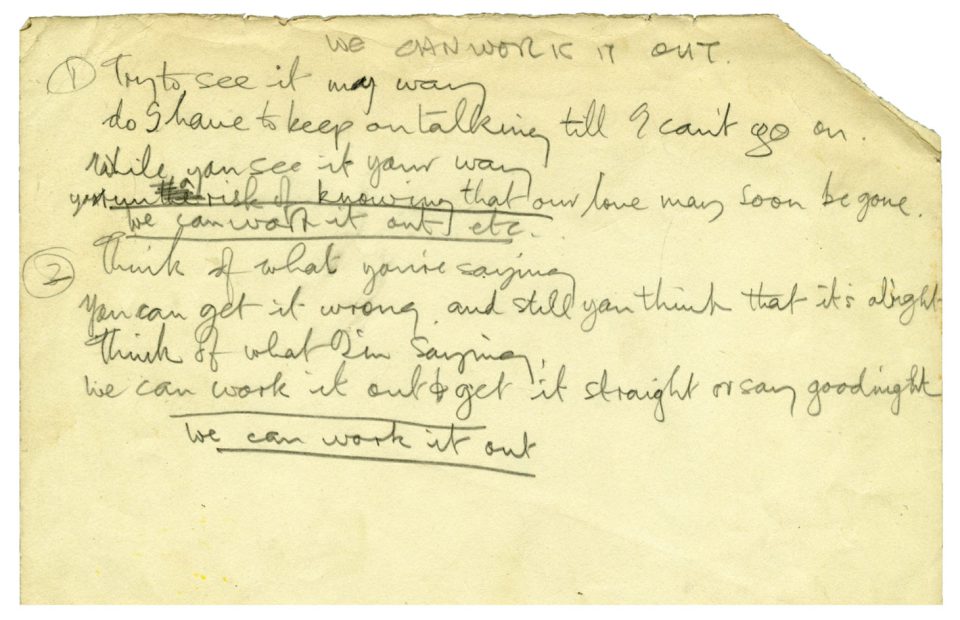
McCartney’s contribution was written at Rembrandt, the house in Heswall, Cheshire he had bought for his father in July 1964. In the dining room of the large mock-Tudor house was a piano, which McCartney often used to work out new songs on. However, ‘We Can Work It Out’ was written on an acoustic guitar in one of the bedrooms.
I had the idea, the title, had a couple of verses and the basic idea for it, then I took it to John to finish it off and we wrote the middle together. Which is nice: ‘Life is very short. There’s no time for fussing and fighting, my friend.’ Then it was George Harrison’s idea to put the middle into waltz time, like a German waltz. That came on the session, it was one of the cases of the arrangement being done on the session.
Many Years From Now, Barry Miles
Promotional films
The Beatles made three promo films for ‘We Can Work It Out’ on 23 November 1965, at Twickenham Film Studios in London, in which they mimed to the song.
The black-and-white clips were immediately distributed to broadcasting organisations. The most commonly-used version of ‘We Can Work It Out’ was a straightforward performance piece with the group wearing black suits; in another the group wore their Shea Stadium gear, and the third opened with a shot of John Lennon with a sunflower over his eye.
In the studio
The basic track of ‘We Can Work It Out’ was laid down on 20 October 1965, while The Beatles were recording Rubber Soul.
When we took it to the studio, George Harrison suggested we try the waltz pattern, with suspended triplets, that ended up giving the song a profound sense of friction and fracture.But the fracture was real, and we did ‘fall apart before too long’. Sadly, Jane and I did break up. And that meant breaking up with her mother too. Margaret Asher was a real mumsy type and, since I’d lost my mum, she had filled that role for me. Now I’d lost a mother for a second time.
The Lyrics: 1956 To The Present
In a four-hour session The Beatles rehearsed and then recorded just two takes of the rhythm track.
They then spent nearly five further hours overdubbing instruments, including John Lennon’s distinctive harmonium in the verses. The vocals took up much of the evening session, and were completed during a two-hour session on 29 October.
The other thing that arrived on the session was we found an old harmonium hidden away in the studio, and said, ‘Oh, this’d be a nice colour on it.’ We put the chords on with the harmonium as a wash, just a basic held chord, what you would call a pad these days.
Chart success
‘Day Tripper’ was originally intended to be The Beatles’ final single of 1965. However, ‘We Can Work It Out’ was felt by the group and Brian Epstein to be the more commercial song.
John Lennon disagreed, and fought to retain ‘Day Tripper’ as the lead song. The result was the single being marketed as the world’s first double a-side, which was released on 3 December 1965 in the UK – the same day as Rubber Soul – and three days later in the US.
Of the two songs, ‘We Can Work It Out’ was more commonly requested by record buyers, and was likewise favoured by radio stations. In the UK it entered the chart at number one five days after its release, where it remained for five weeks and sold over a million copies.
‘We Can Work It Out’/’Day Tripper’ also topped the charts in the US, and became The Beatles’ fastest-selling single since ‘Can’t Buy Me Love’. It was with this release that Lennon’s dominance of The Beatles began to cede to Paul McCartney, who was steadily becoming more influential as a musical leader of the group.


paul is the only lead vocalist on the song
On the chorus which he is mainly responsible for, Lennon’s voice is the most prominent.
“We can work it out/ We can work it out” is the chorus, and was written by McCartney. You’re referring to the middle eight, which John wrote/helped Paul write.
I wouldn’t agree that John’s voice is more prominent, though.
John only sings harmony to Paul’s lead throughout the middle eight, although his voice MAY be slightly LOUDER.
When there are two voices singing the same words, the line between who sings “lead” and who sings “harmony” is rendered meaningless, if not eliminated altogether. If John’s voice is louder during the “Life is very short” bits then it IS more prominent. Which is not to call it a “lead” vocal, since there IS no single lead, just two voices harmonizing – although it might be called a twin-lead or something.
Interesting how all this disagreement has to do with just the TERMINOLOGY, since everyone agrees whose voice is whose! If I were doing the write-up, I’d credit Paul with “lead and harmony vocals” and John with just “harmony vocals”. I don’t think George sang on any part of this (Carlos and Lansdale can’t hear him either), but I’ll defer to Joe’s claim that he “obviously” sang backup.
Hmm, it hadn’t occurred to me that George might not be singing on this at all. I’ll recheck my sources and see what I can come up with.
No need to check the sources. There are just two vocals, Paul and John.
And Paul double-tracked in the verses, obviously.
Where there is disagreement it is always necessary to check the sources — beginning with listening to the recording.
Ian MacDonald credits George with harmony vocal ,and interestingly enough ONLY vocals…no guitar, or tambourine for that matter…
I’m agree with Albert Cunning, John only sings harmony. The lead vocalist is paul. In the middle, paul is leading too with john singing below him.
This kind of things are the reason why paul talks everyday to defend his beatle legacy, because everyday people tries to rewrite (changing small bits than become big when you take all) the histoy in john’s favour.
Right. I had a professor who insisted Eleanor Rigby was written by Lenon. A Harvard professor makes a useless “mathmatical model” to claim he knows McCartney didn’t write the music for In My Life, as well as declaring McCartney the sole writer of The Word. McCartney has clear memories countering these false claims & Lenon often made blatantly false claims, such as writting 3/4 of Eleanor Rigby !
Paul has to defend his Beatle legacy every day! How interesting.
I would think that with books and interviews, he has already defined his position on who did what.
Who else of importance could dispute him?
In matters concerning partnerships, it is usually the deceased person who has to be defended against revisionism.
Don’t you know the walrus was Paul. Turn me on dead man.
Yeah, but you see a lot people in beatles forums and the media complaining about paul “rewriting the history” only because his version is different from lennon`s, which by the way had the bad habit to change his recollections about the beatles as much his clothes.
Since Lennon was a Beatle, he earned the right to say what he felt whether he changed his clothes or not.
Paul’s recollections doesn’t seem to be that much different from Lennon’s with a few exceptions.
Remember that both of them are talking about recollections that occured over 40 years ago.
Naturally, more fans would defend someone who has been dead for almost 29 years and nothing is going to change that.
There are a lot of differences between Paul’s version and John’s version about “who wrote what”. It’s not only the eleanor rigby and in my life disagreements like some experts claim, they have quite different recollections about who was the composer of a considerable quantity of songs: There’s place, ticket to ride, this boy, do you want to know a secret, you’re going to lose that girl… And the list goes on. We can work it out is a minor example of that, paul says the middle was co-written, but lennon said that was his. I don’t who is right, because obviously I wasn’t there with them, but most of the people doesn’t take Paul’s version as seriously as john’s, even when the discussion is about a song like this, which is mainly McCartney’s.
Returning to the “we can work it out vocal debate”, it’s your decision to change the mistake about john sharing the lead, because of course this is your “bible”, but I tell you most, if not all, the books and websites about the Beatles coincide with what I’m saying. I mean, I had read a lot books about The Beatles and all mentioned Paul as the only lead vocalist in We can work it out.
If you’re going to give john a lead vocal credit in we can work it out only because his voice sounds a little bit more prominent in the middle(which I think is not the case), you might as well do the same with Paul in mean mister mustard (his harmony vocal sounds louder than john’s voice for a great part of the song) or in Norwegian wood (Paul’s voice sounds louder than john’s in the middle section , and according to the musicologist Ian McDonald ,McCartney sings the melody in that part). If you’re writing the Beatles “bible” you have to be bit more objective and fair. I would like to see you change the mistake about john singing lead with paul on we can work it out, but I think probably it’s not going to happen.
All said, I think your website is great.
Ps: forgive my English, my native tongue is Spanish.
Both Lennon and McCartney were listed as having sung ‘vocals’. I preferred not to distinguish between lead, harmony and backing vocals here (although George obviously does the latter) as evidently there’s some conjecture surrounding their roles.
I’ve listened to the remasters a bit more closely, though, and I think you’re right – Lennon is doing harmony vocals, McCartney is on lead.
Goodness me, the mono version has a lot more bass in it than the stereo.
Glad you like the site Sebastian, and thanks for sharing your thoughts.
Paul and John agreed on who wrote what — in a two -part article in “Hit Parader”. There were, surprisingly, little to no differences between them.
To put it simply but accurately: one can tell who wrote what by who sings it — even if it’s only a line or two, such as the bridge in, “A Day in the Life” — “Woke up, fell out of bed . . .” — Paul wrote it, Paul sings it.
Since the beginning sounds exactly like Paul’s music and the middle sounds exactly like Lennon’s music, it shouldn’t be difficult to see who composed each melody. Paul loves the “we wrote that together” whenever he throws a word or two into something John wrote. With Paul it’s usually “I did this” and then “we did that”. It is a known fact that Paul has been trying to put as much claim on as much Beatles output as possible as he has felt he doesn’t get enough credit. It is established that he is a propaganda machine. He can take all the credit for Wings and his solo work. That is all his own fault. Truth hurts sometimes.
I did not say that John was the lead vocalist for any part of We Can Work It Out.
I stated that “Lennon’s voice is the most prominent” for one section of the song.
Paul sang lead on We can work it out but the middle eight would be considered just two part harmony, basically both singing lead as in so many Simon & Garfunkel songs.
What was so fascinating about the Beatles’ vocals was that whether Paul was singing lead or harmony, his voice was virtually always the higher (pitch-wise, not volume-wise) part. So if it was a John song, Paul’s harmony would almost always be the higher of the two – and generally the highest or middle parts when George harmonized with them; John generally singing the lowest part be it lead or harmony. In some cases Paul’s harmonies would be louder than John’s or more distinct in the mix owing to the higher pitch; however the writer almost always sang the lead part on their own songs.
Additionally, sometimes the harmonies were so unique that they became almost a ‘counterpoint’ lead vocal due to both the structure of them as well as their relative volume to the lead vocal.
Also…on the new remastered version of this song, I could swear there’s a banjo or second guitar on the 2nd bridge, and for that matter, a second guitar on the verses. I’m sure I’m wrong about the former and it’s just John picking the strings of the guitar with lots of compression; but if there isn’t a second guitar on the verses, then they’ve ADT’d John’s guitar.
Lead vocal, harmony vocal . what shalls? Its one of their best songs, because of their vocals and it doenst intrest me, if Johns vocal is a lead vocal or a harmony. I never eben thought about it.
The “Life is very short” is Johns baby and its the counterpoint to the part of Paul.
I hear a guitar on a clean setting. Perhaps George’s Gretsch?
I think it’s interesting that people are fussing and fighting about who’s singing the lead vocal on the “fussing and fighting” part.
Especially since life is very short.
And there’s no time.
When I was younger, I always had me favourite Beatle songs and me least favourite Beatle songs. “We Can Work It Out” always got a fast-forward from me. I never much cared for it….often regarded it as “McCartney Fluff”.
Now that I am older I find this song more appealing to my ears, especially John’s bluesy middle eight. It’s very haunting to me, sound wise. Whenever I hear this song now, rather than skip over/FFWD, my old ears wait and relish in the middle eight.
The middle eight makes the song and the waltz part is a nice touch. The rest isn’t much.
Yesterday and Today was my first Beatles Album. I loved it! I got it in about 1967 when I was six. Lennon and McCartney had some of the best vocal harmony’s in R&R. Their harmony in the chorus of We Can Work it Out is my personal favorite. Johns voice in that song was perfect.
I don´t think George has a vocal harmony part, it´s John´s double track, as well as Paul lead vocal is double tracked too(there wasn´t ADT at that time), George only playing tambourine ? I don´t think so. I´ve also read somewhere that Paul played acoustic guitar and George the bass (??????) Any idea ?
I agree that I have never heard George in the harmony’s here. The middle 8 is probably my favorite Beatles harmony and I’ve listened to it closely many many times. My question to all is I cannot tell the difference between the vocals in the two middle 8 sections. The harmony is so close I believe that the same vocal recording was used for both sections? Can anyone tell a difference?
I was quite surprised to learn that it was John who played that distinctive harmonium which contributes so much to the feel of this song. Music writer Ian MacDonald, who seems to be a bit of a Paul partisan, nonetheless had this to say about that: “[Lennon’s] passages are so suited to his Salvation Army harmonium that it’s hard to imagine them not being composed on it. The swell-pedal crescendos he adds to the verses are, on the other hand, textural washes added in the studio, the first of their kind on a Beatles record and signposts to the enriched sound-palette of Revolver.”
“Since Lennon was a Beatle, he earned the right to say what he felt whether he changed his clothes or not.”
That’s obviously true. It becomes a problem when he’s lying through his bloody teeth, as in the Rolling Stone interview, which of course came out as a book, which sold a lot of copies, which is STILL the source of Beatles information for a distressingly large number of people.
It is easy to judge in hindsight what was uttered and printed over forty years ago.
You vastly overrate the effect of the rolling stones article. Ancient history to most. Many if not most Beatle fans became fans after they broke up and know nothing about these stones articles. It isn’t that difficult to see which songs are mainly Paul’s and which are mainly John’s. They helped each other and Harrison and George Martin helped make these songs better too. Neither Lennon nor McCartney songs would be near as good if they weren’t in the Beatles with all the help they both received.
I believe they played this song live only on their December 1965 UK tour. Would be interesting to hear, but lamentably no recordings exist from that tour…at least I’ve never come across any!
Is it definitely John playing acoustic on this, always wondered.
What is the accordion type instrument throughout this song? It really adds an additional layer to the instrumentation and IMHO a heading out to sea pub song type feeling. 🙂
It’s an old harmonium as stated ‘In The Studio’.
This is an enjoyable one to play on the guitar. The drastic key change from D to Bm as you get to the middle 8 is cool. I do somewhat disagree about the differences in the words between the Lennon and McCartney parts. While Paul’s part does have a more uplifting sound to it, it is the more fiesty and adversarial lyric. He’s saying “Look, you need to do things the way I say, or we’re going to break up. Keep doing your thing, and it’s over.” John’s part is complementary to this, basically saying these little fusses aren’t worth the time, since life is short. Really, they are both saying to stop arguing, with Paul going a bit further by saying things should be tried his way. So, I think John’s quote about being impatient is dead on, but the part about Paul being optimistic is a bit simplistic, since he only believes they can work it out if she sees things his way.
It is indeed! I have played it many times… even in my dreams :)… and the middle eight switch gives a thrilling tension. But I don’t think it’s really a “drastic” key change. D Major to its relative minor, nothing crazy. But the feel of the song does change pretty drastically there– from bright-and-breezy to almost comically tragic. Then it goes waltz, which furthers the effect.
When I first played it, though, the thing that knocked me out the most was the C chord (in the key of D!) under the verses (“..keep on talking till I can’t go…” is the first one). I thought it was sheer (mad) genius. Now I’ve grown accustomed to the notion. But, really, I love every bit of it to pieces.
If I were asked which song I wish I’d written, this might be it. As it is, I’m so glad Lennon-McCartney did it.
The boys sure know how to Harmonize, don’t they?
“Then it was George Harrison’s idea to put the middle into waltz time, like a German waltz. That came on the session, it was one of the cases of the arrangement being done on the session.”
So if George did not play, how was he in on the session?
Who said that George did not play? Anyway, he could have been in the studio even if he wasn’t on the final recording.
What I find amazing is how ‘off hand’ the comment is made about George coming up with the waltz bit. I find that bit of arranging arguable what makes the song incredible. It’s an absolutely brilliant suggestion and a contribution equal to almost anything else in the song.
I think its Paul on acoustic,John on harmonium and George on bass. He did have a Burns bass at the time. not a complicated bass part and it was easier for Paul to play the acoustic part since he wrote most of it. either way its a great song. don’t nitpick
Not a plausible scenario I’m afraid as far as guitar and bass are concerned. I doubt that George, let alone John, would’ve happily agreed to swapping guitar and bass roles with Paul for a song or two and besides, photographs from the Rubber Soul sessions don’t show any evidence of a right-handed bass, only Paul’s left-handed Rickenbacker and Hofners.
I have listened to the recording and at some point, I could hear two acoustic guitar parts, so perhaps George and John were on acoustic guitars, but it’s only my guess.
John uses a similar B minor chord walk down (the “life is very short” bit) on Come Together (the “come together right now over me” bit)
Sometimes I think I can hear an electric guitar very deeply buried in the mix. If you listen to just the left channel with the drums, acoustic and bass, it seems even more true on the last chord.
The beginning “…try to see it my way…” with its short notes is McCartney´s. The beginning I think, works more like a prelude to the heavy bit, the middle part by Lennon “…Life is very short..” very typical Lennon with 1. l o n g notes, and 2. the use of only o n e note. Lennon said he did the middle part. The waltz-time was Harrison´s idea. McCartney said, after Lennon´s death, they wrote the middle part “together”. One never knows what McCartney means with “together”. He helped Lennon with the lyric? or the harmonies? or the melody? If he meant the melody he would have said it. But the establishment interpreted it as a co-composition, and that was McCartney´s purpose. In all literature this song is called a McCartney-composition. How often hasn´t Lennon´s music been called McCartney-composition? Does it exist o n e s i n g l e song, or part of a song, McCartney has composed, but Lennon got the credit of? No.
Will someone change that record!!!? This one is skipping !
Funny. And so true!
Funny. And true!
Why is it – when someone makes a great point exposing Paul McCartney’s “I wrote everything” propaganda that someone always chimes in saying how tired they are of this argument? So many of us enjoy calling Paul out on his selfish vague, song writing greed. If you don’t like it, just skip to the comments you never argue with like “everything Paul says is true and everything Lennon says is a lie because he was on heroin in 1969”
Johan, Yes, I think they wrote the middle eight together of “We Can Work It Out”. It was Paul McCartney Song and BOTH of them Sang the middle eight together. In fact, Paul McCartney had Sang the entire Song. I would say the Song “We Can Work It Out” was mainly written by Paul and he had help with the middle eight that him & John wrote.
McCartney has spent the decades following John’s death to steal credit. He loves to use “we” on things John did, but always uses “I” when talking about his contribution. Extremely obvious and pretty sad.
Mr. Stick- You have made at least four entries on this song title alone and they sound very much like at least one another poster, also in this thread interestingly enough, and the theme is the same old, boring yawn: Paul is rewriting Beatles’ history, Paul is stealing from John’s legacy, etc., etc. If one didn’t know better one might think your given name is Johan. Besides you are old news. Find something new and interesting to share about the Beatles.
Dr. Robert – Seems like you too have made at least four entries on this song title alone and they sound very much like one other poster, also in this thread interestingly enough.
Mr. Slave- Fair enough I have though one is somewhat of a repeat. Thanks for keeping me honest.
Wonderful song, with Lennon and McCartney writing different sections. A long with “Day Tripper”, this makes one of the greatest double A sides.
Love it, that after 40 years, were still talking about these great songs. Can’t wait to hear it in 5.1 Surround on the new Beatles 1 LP
One of the vídeos they filmed in 1965 shows John doing his best to make Paul laugh and lose his concentration. Very funny! It showed how close they were.
George Harrison came with the idea of putting in the waltz-time after the middle part. But he never boasted of it. If it had been McCartney´s idea in a Lennon composition, he would have said it is a co-composition, and that the waltz-time is the mainpoint in the song. And all music writers would forever have written the same thing.
You Johan are a turd. You are always doing this crap putting Mccartney down. Listen to the Quarrymen talking about Mccartney being the man when he was just a young kid. It’s on the Quarrymen part 2.
Thank you FDR. If you believe Johan, The Beatles would have been the same without Paul. Just John and any other bassist/ co-composer and we would have had the same music. I am glad that someone else has called him out on his crapola.
LOL! And I try so hard to not get TOO personal (not always succeeding)….all the while thinking the same thing!
Very good, FDR!
Where can I find this Quarrymen part 2 that you reference?
Great song, with a poignant message. A real Lennon-McCartney collaboration. It is one of the great double A sides, with “Day Tripper” on the other side.
Of course, the song is about Paul and Jane. But watching one of the promo films just now (the black suit one), where Paul on bass and John on harmonium are in picture together a lot, it really does seem to presage the split between the two of them. Even John singing “life is very short…”
There’s some lovely nuances in Lennon’s vocal harmony – in the first bridge, he steps up on ‘ti-ime’ and ‘cri-ime’, whereas he goes straight to the top notes on those words in the second bridge, half a beat earlier. It seems fairly likely to me that this was intentional.
The way Lennon sustains ‘time’ differently on the second bridge is also nice, with his volume dipping in the middle of the word.
I’m sure intricacies like this could be found all over the Beatles’ catalogue – I’ve only studied this one in particular so closely because it’s one of my favourite sections in any Beatles song. Simple but sublime.
Beautiful discourse on this tune. Seems like Lennon’s style of acoustic guitar strumming (recall the 12 string acoustic strumming he did on “Help”; ending the line “…help in anyway” with his signature ‘ba-dun-dun’ signature strum on a 1st position A chord to punctuate the end of a sung line: same thing he used in “We can work it out” on a 1st position D chord on a 6 string acoustic at the end of various lines). So, to me, Lennon is the acoustic strummer here (lively and cocky). McCartney wrote his part of the tune on a piano…and to me, it seems he is on bass on the recording.
I agree with you. the strumming part was a Lennon act.
More than any other era, Paul during the Rubber Soul was very brutally honest in expressing lyrically his difficulties in his relationship with Jane Asher. Of course the lyrics of we can work it out are an example. But some more real stabbing lyrics are from the album itself. In im looking through you he says “you were above me but not today” referring her to being a famous actress in the U.K. But he surpassed her in fame. He further goes on to state “the only difference is you’re down there”. ‘You don’t look different but you have changed. Baby you’ve changed” “why did you not treat me right” and then threatening her with ” love has a nasty habit of disappearing overnight”. These are extremely pointedly honest reflections of his frustration.
He continued the same vain in ‘you won’t see me” where he says “act your age” and once again threatens her with “you won’t see me”.
I have never thought of “you were above me, but not today” in the sense you mention, though that may be correct. Paul’s infidelities while with Jane have become well known. My thoughts are that she has always known about his infidelity and has held it over his head, implying that she is “above” all that. Now she has had her turn at infidelity, been caught, and is no longer above him because of it. I have no idea if there are details to support that Jane was unfaithful.
I think you may have guessed it about the second half, but that the first half is about social class. Jane was the daughter of a prominent physician and an oboe professor living with her parents, brother, and sister in a big house in a very good London neighborhood. When Peter Asher talks about it on his Sirius show, it sounds like the house had three or four levels and two piano rooms. I always thought that when Dr. Asher let Paul live there (in his own room), Paul would have been acutely conscious of being a working-class Scouse without much of a formal education.
I think the theory that George Harrison played the tambourine is the most plausible: if you listen to the two takes they recorded, you’ll notice that the first one has the tambourine in it. Since it was a breakdown, I doubt Starr overdubbed a tambourine part on it. The tambourine must’ve been played alongside the drums, the guitar and the bass.
I’m basing my opinion on other recordings: for example, the first take of Day Tripper (which was also a breakdown), doesn’t have any overdubs.
What do you think?
Good detective work! Regardless, the tambourine support is among the best of any Beatles recording.
A few points:
(1) When the Beatles used the innovative 2-part harmony singing, developed “eyeball to eyeball”, they didn’t consider one or the other to be the “lead” and are on record as finding it amusing that this only had to be decided by the sheet-music writers
(2) Rightly or wrongly, Paul is consistent in his opinion that when one of these 2-part creations is present, that section is “co-written”. Note that he’s not talking about two parts that go in lock step in thirds – if you listen carefully to all the great 2-part songs (There’s a Place, etc.) the voices sometimes go in different directions, sometimes one changes why the other stays steady, and often jump between thirds, fourths, fifths and sixths in crazy and wonderful ways – thus there’s not really disagreement on the middle 8 of this song – John came up with the words and chords and they then did an eyeball to eyeball session to arrive at the harmony, during which both melodies were likely changed and re-changed until they were happy. Whether or not you call that co-composing by Paul is irrelevant – that was how the creative process worked. And the fact that one of the most memorable parts of the track, the triplet or waltz rhythm, was George’s idea, further shows that it’s all about chemistry, not so much about individual accomplishment. All you have to do is listen to the solo records to see how important chemistry was – when it was taken away, you were left with talented humans – when it was present there was true magic.
(3) In general, I am disturbed by the amount of deference accorded here to Ian MacDonald. He was a great *writer*, but not a great listener and that book is riddled with errors and completely silly takes. This may be the Beatles Bible, but the dearly departed Mr. MacDonald is a long long way from being the holy ghost or one of the apostles. I’m glad to have the book and keep it on my desk for reference, but I take everything in it with a pillar of salt – he was a bitter man with some twisted and misplaced hostility towards some of these wonderful songs. If you don’t believe me, read his review of almost any Harrison song.
I know what you mean with Ian MacDonald’s book – it not only was riddled with errors, but also some very unconvincing and unrealistic song line-ups, considering the limitations of 4-track recording.
I object to him arbitrarily miscrediting guitar parts played by John or George to Paul, unnecessarily criticizing George’s songs, making dubious claims of what George did or didn’t play with no proof to substantiate it, erroneously crediting guitar parts praised by him to Paul (in reality, they were played by either John and/or George) and foolishly believing that everything Paul says in retrospect is true when it’s not always the case.
He also incorrectly credited George with playing bass on “Birthday” and “She Said She Said” (in reality, Paul played bass on both songs while John and George were on guitars), Paul with playing acoustic guitar on “I’ll Follow the Sun” (he didn’t have his Epiphone Texan yet), John with playing bass on “Helter Skelter” (in reality, Paul played bass on the final take, as evidenced by the studio chatter on Take 17 of the final version), John with playing guitar on “Something” (he actually played piano), Paul with playing the guitar solo on “She’s a Woman” (in reality, it was clearly George on one of his Gretsch guitars and Paul didn’t have a left-handed electric guitar yet either), John with playing lead guitar on “Slow Down” (again, it was George playing it and the tone corresponds to his Gretsch guitar), and he also made a ridiculous speculation that Paul played most of the instruments on “Michelle” himself, only to contradict himself by asserting that John played all the acoustic guitars (in reality, according to Walter Everett, Paul played 6-string acoustic guitar, John played nylon-string acoustic guitar and George played 12-string acoustic guitar and even session photos confirm this).
This is not to say that Mr. MacDonald never got any song line-ups correct – he got the line-ups correct on “And I Love Her”, “Not a Second Time”, “Roll Over Beethoven”, “Hold Me Tight” and “No Reply” to name a few.
Did it ever occur to Mr. MacDonald to ask for photocopies of session sheets and personally handwritten notes? I agree with you that Mr. MacDonald was a bitter man with a lot of misplaced hostility and gratuitously criticizing these timeless songs was so unwarranted.
I was foolish enough to believe everything that Mr. MacDonald wrote, but not anymore.
Re: “We Can Work It Out” [my favorite Beatles song by the way] they write: “It was with this release that Lennon’s dominance of The Beatles began to cede to McCartney, who was steadily becoming more influential as a musical leader of the group.” What about “Yesterday”?
In the book “The Beatles’ Chronicle, Mark Lewihson informs that We Can Work It Out was played live by the Beatles in theira last british tour, in december 1965. Anyone has any information about that ?
That’s about all we know…it was played on ’65 UK tour in December. Apparently no recordings exist
From the day I first heard this in 1965 until a couple of years ago, I thought the instrument in the background was an accordion rather than a harmonium. Many similarities.
Here’s a thought: the harmonium is generally associated with India. Is it possible that George became interested in this instrument at the same time that he discovered the sitar? Maybe there’s some connection with the Indian restaurant scene in Help!
I have listened to one of the instrumental outtakes on YouTube and it is apparent that there are two acoustic guitars, so this implies that perhaps both George and John were on acoustic guitars, Paul was on bass and Ringo is on drums and tambourine.
The idea that Paul played acoustic guitar while John or George covered on bass is not likely and I very much doubt that George, let alone John, would’ve happily agreed to swapping guitar and bass roles with Paul, even for a song or two, and Paul is capable of playing simple bass parts whenever he wants to or whenever it’s necessary.
Don’t forget that there was no right-handed bass at this point in time, so it wouldn’t have been feasible for John or George to borrow Paul’s left-handed bass and in contrast to having customized left-handed basses, Paul had restrung his electric and acoustic guitars left-handed rather than undertaking the logical method of custom-ordering left-handed versions of either guitar, much like what he does now.
Owing to the lack of any official data or handwritten notes as to who played what on this song or any published paperwork, one can only speculate.
About the tambourine:
I think in general it’s just another example of the GREAT use of the tambourine on MANY songs from that Beatles-era, starting with Rubber Soul, over Packback Writer to Revolver.
But I SWEAR when I listened to my remastered Past-Masters CD the tambourin sounds totally out of synch in a short part after the second bridge, I think. Like, TOTALLY out of rhythm!
Funny enough, when I listened to it again on Youtube before pointing it out here it didn’t sound wrong to me at all!
Anyone else having that CD you might want to check it out.
“World’s first double-A side”? Hardly. Think that distinction just might go to “Hound Dog”/“Don’t Be Cruel”, issued 9 1/2 years earlier.