
‘Revolution’ was John Lennon’s response to the popular calls for uprising in the US and Europe. It was a revision of a version already recorded for the White Album, and became the b-side of the ‘Hey Jude’ single.
Although taped after ‘Revolution 1’, this faster, louder version was the first to be released. The song was written in India while The Beatles were studying meditation in Rishikesh.
I wanted to put out what I felt about revolution. I thought it was time we fucking spoke about it, the same as I thought it was about time we stopped not answering about the Vietnamese war when we were on tour with Brian Epstein and had to tell him, ‘We’re going to talk about the war this time, and we’re not going to just waffle.’ I wanted to say what I thought about revolution.I had been thinking about it up in the hills in India. I still had this ‘God will save us’ feeling about it, that it’s going to be all right. That’s why I did it: I wanted to talk, I wanted to say my piece about revolution. I wanted to tell you, or whoever listens, to communicate, to say ‘What do you say? This is what I say.’
Rolling Stone, 1970
While ‘Revolution 1’ found Lennon uncertain about whether to join the struggle, on the faster ‘Revolution’ he emphatically demanded to be excluded.
Count me out if it’s for violence. Don’t expect me on the barricades unless it’s with flowers.
The urgency of the new arrangement was a result of Paul McCartney’s resistance to Lennon’s hopes of ‘Revolution 1′ being The Beatles’ next single after ‘Lady Madonna’. With the backing of George Harrison, McCartney argued that the recording was too slow, inspiring Lennon to re-record it in an up-tempo, distorted and spontaneous outburst of anti-revolutionary fervour. After two years lost in an LSD haze, and newly energised in his love for Yoko Ono, Lennon gladly rose to the challenge he perceived.
We recorded the song twice. The Beatles were getting real tense with each other. I did the slow version and I wanted it out as a single: as a statement of The Beatles’ position on Vietnam and The Beatles’ position on revolution. For years, on The Beatles’ tours, Brian Epstein had stopped us from saying anything about Vietnam or the war. And he wouldn’t allow questions about it. But on one of the last tours, I said, ‘I am going to answer about the war. We can’t ignore it.’ I absolutely wanted The Beatles to say something about the war.
All We Are Saying, David Sheff
In the studio
‘Revolution’ featured the most distortion on any Beatles recording, particularly in the twin fuzz-toned guitars plugged directly into the Abbey Road desk and deliberately played loud to overload the meters.
We got into distortion on that, which we had a lot of complaints from the technical people about. But that was the idea: it was John’s song and the idea was to push it right to the limit. Well, we went to the limit and beyond.
On 9 July 1968, following a remake of ‘Ob-La-Di, Ob-La-Da’, The Beatles began the remake of ‘Revolution’, rehearsing the song and trying out the new arrangement.
The first take of ‘Revolution’ – well, George and Paul were resentful and said it wasn’t fast enough. Now, if you go into the details of what a hit record is and isn’t, maybe. But The Beatles could have afforded to put out the slow, understandable version of ‘Revolution’ as a single, whether it was a gold record or a wooden record. But because they were so upset over the Yoko thing and the fact that I was becoming as creative and dominating as I had been in the early days, after lying fallow for a couple of years, it upset the applecart. I was awake again and they weren’t used to it.
All We Are Saying, David Sheff
Although the rehearsal was taped, the next day they wiped the tape and recorded 10 takes afresh, with handclaps and another drum track overdubbed afterwards. The drums were as hard-hitting as the guitars were distorted, being compressed and put through limiters to give a claustrophobic air.
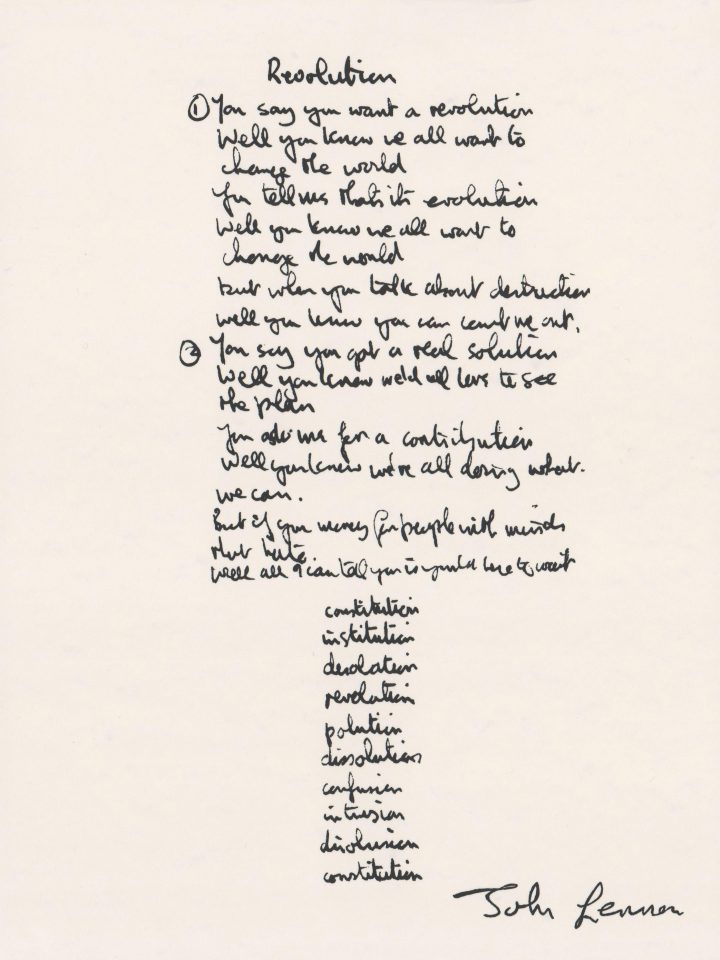
John Lennon also added his two vocal tracks on that day. He double tracked key words during the song, leaving in the odd mistake to emphasise the spontaneous sound of the recording, and also added the screaming introduction.
11 July saw the addition of bass and electric piano, the latter played by ace session musician Nicky Hopkins. ‘Revolution’ was completed the following day (or, more accurately, on the morning of 13 July; the session started at midnight), with another bass part and some more lead guitar, performed by McCartney and Lennon.


Yes, the single version of this song (in mono) is what John Lennon preferred. He listened to the stereo version on The Beatles 1967-70 and stated that the song lost it’s heaviness in the transition. “They took a heavy record and turned it into a piece of ice cream!” He stated. Although the version on “Love” brings buried guitars out in the open, it’s heavily edited and not the full song.
Revolution was John’s answer not only to the political unrest in France and America in the spring of 1968, but also an answer to Jean-Luc Godard and the New Left who said the Stones were more responsive to the times with “Street Fighting Man” than the Beatles were in the spring and summer of 1968.
In fact, Godard filmed a movie with the Stones titled One Plus One.
Lennon may have been thinking about leaving the Beatles by that time but that didn’t mean he wasn’t going to let anyone criticize the Beatles without a response.
I doubt this track had anything to do with the Rolling Stones at all. It was recorded about the same time as “Street Fighting Man” and released earlier, so John wouldn’t even have been aware of the Stones song unless he visited them during the recording sessions (admmittedly not impossible.)
A great Lennon composition. Trying to emphasize his views of not only the growing conflicts in the USA and the UK but the whole world. Seems he was trying to establish and demand a new way of life for all of mankind by himself.
I don’t have a very finely-tuned musical ear (I’m a drummer – although that’s not a very good excuse!) and I can’t hear the difference between the normal version and the Love version other than the loudness and the length; however, on the DVD-audio version of Love, there are longer versions of Revolution and Back In The U.S.S.R.
Man! I need to get that DVD then! I think that the “Love” version sounds wonderful it’s just that they cut out a huge portion of it on the cd. (I’m guessing the edited “Love” version goes along with the show?)
I’m a drummer as well… lol I do hear the difference. The ‘Love’ version is smoother, softer and the drums are sharp, not distorted as they were in the White Album version. On the WA version, sometimes the guitar part seems to jump out and it almost swallows the vocal. Compression/overdriving of the whole track makes it pop thru… whereas the L version sounds like the guitars were compressed separately behind the vocals. I like the WA version better.
Is there really a Hammond organ on this track? I can’t hear it.
There is another difference between the Revolution 1 and Revolution versions: the latter was increased to a half semitone higher (from A to A#), isn´t it?
That would make sense since Revolution #1 uses horns.
If “Revolution 1” were in Bb to make it easier for the horn players, you’d be right, but it’s actually the non-horn version that’s in Bb.
The fuzziest recording ever made. Awesome.
Far better than “Revolution 1”.
What I absolutely love about the “Love” version: the 2 guitars are separated, where the original stereo version had them both in the same channel. Listen with headphones… awesome.
Yeah, I couldn’t agree more… perhaps the Rock Band game allows for guitars’ isolation and make a mix like Love’s with that?
All this time when i was hearing the single version and although i loved the song i always felt like something is missing,
until yesterday when i discover the love version…. just what it needed to make this song as amazing as it should be.
I wonder why they didn’t make it sound that way in the first place
Yes but the stereo version and the Love version aren’t the mix that the guys made at the studio. They did the mono version. The stereo one was mixed a year later by the Abbey Road studios personnel; and the Love version, you know, a lot of years later by George and Giles Martin.
Is there an organ I don’t hear one. Nice song, lennon’s best, much better than the album version although the shooby-doo-was are nice, you know, so the semi-live version (the promo video) is possibly my favourite versiin
The irony to your comment GeorgeT is that Lennon preferred Revolution 1 (the slower version) and McCartney and Harrison vetoed it as a single (the slow one). In a sort of heated response, Lennon did the faster one and purposely fuzzed out the guitar to stick it to the other two. So Lennon’s fav is the slow one.
There is no rythm guitar, it’s two lead guitars. You can hear both guitars in different channels in the love version. Lennon plays the opening riff and the short guitar only breaks, but he plays the rythm guitar parts during the parts with vocals and harrison plays the lead guitar in those parts
You’re right about who plays what guitar part, which you can discern when the guitars are separated. Lennon really does the heavy lifting on this one, including the nice little licks over the “Don’t you know it’s gonna be…. all right” part.
And the left hand on Nicky Hopkins’s part is amazingly out of time when you listen to the isolated tracks. The right hand is great though.
The organ is heard during the guitar solo just after the half way mark. It is very clear,
Right before the electric piano solo?
Yes, the ascending line. Or rather just before the ascending line. And it’s more like another electric piano to my ears, not organ; it’s deep under John’s rhythm guitar throughout the song
It’s pretty hard to follow John’s rhythm guitar throughout. I’ve been listening to isolated tracks provided by rock band and the guitars inexplicably seem to switch channels time after time.
So what sounds like the bass part of the piano is actually Paul’s organ?
This is my favorite version of Revolution. I love the guitar tones, the urgency of the vocal, the walking bass line, the back-to-basics drums, Nicky Hopkins’s electric piano solo… The White Album’s Revolution 1 always seemed a little tepid to me.
If you listen to the Esher demos, John plays Revolution at a pretty snappy tempo, so maybe even then and even in an acoustic context this tempo was what seemed natural to him.
Regarding the group contretemps over releasing (or deciding not to release) Revolution 1 as a single, it really would have been far out and Solomonic to have put out both versions on the same single. Although I think the uptempo Revolution is the more commercial (and indeed I like it better) it would have been mind-blowing to make it the B side. Wind down Rev 1 with the fade out, then flip it over and that screaming riff and screaming scream, hello! [Cross-posting this to the Revolution page as the decision on which version was suitable for the single is also discussed there.]
Though Revolution is technically a B side, I think of it as a double-A side with two timeless classic songs equal to the double-‘A’s of Penny Lane/Strawberry Fields Forever and Come Together/Something.
Any single by the Beatles was double-A, no question about it.
Has anyone heard another version of Revolution? It is the hard version but with George and Paul’s background vocals in between John’s verses, i.e. “shooby doo wop.” It’s incredible. Where can I get this version? I just heard it today on satellite radio.
Yes, that was from the David Frost show on 4 September 1968, available on YouTube.
Yeah, the “shooby doo wop” by Paul and George is really incredible….it made the song better…the 67-70 album doesn’t have it.
It’s on the Beatles 1 remixed and remastered disc 2.
The David Frost version is on the Anthology dvd with video but it’s spoiled by a voice over in the middle
How do you like Do Unto Others by Pee Wee Crayton?
you’ve made me lost the chance to be the first to post about the “borrowed” introduction of that song “unto” Revolution…John was a blues listener…
Yeah, you missed it by nearly two years chum. So close.
There is yet another version of Revolution that I have heard on Chris Carter’s “Breakfast With the Beatles” show out of L.A. (used to be on Sirius radio). It’s Lennon messing up the guitar intro, long missed chord kinda hanging there…Only place of have ever heard it, no idea where it’s from.
Brilliant John Lennon song. First obtained this when I got the “Hey Jude” album.As is typical of The Beatles, this provides a real contrast to”Hey Jude”,a McCartney classic on the A side. A long with The Rolling Stones equally brilliant “Street Fighting Man”, summarizes so well the tumultuous year that 1968 undoubtedly was.Funnily enough Nicky Hopkins played on both songs. What a brilliant musician he was.
Great song, great recording. Also shows what a great rhythm player Lennon was. His riffs and voicings keep you riveted the whole way through.
Iconic song. Surprising that ‘Hey Jude’ is up there among the best songs of all time but ‘Revolution’ is further down the list. Has to be the best double-A side record of all time.
It wasn’t a double-A single. “Revolution” is the B-side.
In some areas of the US, it was listed as a double A-side (albeit unofficially). For example, in Chicago, WLS Radio listed it as such on their weekly surveys.
Both versions of Revolution are valid. The laid back, almost lounge version is darker, more biting than the loud one, actually. Lennon with a sardonic grin, “shooby doo wop, you effen hippies”. The single version is pure street, dirty and gritty. Both work.
Take nothing John Lennon did at face value. He was a brilliant man. The mind was always spinning.
Was John on heroin at this point? I’ve always felt like he was more sober than usual on this take. It’s very vintage John, very focused vocals.
I don’t believe John and Yoko started heroin until late ’68, after the White Album session but before the Get Back sessions.
I will date myself here, but so be it… I remember sitting in the basement of the house I grew up in and playing Hey Jude, then Revolution, over and over again, flipping the 45 back and forth between the two, and marveling at how they complemented each other 🙂
There is no better version of Revolution. They are all great. I love watching John on YouTube with the starting riff then the Beatles come in. It’s a beauty.
I was always under the impression that Hey Jude/Revolution was released as a double A side until now. I’m sure it was written in lists as Hey Jude/Revolution but obviously Revolution was the B side.
In Chicago (on the WLS Radio surveys of the time, specifically), both “Hey Jude” and “Revolution” were listed together as a double A-side.
An individual radio station can list it as it chooses – officially from Apple/Parlophone/Capitol , Hey Jude is the A-side and Revolution the B-side.
I love the song, love the arrangement of the fast version
BUT I HATE THE SOUND OF THE GUITARS!!!!
Trebly, buzzing like mosquitoes on meth, thin sound, all the wrong harmonics.
If the Beatles wanted REAL power behind the two guitars, George M
should have let them plug into Traynor or Marshall amps (like the Who), and get
REAL power chords. Smooth, but crunchy distortion.
IS ANYONE ELSE BOTHERED BY THIS?
No.
No. That is what made that song. I remember getting that 45 when it came out and listening to Hey Jude first. Just piano and vocals to start out with and then, in the long fade out, Paul’s voice is shouting and you have the horn section, etc al.
Then you flip it over, drop the needle, and WHAM! Those guitars blew me away. That 45 showed you the difference between to superstar song writers and the way they thought about music and lyrics.
If someone ever asks you to demonstrate the difference between John and Paul, play them this 45.
Quite agree about the guitar sound.
John Lennon pinched the intro to “Revolution” from “Do Unto Others” by 50’s Rhythm And Blues/Rock ‘n’ Roll musician “Pee Wee Crayton”.
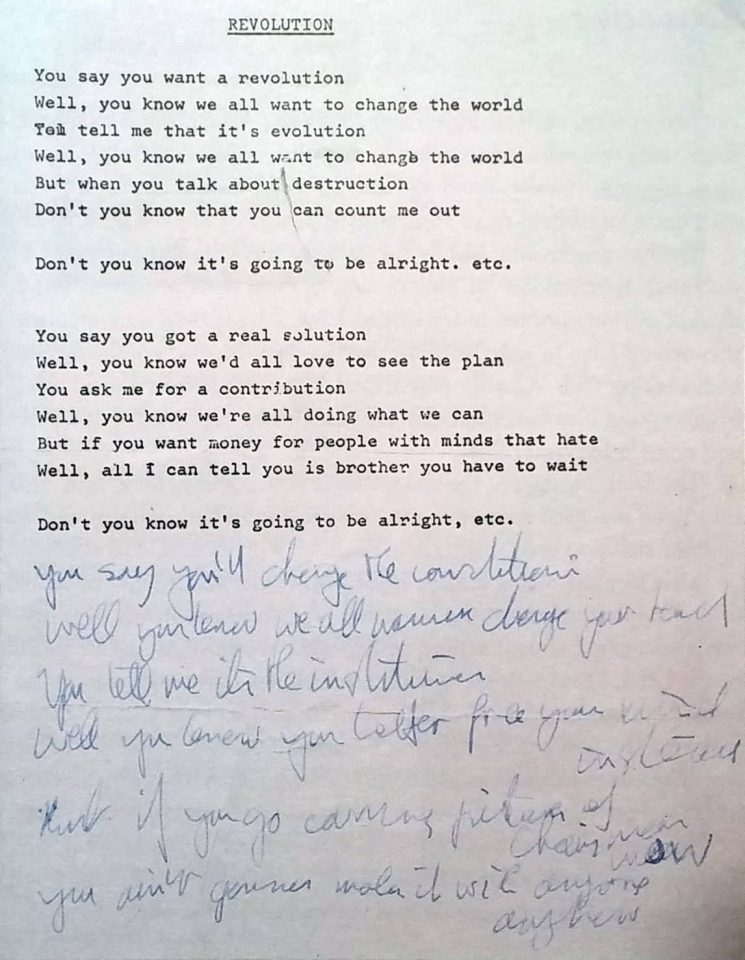
I never liked the Third Verse on “Revolution”! That “Change your head”/”Chairman Mao” business I found silly and superfluous! I would’ve preferred The arrangement on the “Esher” Demo where John simply repeats the First Verse! George Harrison loved the Esher Demo version and I can see why!
I dunno though. To me that final verse is the killer. “If you go carrying pictures of chairman Mao“ was spot on. Thank God some Pop star with a big megaphone blew that raspberry in the faces of the New Left. And those who preached revolution at the time hated that line too. But John was right. (And the Stones whose STM was hardly more sympathetic.)
You know, I love this song and the manner in which it was recorded, but I have always believed John ruined the song by inserting that third verse!
I’ve always thought that “Change your head”, “Chairman Mao” business was superfluous!
The Beatles should have recorded exactly it with the original arrangement on the “Esther” Demo!
It’s perfection!
George liked that arrangement!
The arrangement on Revolution 1 also utilized the third verse and has a lot less enthusiasm and than on the “Esher” Demo.
You notice how John “wrote” the third verse as an afterthought.