
Promotional film
On 4 September 1968 The Beatles made promotional films for ‘Hey Jude’ and ‘Revolution’, at Twickenham Film Studios in London.At least three performances of ‘Hey Jude’ were filmed; the most commonly-seen is an edit of two of these. Only the vocals were live: during the first part of the song Paul McCartney sang along with the studio vocals, and ad-libbed during the end.
We made a film in front of an audience. They had brought people in for ‘Hey Jude’. It wasn’t done just for David Frost, but it was shown on his show and he was actually there when we filmed it.
The clip was first shown on Frost On Sunday on 8 September. David Frost was at Twickenham for the recording; The Beatles taped a version of the programme’s George Martin-penned theme tune, ‘By George! It’s The David Frost Theme’, before the host introduced ‘Hey Jude’.
Magnificent! A perfect rendition! Ladies and gentlemen, there you see the greatest tea-room orchestra in the world. It’s my pleasure to introduce now, in their first live appearance for goodness knows how long in front of a live audience, The Beatles!
Frost On Sunday, 1968
Following this introduction, The Beatles improvised a parody of Elvis Presley’s ‘It’s Now Or Never’, which was never seen by television viewers.
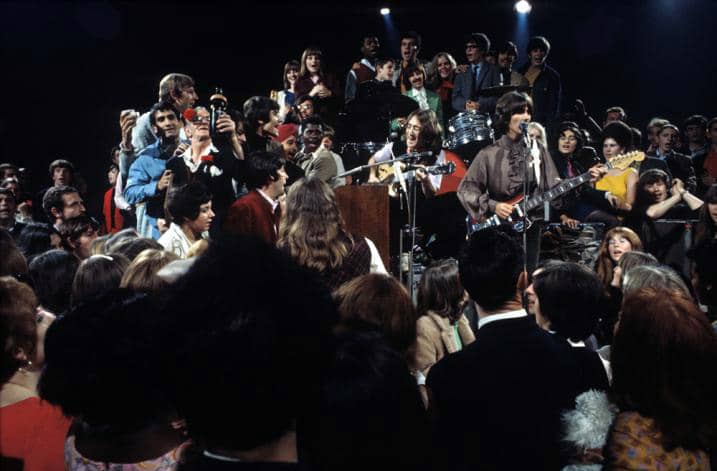
Chart success
‘Hey Jude’ was released just a few weeks after The Beatles finished its recording. It was backed with John Lennon’s ‘Revolution’, and was the first single released on the group’s Apple Records.
The single was issued in the USA on 26 August 1968, and four days later in the United Kingdom.
I wanted to put [‘Revolution’] out as a single, I had it all prepared, but they came by, and said it wasn’t good enough. And we put out what? ‘Hello, Goodbye’ or some shit like that? No, we put out ‘Hey Jude’, which was worth it – I’m sorry – but we could have had both.
Rolling Stone, 1970
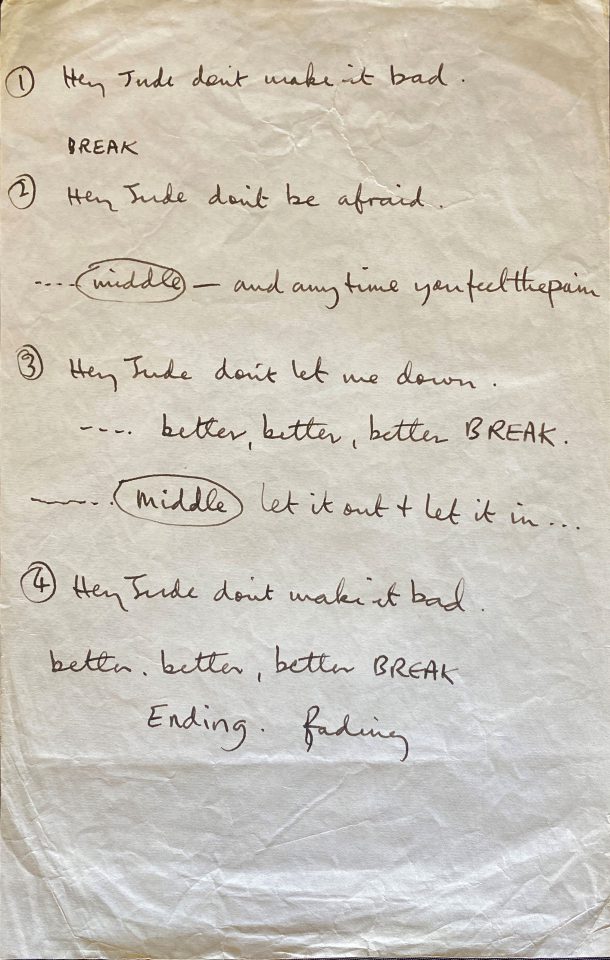
At over seven minutes, ‘Hey Jude’ was the longest single ever to have topped the British charts. Its lengthy fade-out brought the song’s length to over seven minutes, perhaps inspired by Richard Harris’ ‘MacArthur Park’, a hit earlier in 1968.
We recorded ‘Hey Jude’ in Trident Studios. It was a long song. In fact, after I timed it I actually said, ‘You can’t make a single that long.’ I was shouted down by the boys – not for the first time in my life – and John asked: ‘Why not?’ I couldn’t think of a good answer, really – except the pathetic one that disc jockeys wouldn’t play it. He said, ‘They will if it’s us.’ And, of course, he was absolutely right.
‘Hey Jude’ was released on 26 August 1968 in the United States. It swiftly rose to the number one spot, where it remained for the next nine weeks – the longest run achieved by any Beatles single. The single sold five million copies in six months, and a further million by the end of 1968. Altogether it spent 19 weeks in the charts.
In the UK it was released on 30 August. The single began its 16-week chart run on 7 September 1968, rising to the top spot a week later. It spent two weeks at number one before being deposed by another Apple single, Mary Hopkin’s ‘Those Were The Days’, which was produced by Paul McCartney.
‘Hey Jude’ is the biggest-selling debut release ever for a label, and remains The Beatles’ most commercially-successful single. It has sold an estimated eight million copies worldwide and has topped the charts in 11 countries.


If you listen on YouTube to the ‘Love’ version of HJ, you can hear a different, more lively version of the bass part during the Na-na-na’s. It sounds like the Fender VI bass, so I’m guessing this is an alternate track, with George taking some liberties. listen starting at 3:00 on the video
Actually, Paul was the only bassist at the recording session and I have seen a photograph taken of him at Trident Studios with his left-handed Fender Jazz Bass, so it was most likely the first time he used it on a recording, not his Rickenbacker or Hofner basses.
George only played the Fender 6-string bass on the David Frost Show performance and it was partially mimed with live vocals, due to a Musicians’ Union ban on lip-synching.
It’s always interesting to read through the comments on personal interpretations of these songs. I am guilty of doing it myself. And, of course, the Beatles themselves have been known to revise and invent things over time. For this one, I could never reconcile the last 3 verses with the first one, which is obviously about Julian. That is, until I heard a little snippet about the song from Paul on the Beatles channel. He talked about how John felt the later verses were about him and Yoko. In actuality, according to Paul, they were about Paul and Linda, with Paul trying to convince himself that it was ok to get serious with her (e.g., “Don’t be afraid, you were made to go out and get her”). It actually makes more sense this way.
Paul did try and dodge the meanings of some of his more personal songs. I don’t believe Paul saying it was about Linda one bit. I think it’s just convenient for him for how people want to interpret it. No doubt it was inspired by Julian but the lyrics are more about self-reproach. Firstly, it was written just after Jane Asher left him. And, like Paul said, written on the journey to see Julian where Cynthia said Paul was heartbroken over Jane and had admitted it was all his fault. A little too coincidental? This was corroborated by others around this time and later by Elvis Costello when he worked with Paul on Flowers in the Dirt (several songs on that album were about unrequited love). There was nothing to stop Paul reaching out to Linda during this time. Instead he made a big effort to win Jane back and had affairs with Francie Schwartz and Maggie McGivern before settling with Linda months later. Either it’s Paul’s pride or ego or he’s trying to protect the image of his marriage, especially after the Heather Mills debacle. A bit of both probably.
.
Kalle,
Paul McCartney first met Linda at the Bag O’ Nail on May 15, 1967. Where he stood up and block Linda way from leaving. Paul asking Linda if she would like to go with him and his group of friends to another bar. And Paul would have said in an interview later on that he knew Linda was Woman! And Linda has a daughter Heather which Paul loves kids. So, Paul stays in touch with Linda.
Paul goes up to see Cynthia and Julian sometime in May of 1968, when John was divorcing Cynthia. And Paul decides to write a Song for Julian called “Hey Jude”.
On July 20, 1968 Jane Asher calls it quits with Paul on Simon Dee’s BBC Television Show. And I know Paul and Jane have been having troubles for years. With Songs like “We Can Work It Out” Released December 3, 1965 and “For No One” Released August 5, 1966 – “A Love that should have lasted years” – The Songs working title was “Why Did It Die?”, Paul said he have a fight with Jane while they on vacation together in the Swiss Alps. Paul knew that things were not going well for them in May of 1968 when he had gone and saw Cynthia and Julian. Paul, Knowing that Jane was finish with him when she caught him in bed with Francie Schwartz (allegedly) during the “White Album”, sometime in June- July of 1968.
When Paul was writing “Hey Jude” he was course thinking about Julian but Paul was thinking about himself, too.
“Hey Jude” – Released on August 26, 1968 (USA) and August 30, 1968 (UK).
“Hey Jude”
“Hey Jude, Don’t make bad
Take a sad song and make it better
Remember to let her into your heart
Then you can start to make it better
Hey Jude, don’t be afraid
You were made to go out and get her
The minute you let her under your skin
Then you begin to make things better”
These two verses could be a message to himself – Saying it is over between Jane and himself {Paul} (Sad Song). And by letting Linda in, you {Paul} could start to make things better. But, first you {Paul} have to go out and get her {Linda}.
He does! And Paul & Linda daughter Mary McCartney was born a year later on August 28, 1969.
I, believe that Paul has Linda on his mind when writing “Hey Jude”.
I would to add to the comment I just made about “Hey Jude” on February 2, 2023 – When
John Lennon and Paul McCartney went to the USA to promote “Apple” on May 11, 1968, Paul saw Linda Eastman. So, I believe Paul McCartney when he said that “Hey Jude” was about him getting the confidence to go out and get Linda.
Hello all, I’m from Melbourne Australia. I remember Hey Jude on the radio, and every Sunday night a local radio station would play its top ten or twenty and every week for ages Hey Jude/Revolution was number one. I always enjoyed listening to it. My question is was Hey Jude/Revolution released as a double A side here in Australia. I read once on the Beatles Bible site that Revolution was the B side, but I was always under the impression it was a double A release . Maybe the radio station released its own list but I was always under the impression it was double A. Anyone can enlighten me?
Stephen Holland, “Hey Jude” was recorded on July 31, 1968, and August 1, 1968. “Hey Jude” was released on the A side on August 26, 1968. And on the B SIDE (Not A DOUBLE A) was Revolution.
When I was a kid, I wondered if the nah nah nah hey Jude part of the song was influenced by the song Nah Nah Hey Hey Kiss Him Goodbye by a group called Steam. I see now that the latter wasn’t released until later in 1969. So it must have been the other way around. Imagine that…a 1960’s song influenced by the Beatles! Go figure…
Saw the boys do both “Hey Jude” and “Revolution” on the Smothers Brothers TV show. At the time, I thought it was live, didn’t realize it was taped beforehand.
Phillip, Paul often talks about people and writes songs about the past or near past in the present tense. It’s unusual and he does this with John Lennon as well. He’s never said Hey Jude was about Linda in the past, not in 1970 or 1980 or when she died in 1998. Or in Many Years From Now. Why not though? And why recently? There was nothing to stop him attributing it to Linda at any time if that was the case. He knows that line you quoted can be interpreted about any woman. He continued his loveless affair with Francie Schwartz for a short time while still trying to win Jane back before taking Maggie McGivern on holiday for two weeks in September. Wasn’t Linda and her child supposed to be ready and waiting for him? Why didn’t he ‘go out and get her’? Yes, he did – eventually, that is. Hey Jude wasn’t written with Linda in mind and because of their seemingly happy marriage it’s all to easy to attribute an interpretation retrospectively. As Paul does. To be honest, I don’t think Paul ever lacked the confidence to find himself a partner, and if he was that enamoured with Linda when he met her at the Bag of Nails he would have called off his relationship with Jane there and then, but obviously not. It wasn’t just Cynthia who said Paul was heartbroken over Jane, it was also Alistair Taylor and several others. But the most illogical thing of all is if Paul didn’t write Hey Jude about himself because of Jane, then why write the song in the first place? The problem with Paul being evasive about Hey Jude and other personal songs is that it could lead to doubts over what he says about the songs he wrote with John Lennon. However, I’d like to think Paul probably has his reasons for keeping some deeply-held personal feelings to himself.
.
After reading comments about the lyrics involving Jane Asher I can see how they can be interpreted that way. Maybe it was originally titled Hey Jane? I can also see them being about John so maybe it was called Hey John? Or maybe even Hey Paul? But I never read them being about Julian. Lyrically that just never made sense to me.
In the live version, McCartney sings some lyrics from, “The Weight”, by The Band, which was just released only months earlier.
just noticed that “It’s Now Or Never” has the same chords as Hey Jude. You can sing it well over it, only the 5th bar differs by major/minor. Was it John’s irony to play that song briefly?