
In the studio
In October 1970 Paul and Linda McCartney flew to New York City to begin work on Ram.They auditioned guitarists over three days in a 45th Street loft; the chosen performer was 21-year-old David Spinozza, who had been invited to audition by Linda. Spinozza was hired for four weeks, but when the Ram sessions proved sporadic he took some other work. The McCartneys drafted in Hugh McCracken to replace him.
The auditions then moved to a basement club, where Denny Seiwell was one of nine drummers to have been tried out. Spinozza was subsequently replaced by Hugh McCracken when he was unable to work on the sessions.
A lot of the boys were really put out at being asked to audition. Paul just asked me to play, he didn’t have a guitar, so I just sat and played. He had a certain look in his eyes … he was looking for more than a drummer, he was looking for a certain attitude too. I just played … I always say that if you can’t get it on by yourself you can’t get it on with anyone.
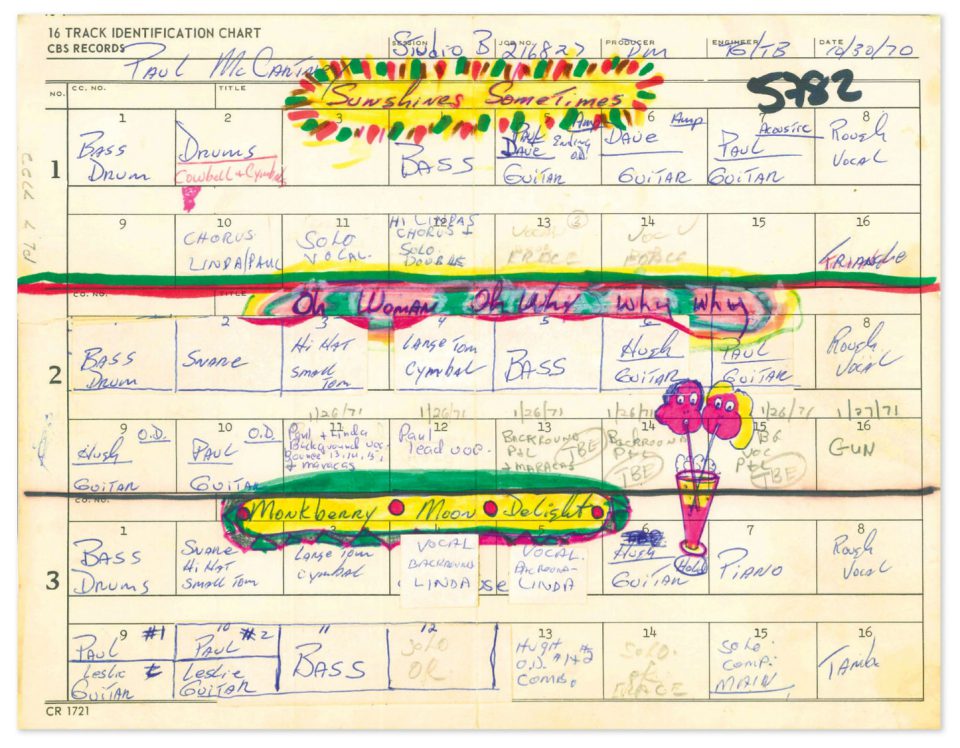
Recording of the album’s basic tracks took place in New York at Columbia Studios’ Studio B in October and November 1970, before the McCartneys returned to their Mull of Kintyre farm for the Christmas period.
Because of the lifestyle we were living, it was very free. The Beatles had been great, and I’d loved it, but I couldn’t say it was free, personally. I couldn’t exactly go to Scotland for a few months. If you were in The Beatles, you had to make records and work. But when we went to Scotland, we had a very free, sort of hippie lifestyle. It meant I could sit around in the kitchen in the little farmhouse we lived in, with the kids running around and me just with my guitar, making up anything I fancied. ‘Three Legs’ for instance was me jamming around with a blues idea, and then with no particular relevance I sang ‘my dog, he got three legs, but he can run’, meaning that everything doesn’t have to be perfect, it can still work. And then I added the lyric ‘a fly flies in’, and I’m sure that happened, with the window open in Scotland! I’m sure a fly actually flew in and I went ‘okay – you’re in the song! Fly flies in, fly flies out’. So yeah, it was a very free period and I think that found its way into the record.I always think that the way we were living then was the way a lot of young people would like to live. We were escaping the constrictions of society. It’s why people move out to the country, or do a lot of gardening, all of those sort of things. It’s a great opportunity in your life to do something different.
paulmccartney.com
Work resumed in the second week of January and through to 25 February at Studio B and A&R Recording Studios, also in New York City.
We knew we would be travelling around, and because Linda was a photographer she was as able to move around as I was. We went out to New York and it was great finding people we could work with like Denny Seiwell, Hugh McCracken, and Dave Spinozza. I spent a little bit of time there auditioning musicians, and then went into the studios in CBS, and then went into A&R Studios with Phil Ramone. And then after that we went out to LA, and I did some work with another great producer Jim Guercio who had done Chicago and Blood, Sweat & Tears. So, I knew it was taking time, but I wasn’t in a hurry. I was enjoying myself! We actually did the cover in LA, me just sitting around in the sunshine doing little drawings and things.
paulmccartney.com
The album was completed with more overdubs, added in March and April 1971 at Sound Recorders Studios in Los Angeles, where Ram was also mixed.
A total of 21 songs were recorded during the sessions, although only 12 appeared on Ram. Two songs – ‘Another Day’ and ‘Oh Woman, Oh Why’ – were issued as a standalone single in February 1971, while two others – ‘Get On The Right Thing’ and ‘Little Lamb Dragonfly’ – were held over for Wings’ 1973 album Red Rose Speedway. The unreleased songs were ‘Little Woman Love’, ‘Sunshine Sometime’, ‘Rode All Night’, ‘A Love For You’, and ‘Hey Diddle’.
Linda McCartney played a key role in shaping the sound of the album, and her husband proved a hard taskmaster during the sessions.
God, I tell you I worked her on the album. Because she hadn’t done a lot, so it was a little bit out of tune. I was not too pleasant to live with, I suppose, then. She was all right; she took it. She understood that it had to be good and you couldn’t let any shit through. I gave her a hard time, I must say, but we were pleased with the results; it just meant we really forced it. [We] worked on all the harmonies even if they were hard harmonies – just stuck on it. Elton John later said somewhere that he thought it was the best harmonies he’d heard in a long while.
While McCartney was grateful for his wife’s contributions, and gave her equal billing on the album, there were some murmurings of dissent. Sir Lew Grade, who had recently bought Northern Songs, claimed that the co-credits were a way to hive off a disproportionate amount of the publishing revenue back to the McCartneys.
Linda and I have been writing songs together – and my publishers are suing because they don’t believe she wrote them with me. You know: suddenly she marries him and suddenly she’s writing songs. ‘Oh sure (wink wink). Oh, sure, she’s writing songs.’
McCartney always maintained that Linda had worked hard to earn her place on the album.
Well, we worked at it. Because that’s what you do when you work on a record, you want it to sound right. Linda told me that she used to be a member of a glee club in America, when she was in college. Like the TV series Glee! I’d never heard of a glee club before, because in Britain we didn’t have that, and she explained that they would sing together and they used to go to a bell tower at the school because it had a good acoustics. She knew certain things about it, so when it came to writing and recording, she would naturally just sing a harmony or I would suggest one and we’d harmonise at home. Then when we would get into the studio, we’d work a little bit harder to try and get it right.Looking back at the records we made together, I think our harmonies were a really individual sound, and a very special sound. Probably because she wasn’t a professional singer, that gave her an innocence to her tone that comes through on the records. I’d be singing ‘hands across the water’ and she’d echo ‘water, water’ and do this funny little American accent, and we’d put it in! We were having fun.
paulmccartney.com
Another negative note was struck by The Beatles’ producer George Martin. Talking after the release of the McCartney album, Martin told Melody Maker:
It was nice enough, but very much a home-made affair, and very much a little family affair. I don’t think he ever really rated it as being as important as the stuff he’d done before. I don’t think Linda is a substitute for John Lennon, any more than Yoko is a substitute for Paul McCartney.
Melody Maker


This is like a secret shame. I like this album. Indeed, Paul ‘carefully crafted’ these songs. He needed to do something after ‘McCartney’ to get his credibility back. Yes, it’s goofy, frequently indulgent and there are some remnants of slop buried in the mix. And yet the sheer strength of committment to the melody is all here. The production values, even in moments of pure-plain-corn, are very slick. And those harmonies….There are touches of ‘You Know My Name…’ and ‘Because’ throughout. If I listen to a McCartney album, it is usually this one. He’s had better songs, but never one as consistently elegant as this one. And he sounds like he is actaully having fun (putting aside the Lennon slams)
Rubbish! It’s a great album. You’re just repeating the cliche nonsense everybody repeats. His first solo was pretty good though. The roughness, the garage-band feel was intentional. It was an album of self-discovery, trying to craft a new sound, something different from the Beatles and I frankly miss the emotional openness of it in his later work but the sound started in McCartney is there all through his Wings stuff in the70’s. It’s the typical Lennon zealot reaction: if John did it, it’s raw, stripped down, etc If Paul does it it’s sloppy. The interesting thing is that they both took a more direct and stripped down direction. What it does show is that they were a lot close to each other than the others. John was more direct in his lyrics and politics and Paul was usually more indirect and obviously less political. Just compare Imagine with Let it Be, two master works and both really anthems and it shows the different personalities.
There aren’t too many albums that been covered in their entirety but several of them feature Paul McCartney and ‘RAM’ is probably the most recent -at least three or four cover versions by younger musicians in the past five or six years. That alone speaks volumes of the disparity between its critical response and reputation on release and its actual long-term value to listeners, the latter already apparent in the 70’s by very strong sales and, since, remarkable in that those from recent generations discovering it must surely be doing so via something approaching word-of-mouth in the absence of a critical standing.
Poor John. He could never in a lifetime have come up with a record as musically inventive as Ram. Instead, John seemed to spin his wheels creatively — which is why his albums today sound so dated and tired, and Ram sounds fresh and modern.
The fact is: John, Ringo, and many 1971 critics were hearing something entirely new and they just didn’t understand it. And they pressured Paul to feel badly about his music for reasons that had nothing to do with the music and entirely to do with boring Beatles internal politics.
Ram is Paul’s masterpiece. And as Pitchfork’s recent review described the album so well in its spot-on review recently, Ram is an album that is the grandfather of indie pop.
Agreed. Ram, and McCartney (in a different way) , were years ahead of their time. Right on critics in 1971, were still stuck in count me in Revolution mode.
Stan, I mean, Paul, I know that’s you! It’s ok boy, we forgive you and your bummer of a record.
Love, Yoko
Really? This is an album I play again and again and it never loses it’s delightfulness. It’s so melodious, playful and upbeat. Paul McCartney’s best. These songs make me so happy! John Lennon’s music was always in minor keys. Like him.
Pitchfork still doesn’t rate Paul’s “masterpiece” Ram in the 100 Best Albums of the 1970’s but it does list the John Lennon/Plastic Ono Band album as an essetial album of the 1970’s.
As a matter of fact, as far as Pitchfork is concerned, there are no McCartney albums that are listed in the 100 Best albums of any decade.
Poor Paul.
How about those apples? No pun intended.
Paul and John wrote good songs as solo artists but better songs when together in The Beatles….
Pitchfork’s 100 best albums list was compiled in 2004 and they re-reviewed RAM giving it 9.2/10 in 2012 or so.
They can re-review Ram all they want but it still isn’t on any list of Pitchfork.
It’s on my list, so there. Pitchfork gave it an outstanding review upon its re-release. Maybe they should put out a new ’70s list. Or not, because who cares?
Of course the Joseph Brush 100 best albums is list they all want to be on.
No offense, but what difference does it make who lists what where? Few people were listening to “Mother” in the 70’s, yet Uncle Albert/Admiral Halsey was a #1 single. “Pet Sounds” is listed, but it’s significance and the place whereit’s listed lives in a few people’s heads, and others just follow. POB is a mediocre album.
In retrospect, the public sniping between the Beatles at the end was the lowest point in their saga. Fans didn’t want to know about this. How disillusioning this must have been to fans since ’64. Disillusionment taken to extremes in 1980.
The split caused rifts with friends.
It was an intense time since we had lived through the Beatles experience firsthand.
The recordings dates for RAM are wrong. The website could be useful for anyone, but if you don’t say the source of the statements, it’s not completely reliable.
And comments like that aren’t useful if they don’t indicate why the recording dates are wrong. Do you have better information? If so I’d always like to hear it.
Sources: John Blaney, Keith Badman, maybe others (I wrote this article a while ago). I don’t provide citations for every fact on this website; most writers don’t either. I don’t make stuff up – I research details carefully before publishing. If you don’t think the website is reliable that’s fine – it’s up to you to find (or found) a better one.
Dear Joe, I din’t intend to criticize this work. And I did not definitely say that this site (that I like very much)is not reliable: I said that “IF” you (or anyone else, for instance) does not tell us sources, wrong things could be taken as right things. On the other side, even if “most writers don’t (provide citations)” I don’t think it’s a good reason to do the same.
It’s only a suggestion. Anyway, RAM recording dates are: from October (likely the first session was ANOTHER DAY on Oct, 12th) to April 1971. Sources: EIGHT ARMS TO HOLD YOU (Madinger-Eastman) or Paul himself, in the RAM booklet (2012 version).
Thanks. I should have mentioned Eight Arms as another (excellent) source. I’ll change the dates now, on this and all the song articles. Unfortunately I don’t have the deluxe copy of the Ram reissue, just the special edition, so I don’t have Paul’s notes.
Incidentally, Eight Arms To Hold You has the sessions as beginning in November 1970, not October. Does the Ram reissue say October?
As for citations, I’ve dealt with this elsewhere, but I provide sources for quotations when I can find out when they were first published (eg Anthology). I don’t feel the need to back up every fact with written references – it would hugely delay me from researching and writing new articles. Some websites do offer citations, notably Wikipedia, and that’s fine. But when reliable authors (eg Lewisohn, Doggett) don’t do the same you can still trust that they’ve done the groundwork to establish the facts. That’s the principle I deploy here.
This website isn’t perfect – I’m sure some mistakes slip through now and then, but when people point them out I make corrections provided they can be substantiated. And please be assured that I spend many hours poring over books, magazines, newspapers and other sources to try and provide an accurate picture of what actually happened. Whenever new evidence emerges I update the site accordingly.
Yes, Ram recordings started in October. It was not clear until the RAM remaster had this dates printed on the book.
Eight Arms… is a fantastic book; obviously, new things have been discovered since 2000.
Most of the RAM album was recorded from October-November 1970, then a few other sessions in early 1971. Here are the recording dates according to the new box set:
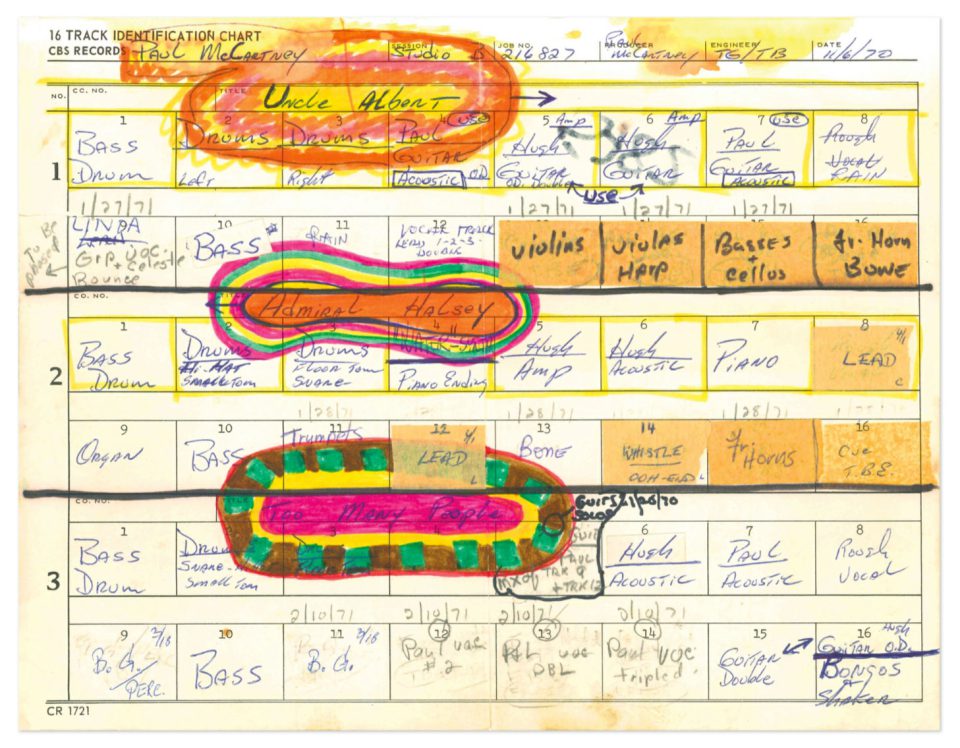
Too Many People: 11th November 1970
Three Legs: 16th October 1970
Ram On: 22nd February 1971
Dear Boy: 1st March 1971
Uncle Albert: 6th November 1970
Smile Away: 16th November 1970
Heart of the Country: 16th November 1970
Monkberry Moon Delight: 5th November 1970
Eat At Home: 16th October 1970
Long Haired Lady: 27th October 1970
Back Seat of My Car: 22nd October 1970
(A few other songs:)
Another Day: 8th February 1971
Oh Woman Oh Why: 2rd November 1970
Little Woman Love: 13th November 1970
I really don’t know why the Beatles Bible says that the album was started on 10th January 1971, because almost the entire album was done by then.
You’re right – I screwed up that part of the article and missed out some important information. It’s redone now, and I’ll check the individual song articles when I have a chance. Thanks for pointing this out.
Another Day was recorded on 12th October 1970 at CBS, New York, being the first track recorded at the sessions. David Spinozza only contributed guitar to Another Day, 3 Legs and Eat At Home. Oh, *and* Get On The Right Thing, ending up on Red Rose Speedway.
Hugh McCracken replaced him on 22th October, starting out with The Back Seat Of My Car.
I guess Lennon won that battle. You’d think McCartney would have known better.
Ram didn’t really carry ‘opening’ salvos. Lennon had already gone on record saying Paul’s first solo album, ‘McCartney I’ was ‘rubbish’. McCartney’s responses were very non-specific and minor compared to the attacks that had already been launched on his work.
Lennon won, if you think behaving in a way that will make people think you were an immature, vindictive bully is a victory.
There were no winners, least of all the fans. The politics of the music environment of the time saw RAM absolutely slammed and McCartney, always susceptible to a need for approval, turned away from the kind of work and the rich vein of creativity that RAM represented.
It was a really sad chapter in music history.
Its seen as uncool to like McCartney whereas cool to like Lennon;This album is great, brimming with creativity and its eclectic and its maybe his best post Beatles work. The production is superb several of the tracks are Brian Wilson influenced and it is an improvement on his 1970 effort “Mc Cartney”. John had described McCartney as rubbish and Paul responded with a few disguised digs back in Too Many People , Dear Boy and Back Seat ( we believe that we cant be wrong) John responded with How do you sleep? a far more direct viscious assault on Paul which I wonder whether he ever regretted. He was allegedly egged on by others in the studio with Ringo acting as a restraining force and there was some even more nasty stuff left off that track.
Dear Boy was about Linda McCartney’s first husband Joseph See.
Yeh I may have read this somwhere but its also commonly reported as one of the digs at John on this album. Not going to disagree though
I would imagine that true to Paul’s word Dear Boy was written about Linda’s first husband, however, I also suspect that even in Paul’s own mind it also turned to thoughts of John. So it’s both.
Two of Us was about Paul and Linda getting lost on a Sunday afternoon. But it wasn’t really…
Somehow, I could never wrap my head around this song being about Linda’s ex-husband. They divorced. It happens. Like about 50% of the time. No reason to sneer at someone for their lack of judgment. And didn’t he give up custody of his daughter Heather so Paul could legally adopt her? This song is as much about Joseph See as “Little Lamb Dragonfly” and “Jet” are about his furry friends.
I agree. Paul said he wrote the song to say to the guy, “Gosh, she’s amazing. I guess you didn’t get it.”
From People magazine at the time of Linda’s death: Back in Arizona she married a fellow student, Joseph Melville See, in 1962 (they had daughter Heather and divorced after three years). “Linda stood out,” says See, 60, a retired geologist who lives in Tucson. “I idolized her presence, her being.”
Never mind the fact that Linda left HIM. Also, Paul says he’s glad he never told Joseph See that “Dear Boy” was about him, because he later committed suicide. He may as well be singing the song to himself then (or more likely, John, with the “cutest thing around” being the Cute One). Because what is the point of addressing someone directly in a song only for the person to be completely oblivious.
I’ve only in recent years gotten into the Beatles solo works… And like you said it was always presented to me that Lennon ruled and McCartney sucked. As a result I put off getting much of McCartney’s work, especially Ram as most of what I’ve read slammed it. One night I’m at the store looking to add to my Beatles solo collection and the only thing they had was Ram, so I reluctantly bought it. Man was I pleasantly surprised, Ram is amazing. I can’t get enough of it! I don’t get all the hate for it, I think people got too wrapped up choosing between Lennon and McCartney and lost focus of what mattered, the music. They both wrote great stuff, they both had blah moments, enjoy both people! I learned not to let others reviews influence me, so often they have some form of bias in them. As the Beatles said, think for yourself! Now then, I’m gonna Ram On!
Indeed, there is a take of how do you sleep in which John Sings ‘ How do you sleep , you cunt ‘.
John bringing his “A” game with the lyrics. Don’t poke or poke back at him unless you don’t mind being referred to as a “cunt” or “twat” or both (see Sexy Sadie). Too bad part of John’s legacy is this kind of verbal (and physical) bullying.
Paul McCartneys best solo album ever. Monkberry Moon Delight is one of the most entertaining songs I’ve ever heard and Heart of the country is beautiful.
One of my favorite vinyl records to play.
Paul McCartney is still the best, he still plays today and i do not think John could of kept up. Even when John was alive McCartney was selling more albums than all beatles combined and trying different types of music and adding effect etc. McCartney tried all types of things and some worked and some didnt. But all bands changed as time went on. John was a good singer and needed Pauls imput to tone down some of johns later Beatles songs. John also didnt have the drive like Paul. Paul McCartney listened and learned as George Martin has said in the past. By 1975-6 Paul McCartney’s band WINGS was big that they could fill up stadiums anywhere and had smash hits and Number 1 albums. John Lennon rcould not keep up and didnt really change his music or add anything new musically except early on for the protest movement. That is why Paul sold way more albums than John. People buy what they want to hear and some people love John’s music. But i find alot of Johns songs downer songs that bring you down and I like feeling good and songs that pick you up, which McCartney is so good at doing. When John Lennon got shot it changed the way people looked at him and created the John Lennon of today that most think he was this nice, friendly, Peaceful and Loving Man who never ages or changes. This is all bull, he actually was a very mean spirited heroine addicted man that rarely played live music for any fans. If it was not for Paul McCartney playing and touring live for the last 50ish years their would be no reminder of the great Beatles songs. Paul has the better songs and beats out Lennon’s on sales every year. Also, Paul raised a family and supported all his children unlike John who moved away from his son in england and never returned once. His son grew up without John doing anything for him. This tells alot about a human being..
Is it John’s music or his character you’re attacking? Paul was more prolific but his best work wasn’t superior to John’s best work, in my opinion. Paul simply threw more stuff at the wall, and some of it happened to stick. Not all of John’s stuff is “downer” music and not all of Paul’s stuff is lighthearted, happy music. This Lennon vs McCartney argument, which never existed when they were helping each other be the best they could be while Beatles, is a huge turnoff when it comes to fansites like these.
This is an interesting album partly because of the music and of course the role some of the songs played in McCartney’s feud with Lennon at that time.I loved the US number 1 Uncle Albert/ Admiral Halsey when it was on the radio when I was kid. It is infectious and unmistakably in the vain of The Beatles Yellow Submarine. Smile Away is a great rocker , in the same way I love Another Days B side Oh Woman Oh Why. Like Paul McCartney’s first album it has received more critical praise in the fullness of time than what it got when it was first released.
I have always been a huge Beatles fan since I was 11,specifically a big highly impressed John and Paul fan and I started collecting their albums when I was 9,and I got my first Beatles book for 11th birthday,and I had every Beatles album by age 13.I was born after 1964 too. Bu I never loved this album like most people do and I really don’t understand all of the love for this album.And if it was the most Beatles sounding,as some people have said it is I would.I really think there are only 3 great songs on this album,the rocker Too Many People,Uncle Albert,and Back Seat of My Car.I think his 1975 Wings album Venus and Mars is his greatest post Beatles album and his best Wings album,and then Band On The Run,Red Rose Speedway and McCartney.
My older sister always said Ram was a good album,but she also bought Venus and Mars when it first came out and for years she said it was one of the best albums she ever heard and that it was really unique and that she knows no other album like it,and she had a very big diverse music collection of all different music artists.
“Ram” vies for the Number One spot on my list of Macca albums. Sheer inventiveness and playfulness abound, with such delightful shifts in genre and tone from one track to the next – and yet it all manages to come together as a unified whole. From the opening’s evocative and almost haunting quality (the sense of anticipation is palpable at the start of “Too Many People”) to the rousingly anthemic “we believe that we can’t be wrong” at the close (in “The Back Seat of My Car”), it’s little short of a masterpiece.
Highlights: “Uncle Albert/Admiral Halsey” is utter perfection, with its multiple songs within a song and its constant shifts in tempo and melody that manage at once to be sudden and perfectly natural. No matter how many times I hear it I am delighted by the surprises on offer. “Monkberry Moon Delight” is as nonsensically wonderful as anything Lennon ever did in that vein, with a blistering powerhouse of a vocal. I like to offer this one up to naysayers who claim that Paul wrote only bland commercial pablum. The humor and abandon in “Smile Away” is infectious – that one always makes me want to open all the windows in the car and scream with glee. “Heart of the Country” is a little piece of acoustic perfection, a gently playful ode to nature that foreshadows later Macca songs like “Country Dreamer” or “Tomorrow.”
Ram is no doubt my favourite Paul album, London town and Tug of war trailing behind. I’m not a dedicated Paul fan, but I enjoy good music and Ram is very good, the feeling is there,if ever there is a Mc Cartney album that’s close to the heart and not playing by the rules of the time it was recorded, that’s the one, far more interesting than its follow up, Wings wild life, that I also appreciate ( mostly side two ) with the heartbreaking “Dear friend”. It’s paul at his best!
Ram is a rather lousy album. The song material is weak, with the exceptions of Uncle Albert and the verse refrains of The back seat of my car.
There are some less than great songs on it. But you’re missing out by sticking with a rigid opinion you probably formed 40 years ago. Sometimes you have to listen TO things to get them, instead of AT them. The sound and feel of this album seems like it belongs between MMT and the White Album. Few ex-Beatle solo albums are as sonically and musically creative as this album.
*Too Many People
3 Legs
Ram On
*Dear Boy
*Uncle Albert/Admiral Halsey
Smile Away
*Heart Of The Country
*Monkberry Moon Delight
Eat At Home
Long Haired Lady
Ram On
The Back Seat Of My Car
Being “sonically and musically creative” does not help if the song material is less than good. Music listeners very often have a difficulty recognizing what is what in that respect. They are too easily impressed with the more superficial components of a song. The same goes for Paul McCartney, he often does not know for sure if he has written a good or a not so good song. That is the reason why at least 80 percent of his album material is in general a source of disappointment.
Ram is critically acclaimed now, even if it still has some negative reviews. But most modern day critics approve it (if that’s what you care about — it went platinum when it came out, so obviously many “music listeners” liked it). The thing that Joe mentioned about it being “sonically and musically creative” is important because of how Paul pre-dated modern music-trends with his early albums, and that’s important to music history’s timeline. The album McCartney is officially listed as one of the pioneers of the “lo-fi” movement and Ram is considered by many as an early example of Indie pop/rock.
Well, with Ram Paul pre-dated the catastrophic general drop in song material quality of the coming decade and thereafter, that is for sure. People have since then become so marinated in songs without musical and lyrical substance, that they can not tell good from bad.
It does not matter if the production is fantastic, without genuinely good song material I just can not be bothered.
Actually, “sonically and musically creative” can indeed help, even if the song material is less than good. Many, many examples exist of hit recordings of songs that, taken down to bare minimums of lyrics and melody, are not very good and even quite bad. Arrangements and inventive recording techniques can and sometimes do result in success for a less-than-stellar song.
Exactly, it is possible to fool many listeners into believing that a song is good when it is not. That is one of the problems with music of today,
Writing a good song is much harder, than putting effort into producing a song so that it becomes popular. A gilded turd is still just a turd, though, which the majority of music listeners have become brain washed into not hearing or understanding.
I liked this album from the first time I heard it on it’s release. I was kind of hoping I didn’t because I was a bigger John fan, but I thought it was a lovely work. I still don’t know why “Backseat of My Car” wasn’t a bigger hit. There’s lots of really good stuff on here. “Too Many People,” “Dear Boy,” “Monkberry Moon Delight” “Uncle Albert” the aforementioned “Backseat…” “Three Legs” “Heart of the Country.”
The back seat of my car was not a bigger hit because it is constituted of one good part, the verse-refrain which holds Beatles quality, and the “Looking for a ride…” part which is not good and does not fit to the mentioned verse-refrain. That is what you get when pairing a very good song part with a rather terrible song part: A not very good song.
I like the verse-refrain in The back seat of my car and Uncle Albert from the Ram album and noting else. Admiral Halsey is a bit of fun, but the “Hands across the water…” part is stolen from Donovan´s superior 1968 hit Atlantis https://www.youtube.com/watch?v=SAMYGzwUTK4.
Ram is my favourite McCartney album and favourite album of all time. I think critics were expecting a big Production album when The Beatles split , but he went the other way and did a home made , simpler Two Albums . John didn’t like it , but it was better than “Two Virgins ” etc.
Comparing Ram with the horrible Two Virgins is another way of saying that the former is not very good, I would say. Why not compare it to Revolver, Sgt Pepper or Abbey Road, that is a lot more illustrative and revelatory.
The only album credited to Paul and Linda McCartney. Maybe choosing that credit and the title RAM meant hitting back at John and Yoko.
Here is a sensible look at the quality of the solo beatles´albums, I agree with most of what is said. This guy can discriminate between good quality and bad quality:
Solo Beatles Overview | #162 https://www.youtube.com/watch?v=w_Z3_CWu0Hs
I think that the reason why they credited Ram to both Linda and Paul was economic strategical. Paul had problems earning money due to judicial disputes between the group members and between The Beatles and other actors. This did not affect Linda, though.
Each individual Beatle was great. But none, alone, would be among the top-ten “greatest rock soloists”. As a team, they exponentially blow past every other band. It’s just one of those things.