The Beatles Bible

The Beatles Bible
The Beatles Bible
  • Home
  • History
  • Songs
  • Albums
  • Discography
  • People
  • Features
  • Books
  • Map
  • Gallery
  • Fab forum
  • Store
  • Subscribe:
  • RSS icon RSS
  • Email envelope icon Email
  • Twitter icon Twitter
  • Facebook icon Facebook
iTunes & App Store
You are here: Home » Beatle people » Bill Harry

Bill Harry

  • Page 3 of 3
  • « Previous
  • 1
  • 2
  • 3
  • Next »

The second page of Mersey Beat's first issue, published on 6 July 1961, featured a biography of The Beatles written by John Lennon. It was titled 'Being A Short Diversion On The Dubious Origins Of Beatles (Translated From The John Lennon)', and was given to Harry shortly before the group's second trip to Hamburg.

Once upon a time there were three little boys called John, George and Paul, by name christened. They decided to get together because they were the getting together type. When they were together they wondered what for after all, what for? So all of a sudden they grew guitars and fashioned a noise. Funnily enough, no one was interested, least of all the three little men. So-o-o-o on discovering a fourth little even littler man called Stuart Sutcliffe running about them they said, quite 'Sonny get a bass guitar and you will be alright' and he did - but he wasn't alright because he couldn't play it. So they sat on him with comfort 'til he could play. Still there was no beat, and a kindly old man said, quote 'Thou hast not drums!' We had no drums! they coffed. So a series of drums came and went and came.

Suddenly, in Scotland, touring with Johnny Gentle, the group (called the Beatles called) discovered they had not a very nice sound - because they had no amplifiers. They got some.

Many people ask what are Beatles? Why Beatles? Ugh, Beatles, how did the name arrive? So we will tell you. It came in a vision - a man appeared on a flaming pie and said unto them 'From this day on you are Beatles with an 'A'. Thank you, mister man, they said, thanking him.

And then a man with a beard cut off said - will you go to Germany (Hamburg) and play mighty rock for the peasants for money? And we said we would play mighty anything for money.

But before we could go we had to grow a drummer, so we grew one in West Derby in a club called Some Casbah and his trouble was Pete Best. we called 'Hello Pete, come off to Germany!' 'Yes!' Zooooom. After a few months, Peter and Paul (who is called McArtrey, son of Jim McArtrey, his father) lit a Kino (cinema) and the German police said 'Bad Beatles, you must go home and light your English cinemas'. Zooooom, half a group. But before even this, the Gestapo had taken my friend little George Harrison (of speke) away because he was only twelve and too young to vote in Germany; but after two months in England he grew eighteen and the Gestapoes said 'you can come'. So suddenly all back in Liverpool Village were many groups playing in grey suits and Jim said 'Why have you no grey suits?' 'We don't like them, Jim' we said, speaking to Jim.

After playing in the clubs a bit, everyone said 'Go to Germany!' So we are. Zooooom Stuart gone. Zoom zoom John (of Woolton) George (of Speke) Peter and Paul zoom zoom. All of them gone. Thank you club members, from John and George (what are friends).

John Lennon
Mersey Beat

Bill Harry presumed that Lennon's spelling of McCartney's surname - McArtrey - was correct; it was written that way in a number of issues of Mersey Beat, including on the front cover of issue 13.

Delighted at seeing his words in print, Lennon gave Harry a huge number of stories and drawings, offering to let them be used as he wished. Harry invented the pseudonym Beatcomber, under which Lennon's articles were published. The Beatles were often guests at the Mersey Beat office, helping out, answering the telephone and typing.

I wrote for Mersey Beat. Some things went into In His Own Write, and I used to write a thing called 'Beatcomber', because I admired the column 'Beachcomber' in the Daily Express. That's when I wrote with George, 'A man came on a flaming pie...' because even back then they were asking: 'How did you get the name, "The Beatles"?'
John Lennon, 1972
Anthology

The first issue of Mersey Beat also featured an article on a local singer, Priscilla White, who also worked as the cloakroom girl in the Cavern Club. Unable to remember her name, Harry wrote "Cilla Black is a Liverpool girl who is starting on the road to fame..." Fortunately, Cilla liked the name and decided to keep it.

Mersey Beat, issue oneIssue one of Mersey Beat had a print run of 5,000 copies, all of which sold out. Bill Harry placed them with the three major distributors - WH Smith, Blackburn's and Conlan's - as well as local newsagents, music venues and record stores in and around the centre of Liverpool.

Among the shops which agreed to stock the newspaper was NEMS in Whitechapel, managed by Brian Epstein. He agreed to take 12 copies which quickly sold out, and more copies were ordered. For the second issue Epstein ordered 144 copies.

The second issue had a front page article about The Beatles' recordings in Hamburg. Intrigued by what he read, Epstein invited Harry into his office to discuss the local music scene, and asked if he might review new records for Mersey Beat.

The third issue featured the column 'Stop the World I Want To Get Off - By Brian Epstein Of NEMS'. Epstein also advertised in Mersey Beat; an August 1961 edition had a NEMS advert on the same page as a feature on The Beatles by Cavern DJ Bob Wooler. As a result, Epstein asked Harry if he could arrange a visit to the Cavern, putting in place a chain of events which led to Epstein becoming the group's manager.

The writing and photographs in Mersey Beat chronicled a formative period for The Beatles and the Liverpool music scene. Between 1961 and 1964 the magazine provided a unique record in the group's history. Local bands began calling themselves 'beat groups' and venues advertised 'beat sessions' and 'beat clubs'.

Mersey Beat's circulation continued to increase, and the paper began covering groups as far afield as Manchester, Birmingham, Sheffield and Newcastle. Once The Beatles found national fame, newspapers began referring to the Liverpool sound as 'Mersey Beat'.

Suddenly, there was an awareness of being young, and young people wanted their own styles and their own music, just at the time they were beginning to earn money, which gave them the spending power. Mersey Beat was their voice, it was a paper for them, crammed with photos and information about their own groups, which is why it also began to appeal to youngsters throughout Britain as its coverage extended to other areas.

The newspapers, television, theaters and radio were all run by people of a different generation who had no idea of what youngsters wanted. For decades they had manipulated and controlled them, but now the youngsters wanted to create their own fashions.

What existed on the banks of the Mersey between 1958 and 1964 was exciting, energetic and unique, a magical time when an entire city danced to the music of youth.

Bill Harry
The Encyclopedia Of Beatles People

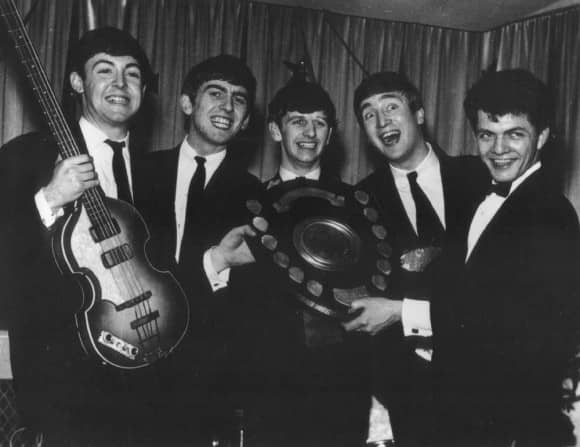
The Beatles with Mersey Beat founder Bill Harry, 1963Harry went on to manage The Four Pennies, who reached number one in 1964 with their second single Juliet. He and Virginia married and moved to London, where he had columns in Record Retailer, Weekend, Marilyn and Valentine magazines, wrote features for Music Now, and was news editor and columnist for Recored Mirror.

Later on he became a press agent for The Kinks, The Hollies and Pink Floyd, and went on to represent artists including The Beach Boys, David Bowie, Led Zeppelin, Suzi Quatro, Hot Chocolate and Kim Wilde. He also managed press campaigns for a number of major record labels including CBS, Charisma, EMI, Island and Polydor.

In the 1980s he returned to publishing and launched a monthly magazine, Tracks, which was the first of its kind to feature new album releases. He went on to write books, of which more than 20 have been published - many on the subject of The Beatles.

In 1994 Bill Harry was presented with a gold award for a Lifetime Achievement in Music by the British Academy of Songwriters, Composers and Authors (BASCA). He has advised on a number of documentaries on The Beatles and Liverpool's music, and was chosen by the British Council to represent them in Hong Kong to promote The Beatles.

He also works as chief consultant to Rock And Pop Shop, a memorabilia company which produces replica issues of Mersey Beat and art prints of front covers and other images from the magazines.

www.mersey-beat.com
www.merseybeat.co.uk
  • Page 2 of 2
  • « Previous
  • 1
  • 2
  • Next »
Related articles:

  • Mersey Beat launches
  • Radio: The Public Ear
  • Raymond Jones orders My Bonnie from Brian Epstein
  • Brian Epstein meets The Beatles
  • Brian Epstein

Leave a reply

Please note that there may be a delay before comments can be approved for publication. We reserve the right to edit for length and/or content. Comments not in the English language may be discarded, and offensive, irrelevant or spam ones will be ignored. For more information please read the full comments policy.
Click here to cancel reply.


  • Latest posts

    • Paul McCartney live at Zócalo de la Ciudad de México, Mexico City, Mexico
    • Paul McCartney live at Estadio Azteca, Mexico City, Mexico
    • Paul McCartney live at Estadio Omnilife, Guadalajara, Mexico
    • Paul McCartney live at Estádio da Ressacada, Florianópolis, Brazil
    • Paul McCartney live at Estádio do Arruda, Recife, Brazil
    • Paul McCartney live at Estádio do Arruda, Recife, Brazil
    • Paul McCartney live at Estadio El Campín, Bogotá, Colombia
    • Paul McCartney live at Estadio Defensores del Chaco, Asunción, Paraguay
    • Paul McCartney live at Estadio Centenario, Montevideo, Uruguay
    • World première of Paul McCartney's My Valentine videos
  • On this day in Beatles history

    • 2010: Paul McCartney to receive Gershwin Prize at the White House
    • 1969: John Lennon and Yoko Ono fly to Barbados
    • 1968: Demo recordings for the White Album
    • 1967: The Beatles watch Procol Harum perform in London
    • 1963: Live: Granada Cinema, Walthamstow, London
    • 1963: Radio: Pop Go The Beatles
    • 1962: Live: Star-Club, Hamburg
    • 1961: Live: Top Ten Club, Hamburg

    Want more? Visit the Beatles history section.

  • Twitter updates

  • Things we said today

    • Fred Schlip on Octopus's Garden
    • pinio65 on Germany discography
    • pinio65 on Germany discography
    • Cristobal on Picasso's Last Words (Drink To Me)
    • 48569 on Octopus's Garden
  • From the forum

    • Strongest Beatle per album in The albums
      By Long John Silver
    • top 3 macca post beatles albums in Paul McCartney
      By lettherebbeatles4ever
    • George's best vocal performances with The Beatles in George Harrison
      By meanmistermustard
    • Rank your favorite George songs (which he wrote or just sang lead vocals) in The songs
      By meanmistermustard
    • Sgt. Pepper in The albums
      By meanmistermustard
iTunes & App Store
  • Top Ten Club

    • Fab forum
    • Days in the life: The Beatles' history
    • The Abbey Road cover photography session
    • The Beatles' songs
    • The Beatles and drugs
    • The Beatles' albums
    • Abbey Road album artwork
    • I Am The Walrus
    • Israel discography
    • Beatles discography
  • Can buy me love

    The Beatles Bible is run for the love of anything and everything to do with The Beatles. If you've learned something new about the band and wish to show your appreciation, why not make a small donation via PayPal? It'll help with server costs, Beatles books etc...
  • Thinking of linking

    • thebeatles.com
    • johnlennon.com
    • paulmccartney.com
    • twitter.com/paulmccartney
    • georgeharrison.com
    • twitter.com/GeorgeHarrison
    • ringostarr.com
    • applerecords.com
      Beatles Bible logo by Yer Logos/The Beatles In 3D
  • Come together

    This site is in no way associated with or endorsed by The Beatles, Apple Corps Ltd, associated organisations or any members of The Beatles or their representatives. It is intended as a tribute to the greatest group of all time, to try - in a small way - to help introduce their music to new generations of fans.

© 2008-2012 The Beatles Bible. All rights reserved. | Contact us | About this site | Privacy policy

Top of page