
It sort of dawned on me that love was the answer, when I was younger, on the Rubber Soul album. My first expression of it was a song called ‘The Word’. The word is ‘love’. ‘In the good and the bad books that I have read,’ whatever, wherever, the word is ‘love’. It seems like the underlying theme to the universe. Everything that was worthwhile got down to this love, love, love thing. And it is the struggle to love, be loved and express that that’s fantastic.
Anthology
The song was written at Lennon’s home in Weybridge. After writing it, Lennon and McCartney drew a coloured lyric sheet.
We smoked a bit of pot, then we wrote out a multicoloured lyric sheet, the first time we’d ever done that. We normally didn’t smoke when we were working. It got in the way of songwriting because it would just cloud your mind up – “Oh, shit, what are we doing?” It’s better to be straight. But we did this multicolour thing.
Many Years From Now, Barry Miles
As he had on Help!, George Harrison contributed two songs to Rubber Soul: ‘Think For Yourself’ and ‘If I Needed Someone’. He also played a key role in the studio collaborations, suggesting a number of arrangements and instruments which defined the sound of the album.
Harrison’s love of American soul and R&B influenced the guitar and bass lines on ‘Drive My Car’, which were inspired by Otis Redding’s ‘Respect’. His burgeoning interest in Indian music, meanwhile, found an outlet in Norwegian Wood’s sitar part – one of the first times the instrument had been used in a Western pop song.
Ringo Starr wasn’t being left out either. He secured his first songwriting credit for ‘What Goes On’, which was uniquely attributed to Lennon-McCartney-Starr. At a press conference in 1966 Starr described his contribution as “About five words, and I haven’t done a thing since!”
The Rubber Soul sessions yielded only one unreleased song. ‘12-Bar Original’ was The Beatles’ first instrumental since the group signed to EMI in 1962, and was a largely unsuccessful attempt at an R&B/soul recording in the style of Booker T and the MGs.
‘12-Bar Original’ was recorded in the early hours of 4 November 1965, after The Beatles had recorded ‘What Goes On’. Their first attempt broke down, but the second lasted 6’36” – an edit lasting 2’55” was eventually released on Anthology 2.
In the studio
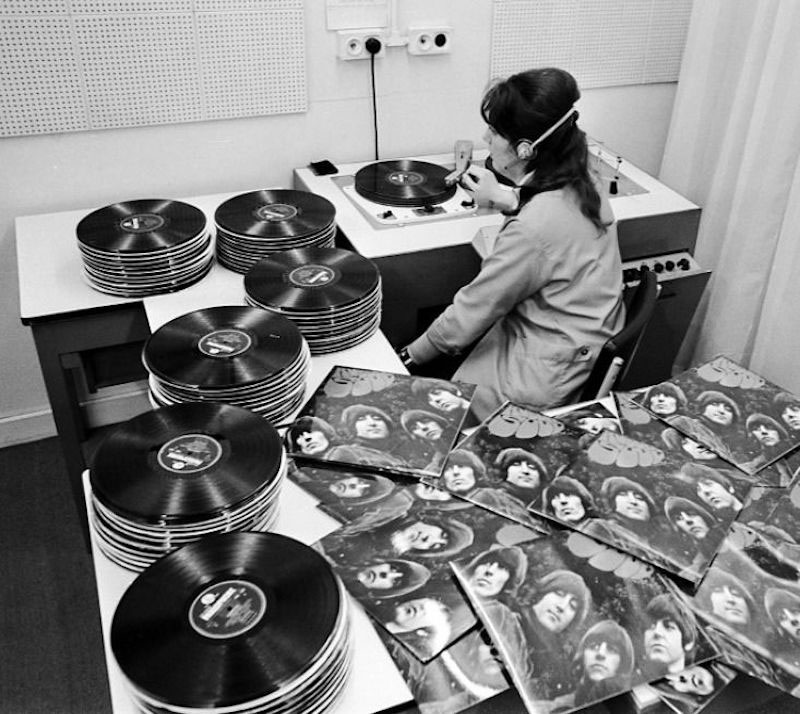
Remarkably, Rubber Soul was recorded in just four weeks, in time for the 1965 Christmas market.
We were getting better technically and muscally, that’s wall. We finally took over the studio. In the early days we had to take what we were given. We had to make it in two hours or whatever it was. And three takes was enough, and we didn’t know about ‘you can get more bass,’ and we were learning the technique. With Rubber Soul, we were more precise about making the album – that’s all. We took over the cover and everything.
Lennon Remembers, Jann S Wenner
Recording began on 12 October 1965; the first song to be worked on was Lennon’s ‘Run For Your Life’, which he later described as his “least favourite Beatles song”.
Working closely with their producer George Martin, on Rubber Soul The Beatles began to expand the musical palate of pop music. They used Greek-style guitar melodies on ‘Michelle’ and ‘Girl’, added a fuzz bass part to ‘Think For Yourself’, and added a sitar to ‘Norwegian Wood’.
The album’s most celebrated musical part, however, was George Martin’s piano solo for ‘In My Life’. This was taped at half speed, then when played back at a normal rate sounded similar to a harpsichord.
Martin originally tried the solo on a Hammond organ, which didn’t give the desired effect. He then switched to a piano, performing the solo slower and an octave lower than it sounds on the final version.
I did it with what I call a ‘wound up’ piano, which was at double speed – partly because you get a harpsichord sound by shortening the attack of everything, but also because I couldn’t play it at real speed anyway. So I played it on piano at exactly half normal speed, and down an octave. When you bring the tape back to normal speed again, it sounds pretty brilliant. It’s a means of tricking everybody into thinking you can do something really well.
Sounds Of The Sixties, BBC Radio 2
The title
Although it may have appeared somewhat opaque to 1965 listeners, the title Rubber Soul referred to the perception of The Rolling Stones’ Mick Jagger among black blues musicians.
I think the title Rubber Soul came from a comment an old blues guy had said of Jagger. I’ve heard some out-takes of us doing ‘I’m Down’ and at the front of it I’m chatting on about Mick. I’m saying how I’d just read about an old bloke in the States who said, ‘Mick Jagger, man. Well you know they’re good – but it’s plastic soul.’ So ‘plastic soul’ was the germ of the Rubber Soul idea.
Anthology
The studio quote can be heard at the end of take one of ‘I’m Down’, included on 1996’s Anthology 2.
That was Paul’s title, it was like ‘Yer Blues’, I suppose, meaning English soul. Rubber Soul is just a pun. There’s no great mysterious meanings behind all of this. It was just four boys working out what to call their new album.
Lennon Remembers, Jann S Wenner

their first truly amazing album!
Yeah. Their first collection of songs that seem to work together on the album somehow, they make the album seem to have a concept or something
Their first albums were AMAZING too but they put fill-in songs, which they stopped doing after Rubber Soul, or Revolver
Its incredible the way they progressed so fast, in every aspect a musician could
Even their fill-in songs were fab in their own way, eh?
Absolutely. The group had a very tight time schedule, with recording sessions, tours, concerts, radio- and TV shows, photo sessions, movies, etc. They had very limited time to write songs, and still they made songs of very high quality. The group’s cover versions were greater than the originals. That’s my personal opinion.
Rubber Soul is a very high quality hit album from start to end. Beatlemania was on its’ peak, and the pressure on the group was thereafter. EMI wanted the album to be released in time for the Christmas shopping. That may have increased the pressure on the group.
Yep, funny how a group can be so damned good in order to accomplish that.
Its was Johns last hurrah as head honcho before Paul started to dominate… All good… It was always the Beatles anyway… John made a big recovery on The White Album And also Abbey Road but their creative processes were so intertwined that its not only difficult but also unnecessary to separate them out
from each other That unity and synergism was what made them the Beatles. These were guys who loved each other for the most part.
Sorry but how do you know what they felt for each other? It’s presumptuous to pretend to know what they felt.
I agree. It was the first Beatles album I bought. I also thought Revolver was fantastic. This time of Beatles was the transition from the love song Beatles to the latter modern Beatles. Also the beginning of the most underrated Beatle George Harrison who later became the most successful of all of them after all went solo. The began to explore new sounds. The sitar is introduced along with other strange guitar sounds. They made seagull sounds on Revolver ‘I’m Only Sleeping’ with some backwards track sounds as well. It becomes more obvious that drugs are influencing their music ‘Dr Roberts’. These two albums are my favorite Beatles albums of all. It’s a difficult choice.
Whoa! George Harrison became the most successful?? That’s a bit of a stretch considering how McCartney was so prolific in both albums written and released & who had the most song on the music charts; I do admit that George’s work had much more depth & I certainly appreciate his music much more, but you cannot argue with what McCartney accomplished.
They progressed and responded to the amazing competion they had at the time on both sides of the Atlantic.
Could’ve conceivably been my favourite album if it didn’t noticably fizzle out near the end with a couple of middling songs. They were new to the art of constructing capital-“A” Albums, and consequently hadn’t thought to create a super-spectacular mindblower of a closing track along the lines of “Tomorrow Never Knows” or “A Day In The Life”.
Hey, Run For Your Life isn’t bad!
Quite right Lukey, but it’s definitely in another (inferior) league with respect to the two ones mentioned by our friend Von Bontee!
Just bung “Daytripper” on the end and voila! It even leads nicely into Revolver. I’ve put “We Can Work It Out” after “You Won’t See Me” to round it out.
We here in the U.S. really like the Capitol release on vinyl. Especially the “East Coast/Dexterized” version with the added reverb. This variation of the album is rare and is not included on the Capitol albums box set.
You can spot this particular version of the album by looking in the “dead wax” on the record. If it has IAM in a triangle following the matrix # and “The Beatles” listed on the label (the first edition has the Beatles individual names only), it’s a Dexterized version.
Man, I never heard of ANYbody who likes that fake stereo – uh, excuse me, “Duophonic” sound! Give me pristine stereo or mono anyday.
Well this particular lp was in true stereo, not Duophonic. I do have some Capitol lp’s with some songs in Duophonic and I agree with you…not the greatest sound.
Ah, I see. I assumed that by “Dexterized” you meant Duophonic – he’s the one who usually gets the blame for that process.
You can almost smell the pot on this album! I’ve heard on the Anthology DVDs that this was probably one of there most favorite albums. A great collection of songs, front to back. I think after this one and Revolver their albums seemed a bit patchy, they still had great songs on them but it became more individual. They didn’t seem to work together as much. Really either the end of an era or the beginning.
This was the first Beatles album I ever bought. It had just come out and I bought with my 9th birthday money.
I bought Rubber Soul and Help that day. I remember being amazed (even as a 9 year old) at the incredible musical differences between the two albums.
Plus the Rubber Soul cover – didn’t even have their names on it – just those incredible four faces! it was all you needed.
Their best album in terms of song quality, the problem, maybe, is that there’s no remarkable end that the next two albums offered. But that’s also why I love this album, you can start it anywhere and end everywhere. It just flows really well.
I was nine when this came out, and it was my second LP (my first was With The Beatles). I played them both morning, noon and night!
Rubber Soul was the first time I realised that The Beatles had an appeal beyond kids and teenagers. I was dragged along to visit some of my mother’s friends – they were school teachers – and to my amazement THEY had Rubber Soul!
Rubber Soul features such a great collection of songs, it’s hard to separate it sometimes. It’s my second fav behind “Pepper”. They never had better harmonies than on this album. “In My Life” was Lennon’s greatest majority work in my opinion & “Norweigan Wood” isn’t far behind. It was a revolutionary sound for them with the sitar, at the time & it really stands out still even after their studio years. It does kind of just flow along, but I think that some of their most underrated songs are on this album, like “You Won’t See Me”, “Wait” & “You Won’t See Me”. Love this album.
Heh, you like “You Won’t See Me” that much, eh? 🙂
I really do. I think it was the best usage of Paul’s double tracking of his voice until he did “Penny Lane”. Also, John & George were great in accenting background vocals. It was their most complex instrumental song, but vocally it stands up with anything of that period.
Well, my point was that you mentioned it twice in that one sentence! (Or was that intentional?…)
(Anyway, don’t worry, I think it’s good enough to be listed twice, too.)
You Won’t See Me is so great! Extremely underrated.
I also don’t understand how none of the Beatles liked Wait. It’s so beautiful, it puts a weird pit in my stomach like I’ve achieved nothing.
yes, exactly! its almost like whatever kind of music you ‘crave’ you can find it on the album.
This is another where I think Capitols bastardizing of the albums worked in the Beatles favor. I’m sure I would have loved either tracklist. But having grown up with the leather-and-suede acoustic feel of the American Rubber Soul it is downright DIFFICULT for me to play the british version all the way through. What Goes On is, to me, simply a travesty in the world of Rubber Soul. Drive My Car and Nowhere Man are good tracks — Nowhere Man a great one — but the Capitol album is just so much more COHERENT a collection of songs.
It is interesting that UK versions have now taken over because when a lot of people refer to Rubber Soul historically they are talking about the U.S. Capitol version. That is the collection of songs that inspired Brian Wilson not the Uk one. I remember listening to the warm “I’ve just seen a face” a staring at the pictures on the back of Rubber Soul and my mind just being blown. Opening track on the uk version is “Drive my car”, it just doesn’t work for me as the Rubber Soul feel. Should have been strictly a single.
It is amazing how John dominates 1965 with major achievements like Help, Ticket to Ride, You’ve Got To Hide Your Love Away, Norwegian Wood, Girl, In My Life, Nowhere Man (I know Paul helped with some of these but they are definitely John songs). Paul taking a back seat with exception of Yesterday writing filler tracks like The Night Before, Another Girl, You Won’t See Me etc. But I feel John takes a back seat to Paul in 1966 (I think Paul’s years are 1966 and 1968).
The combination of John’s disillution with his marriage to Cynthia and his motivation being somewhat dulled by his prodigious intake of acid are the two main reasons that Paul took over as the central focus of the band during 1966/67 and its de-facto leader. And once John met Yoko…well, that meant more to him than anything else. Oddly, though, the ‘White Album’ was the one exception in the later part of the Beatles’ career where John’s songwriting became front-and-center again.
I agree with you 100%!!! Whenever I hear the UK version I’m disappointed. The album really flows much nicer on the US version!
Yes, starting off with “I’ve Just Seen a Face” on the U S. version seemed to signal a sharp change in The Beatles’ sound. That song appeared the preceding August on the Help! album (side 2, the non-film side) in UK.
Yeah, the yanks are always there with their attempts at oneupmanship. They cracked the Enigma code (so would one of their trash films have us believe), then TAUGHT the Beatles (who were of course yanks anyway, as everybody knows) how to put albums together. Talk about “bastardising” and “travesties”!
The Beatles discovered black American music and sold it back to the Americans
OK, maybe you could lose What Goes On, but Drive My Car, Nowhere Man and If I Needed Someone are among The Beatles’ finest songs. I wonder if Capitol really ‘got’ The Beatles. Bad enough they ignored the early songs, but the butchering (or bastardizing!) was uncalled for here. I wonder how The Beatles themselves felt about it. Joe?
The following comment is regarding Julio’s preference for the US edition of ‘Rubber Soul’. I thought it would be listed right after his comment, but apparently it hasn’t.
I don’t agree. The UK version is the way the Beatles intended it to be, and the Capitol version cuts out three of the album’s best songs — “Drive My Car”, “Nowhere Man” and “If I Needed Someone”. Yes, “What Goes On” is the weakest track on the album, but it’s certainly better than later Ringo songs like “Yellow Submarine” and “Octopuss’ Garden”. Besides, “I’ve Just Seen a Face” and “It’s Only Love” were recorded earlier for the UK ‘Help!’ album, and they fit in just fine on that record. Capitol always bastardized the early Beatles albums, and once you hear the UK versions in their full, intended presentations, you don’t want to go back. At least I don’t.
Although I post an alternative fantasy Capitol scenario (in another posting) which keeps DmC, NM, and If I Needed… (I completely agree with you about those three songs), I do generally agree with your assertion that Capitol bastardized the Beatles’ artistic intentions by chopping things up.
On the differences between the U.S. and U.K. versions of “Rubber Soul.” Since I discovered the Beatles, really, when “Pepper” came out in 1967, I never really heard the U.S. version as a whole although I grew up in the U.S. There are clear disappointments with the U.S. version, most notably, two of the best songs–“Nowhere Man” and “If I Needed Someone”, have been removed, as well as the very creative “Drive My Car”. Capitol would have created a better product by knocking off “Wait” and “Run for Your Life” (RfYL is a weak ending to an album packed with masterpieces; even Lennon himself claimed that it was one of his worst songs).
I do think that “I’ve Just Seen a Face” does work well as an opener on the U.S. album. Many have argued that because of this, the U.S. version has a more “folky” flavor, but replacing “What Goes On” with “It’s Only Love” reverses that feel, since “What Goes On” has more of a country sound (I’m not crazy about either song). Though I’m not a fan, generally, of Capitol’s practice of chopping up Beatles albums and creating new hodgepodges, since they were going to do it ANYWAY, here’s what they should have done (since they changed track order, I did too, to create what I think would have been a more coherent album without losing two of its best songs and including the two singles that were released on the same day). Keep in mind that Capitol albums would only have 6 songs per side, not 7.
Side One:
“I’ve Just Seen a Face”
“Girl” (a great song that works anywhere on the album but links thematically to IJSaF)
“We Can Work it Out” (not on the original album but released as a single the same day)
“Drive My Car” (after three more “folky” songs, moves to a harder rock feel)
“Day Tripper (maintains the harder rock feel)
“Norwegian Wood” (one of Lennon’s masterpieces, worthy of being a side closer)
Side Two:
“Nowhere Man” (a much stronger side opener than either “What Goes On” or “It’s Only Love”
“I’m Looking Through You” (picks up on the theme of “sight” that’s address in “Nowhere Man”)
“You Won’t See Me” (keeps the theme going)
“Michelle” (beautiful melody, uninspired words–would sound better if the whole thing were in French)
“In My Life” (another masterpiece, could be the album closer if the last chords were more assertive and final sounding)
“If I Needed Someone” (one of Harrison’s best ever)
So as you can see, I knocked off “Wait”, “Run for Your Life”, “What Goes On”, and “Think for Yourself” (not a fave), and “The Word” (which I think is overrated). I know that many will take issue with these choices, especially the last two (which I’d leave on if I were producing a 14-track album). This is just a thought exercise anyway.
I didn’t mean to imply that my choices were superior to those of the Beatles, who remain the last word in their artistic creations. I was just trying to say that if I were the producer at Capitol and had to chop up the album, I would have done it differently and more creatively.
Drive my car
Norwegian wood (This bird has flown)
I´m looking through you
Nowhere man
Think for yourself
The word
Michelle
Day tripper
What goes on
Girl
You won´t see me
If I needed someone
We can work it out
In my life.
John’s output in 66 & 68, while not as catchy or single-worthy as Paul’s, was awesome and inspiring nonetheless:
I’m only sleeping, Tomorrow never knows, Dr. Robert, She said she said, And your bird can sing, Happiness is a warm gun, I’m so tired, Revolution, Glass Onion, Dear Prudence, The continuing story of Bungalow Bill, Julia, Yer blues, Everybody’s got something to hide except me and my monkey, Sexie Sadie, Cry Baby Cry, Goodnight.
There, Jammy. I think that, given the impossibility of picking the best Beatle song, I can’t squeeze the shortlist any tighter than four “best songs”, to wit: Dear Prudence, Happiness is a warm gun, Yer blues and Oh! Darling. Three of these are Lennon’s, and from the period you mention. John was an extreme talent, but his disorganisation and tendency to laziness dragged his career down when he lost (dumped) his three wonderful colleagues. And yet, he somehow managed to turn in gems like Woman is the n—-r of the world and Steel and glass. If only he could have kept Paul’s coherence, attention to detail and dutifulness (virtues he once had had, for example by the time of A hard day’s night), John would have cut a really amazing solo career. And, if only he had stayed away from Phil Spector…..
You Won’t See Me is a hidden classic. Harrison has two gems here. About the only thing off-putting are the lyrics on the last song on side two, but the playing on that song and the melody are quite good.
You won’t see me is one of there best songs that nobody knows about. All people ever know are “Come Together” and “All You Need is Love”
The “Rubber Soul” album released in the United States did not have “If I needed Someone” on it, nor “Drive My Car.” “If I needed Someone” was the song right after “And Your Bird Can Sing” (my FAV on the album) on “Yesterday and Today,” the butchered babies album that got covered up with a more “respectable” cover. I have one of the butchered babies albums but alas, I was just a kid and it looks like a kid tried to get the cover-up off by herself. In other words, it is a mess. “Drive my Car” was also on the US release album “Yesterday and Today.” “I’m only sleeping” was the second song after it. I wish we could buy CDs with the same songs on the original US release albums, but I’ll be thankful for what we can get.
What d’you mean “the original US release albums”, Freak? The original Beatles albums are those issued in the UK. Calling a mish-mash including “Drive my Car” followed by “I’m only sleeping” (separated in fact by a full EIGHT MONTHS) an “original” is only a token of how deluded and wide-of-the-mark of reality yanks are!!!
I truly love this album. Every song is perfect, and that is very rare. I like Abbey Road and Revolver, but I’d say this was their masterpiece. Album openers don’t get much better than ‘Drive My Car,’ one of the funkiest things they ever recorded. Four white guys from Liverpool sounding like four black guys from Detroit!
This has always been one of my top 10 albums of all time in either the UK or folkier US incarnation. The songs are superb. I love the variety of sounds and the economical arrangements. And the performances have a relaxed confidence. The one thing I don’t really like is George Martin’s famous ersatz baroque solo in “In My Life”, especially the end of it when it smashes into the middle eight. But that’s a small thing. Wall to wall this is a truly great album.
The songs on this album – RUBBER SOUL – by The BEATLES -In MY opinion is the most QUANTUM – LEAP in the history of POP MUSIC – To me I feel that here the Beatles were totally ahead of any one on the EARTH that was writing songs – This RUBBER SOUL album is the TURNING POINT in Pop Music HISTORY – all 12 songs on the U.S. album and 14 on their U.K. release show how their minds(the Beatels’) were so far advanced from anyone on Earth – Joe Nania A.K.A. Hollywood Joe
I much prefere the uk track listing to us. I cant imagine the album opening with any track but drive my car. Song for song one of there better albums. I enjoy so called filler such as wait, word, run for your life just as much as in my life and Norwegian wood.
I still agree with George Harrison that Rubber Soul & Revolver could have been album 1 & 2. Yes Revolver is a great LP, but Rubber Soul is the album that they matured. Matter of fact, Rubber Soul had 6 hits on the 1962-66 Red LP, while Revolver only had 2.
I hadn’t realised that Rubber Soul was the album with the most tracks included on either of the red or blue albums, which is impressive when you consider that the WCWIO and Day Tripper were also included to give 8 tracks from late 1965!
In retrospect the Revolver selection does seem ridiculously skimpy, with just the 2 tracks issued as a single, and only the A side of the Paperback writer single to give a meagre 3 tracks from 1966
It certainly would have been an awesome double album. The only problem with that is I enjoy them separately to more independently observe the beatles growth in almost every way imaginable present on both lps.
I got this in 1979 for my 13th birthday,36 years ago tomorrow!! I also got the album A Hard Days Night. Rubber Soul was a landmark at the end of 1965 when The Beatles, The Stones, The Who, Bob Dylan,The Beach Boys and The Byrds were all seemingly competing with each other and producing classic albums and singles. When I first got it; for quite awhile after it was my favourite Beatles album, though over the years that opinion has chopped and changed. Rubber Soul mixes folk rock, classic pop and ballad and country with some of the best harmonizing courtesy of John, Paul and George. Harrison matured as a song writer on this with If I Needed Someone and Think For Yourself. Pauls Michelle and You Wont See Me are classics. John Lennon was on a real roll on this album with brilliant numbers like Norwegian Wood,Girl, Nowhere Man and one of his greatest works In My Life. The latter is one of my favourite songs of all time with a timeless message that we can all relate to. I just love The Word and Run For Your Life, even though Lennon himself was critical of the latter years later. Drive My Car, another great song. This is one of the greatest albums of all time.
Does anybody happen to know if they were inspired by a Dylan song/album specifically? I was always curious about this..
@J.D. Lyle: In the Anthology George says that they listened excessively to “The Freewheeling Bob Dylan”, in Barry Miles’ “Many Years From Now” Paul also says that they all had the first Dylan LP and that Lennon actually adopted his black cap (that leather thing he used to wear in 1964) from the cover of that LP. I read somewhere, but don’t know if Lennon said so himself, that the “Another Side Of Bob Dylan” – LP influenced Lennon to write more personal and introspective songs. I get the impression that they were all big Dylan fans (especially John & George) and pretty much owned every album he issued at the time.
By the way: Dylan was a big Beatles fan as well – he later “confessed” that he didn’t dare to say so at the time because to his purist folk hipster friends they were sellouts that represented the bad bad establishement (the same “friends” that turned on him when he went electric – a move probably inspired by the Beatles and/or the whole British invasion).
To me from a songwriting point of view Rubber Soul is their best album. I don’t think Rubber Soul and Revolver are like part 1 & 2 although there is of course a connection between those albums. Rubber Soul is folky, sparse and laid back. It works very well as a unit. Revolver is very diverse and every song seems to come from a totally different place (look at the first 4 songs: Taxman, Eleanor Rigby, I’m Only Sleeping, Love You To – 4 songs 4 genres) – hearing it nowadays it almost feels like a sampler compiled to demonstrate the diversity of the group. Regarding that it’s more like a forerunner of the White Album. Some tunes could indeed have been on both albums but having Tomorrow Never Knows on Rubber Soul is unthinkable.
The Beach Boys made Pet Sounds a response to this album, trying to top it. You can really hear the similarities. Most great albums rise emotions and peak at the end, this one sounds like it’s about to peak after If I needed Someone, and just all falls apart at Run For Your Life. Pet Sounds does the same at Here Today, and starts falling at I Just Wasn’t made for these times.
Interesting to ponder: did the Beach Boys hear the U.K. version of the album or its chopped-up U.S. counterpart?
In a couple of interviews I’ve seen with Brian Wilson he refers to the “folky” sound of the album. I’d therefore assume he meant the U.S. version
and therefore wouldnt have heard If I needed Someone.
I love The Beatles. They are the best band of all time. Sgt. Pepper, Revolver and Abbey Road all find a place in my top 5 favourites of all time. The Double White makes it 4 in the top 10. But, I’m sorry. I don’t understand what’s so great about this one. It’s not in my top 20. I don’t come close to seeing any “concept” in here. It seems like a great big leap from this to Revolver for me. I want to, but I just don’t connect.
What makes “Rubber Soul” such a great album, in my opinion, is not the “concept”, but (1) the collection of some of the best song-writing the Beatles ever displayed, particularly Lennon’s “Norwegian Wood”, “In My Life”, “Girl”; McCartney’s “I’m Looking Through You”, and Harrison’s “If I Needed Someone”, (and the melody, if not the words, to “Michelle”) (2) the increased willingness to experiment with harmony and texture in songs like “Drive My Car”, “Norwegian Wood”, “Nowhere Man”, “Girl”, and “If I Needed Someone”, and (3) the use of new techniques in the recording studio in just about every song. It doesn’t necessarily hang together as a complete album the way “Revolver”, “Pepper”, or even “Abbey Road” does, but most of the parts are worth listening to the whole.
The relative virtues of the Brit and US versions of “Rubber Soul” are infinitely debatable, obviously. I heard the US version first, but have long since owned both. I suppose I like the British original better, in part because that’s the one the band members created and preferred. But, as much as I love “Drive My Car,” it seems sonically out of place on the overwhelmingly acoustic Brit version. Capitol did find a compatible opener in “I’ve Just Seen a Face.” And “Nowhere Man,” though it’s beautiful melodically, is preachy and feels to me out of place among all those love songs. Here again, Capitol’s trim makes a certain sense. I actually like “What Goes On” as a record even if it is the weakest “song” on the British “RS.” But that’s a defensible trim too. What I wish Capitol had done, if it just had to cut one more, is leave George’s second “RS” song on the record and remove “Run for Your Life,” an early blast of Lennon misogyny. It hasn’t aged well.
I have read that part of reason for the “bastardization” of Rubber Soul in the U.S. format (apart from fleecing the public with shorter and more albums) was that with the new popularity of the Byrds and American Folk/Rock, Capitol were creating the Beatles Folk/Rock album. Ironic then that they left off “If I Needed Someone” which has Harrison recreating his own Byrds sound with his won “jingle-jangle 12 string guitar sound.
Even after 30+ years of having the “proper” edit of “I’m Looking Through You”, it still – to this day – startles me when the song starts without the two false-starts. LOL!
So happy Wait was resurrected from help sessions. Had it not been, Wait would have been their best unreleased track. As it is I feel Leave My Kitten Alone is there most solid unreleased track and should have been used on Beatles For Sale as it is better than half the tracks on BFS.
It’s pretty clear in my life was a cowrite not just Lennon
In my opinion, Rubber Soul is the Beatles best. Wait and If I needed someone are seriously underappreciated. Run for your life is an the only average song with a deeply disturbing subject matter that is glossed over in the beatles myth.
My favourite nowadays, but I believe that’s only because I over-listened Sgt. Pepper’s and Abbey. Magical Mystery is equal favourite nowadays as well with Rubber. I always thought Rubber was far better than Revolver, in-fact Revolver is easily my least favourite of the Rubber and onwards albums. Still love it a ton though. Rubber Soul has the best harmonies and is the perfect transition album. Songs like Michelle, Girl (underrated) and Norwegian Wood are among my favourites and George really shines on this album with some of the best here with If I Needed Someone, his incredible contribution to Norwegian Wood and Think For Yourself. It’s also the second best in terms of sound quality oddly enough right behind Abbey Road. Not sure why. The silly vocals to the right thing and it being quiet on Norwegian Wood, similar to the song Sgt. Pepper’s is a real shame though. Can’t stand that. All in all one of my favourite albums and nowadays my favourite Beatles album tied with Mystery Tour.
I’m with you on that. Von Bontee makes and excellent point about having a great closing track. Having a great opener goes without saying for the marketing point of view – but a great closer is equally important from the artistic point of view.
It not so subliminally suggests ‘there’s plenty more where this came from so if you like it, start saving for the next album’! Run For Your Life is not a great song, it’s anything but positive and is not blessed with either great harmonies or great bass-playing. If I’m going to listen to Rubber Soul and Revolver back to back (which I often do) I sometimes kill it and move on. Wait is pretty good (good drumming) and IINS is one of my all-times faves so Side 2 always gets played – just not RFYL. A brave song in some ways, just not a good song. I suppose it reveals a true side of John that we wish wasn’t there. He knew it was true and showed some courage in revealing it. Shame the others didn’t veto it pressed John to come up with something better – much better. He certainly had it in him. They were beyond covers by this stage but I’d sooner listen to John doing Money or Please Mr Postman than this track. It Won’t Be Long of course is another far better song that comes to mind though John was moving away from rock’n’roll in some ways and going into himself from where so many great, great songs would emerge.
One of my first Beatles album experiences was listening to my mother’s US Rubber Soul that I “acquired” (stole) during my burgeoning Beatle-obsessed teens. Even though I’m a ’90s kid that’s grown up only knowing them on cassette/CD I absolutely loved it, and I completely agree with all those that say it’s superior to the UK version. (Though I would add the missing songs from the UK version plus Day Tripper and We Can Work It Out to my personal playlist — I’m greedy. 😉 ) My dad still has that album, and if I only had a turntable I’d rescue it.
When I was a kid, I was always buying their albums in the U.S. version; so I get thrown off now by songs on Rubber Soul and Revolver.
Either way, my top two favorite albums of theirs…well, that changes from time to time, though. 😀
Amazing amount of rubbish commentary, as if some of these musos had the credibility to criticize anything. Attempting to criticize ¨Run for your life” , as if the only good Beatle song must be a happy, cheery one (?)… Its a powerful kick in the face, with great harmonies and clever guitar, which I challenge the “critics” here to come up with something 1/10 as good. There certainly are Beatle songs that I dont like, but I wouldnt, and Its complete buffoonery to make Statements such as “Its A weak closing song¨… Until you present something better, ANY Beatles song is far superior to anything you produce, as a false “Beatle elitist”.
A silly and childish comment, to be honest. “Rubbish” because YOU don’t agree? And the old saw of “Let’s hear you do better” is as ridiculous and irrelevant as it sounds.
“Run…” is not a great song at all – IN MY OPINION. It’s loud and has a beat. So, what? It’s listenable, but not much more.
While your passion is perhaps commendable, I cannot endorse the notion that only those deemed to be brilliant composers and musicians have any right to be critical of a piece of music. I mean, if this were true, how would it ever be determined what people were creating great music in the first place? Perhaps more importantly, people do not have to be brilliant composers of music to enjoy music.
I agree, one should not have the right to express any opinions. We need less democracy in the world.
A great album and a massive achievement for such an incredibly busy touring group to come up with 14 original songs for it, indeed the first time they’d done this as previous albums had either included covers or in the case of A Hard Day’s Night the A and B sides of previous singles
“Rubber Soul” is one of the best albums ever made in British 60’s music as well as one of The Beatles’ best out of their discography. It was absolutely the right thing for The Beatles to develop and grow up musically and artistically; otherwise, their music would’ve sounded boring and outdated.
The innovations and new ideas during the sessions consisted of Paul using a capo on his bass part on “Michelle” and using a fuzzbox on his bass for “Think for Yourself”, Ringo playing two-vamp notes on a Vox organ on “I’m Looking Through You” (incorrectly credited as Hammond organ in the liner notes), George playing a sitar on “Norwegian Wood”, John and George began to frequently employ capos on their guitars with Paul doing likewise on “Michelle” as well as his bass and George Martin playing a piano solo on “In My Life” at half-speed to give it a harpsichord-like timbre upon playback at normal speed.
The song “Michelle” featured an interesting composite of four different guitar parts – 6-string acoustic guitar (Paul), nylon-string acoustic guitar (John), 12-string acoustic guitar (George) and electrified 6-string acoustic guitar solos (George). In addition, Paul used his new left-handed Rickenbacker bass for the first time over the course of the sessions and he increasingly gravitated towards it for recording, but he still used his left-handed Höfner as well.
John, Paul and George took their songwriting in new directions as well and Ringo got his first co-writing credit on “What Goes On”.
I have been through three vinyl copies of the album.
I remember listening to my parents and their friends talk about this record and the divide between all the records before and after Rubber Soul. All the straightforward loves songs are gone and personal and reflective songs appear. Instead of sounding closer to the 50s, new and exciting genres and sounds are explored and obviously the big influence over everything was weed. In My Life is one of the best songs ever written and George really starts coming into his own with If I Needed Someone