
Innovations
Abbey Road was The Beatles’ first album to be recorded exclusively using 8-track technology. The greater flexibility in the studio allowed them to experiment with arrangements and instrumentation, although the group mostly recorded with their customary restraint.We never got past eight-track. All of The Beatles’ work was on two-track, four-track or eight-track. Sgt Pepper was four-track. By Abbey Road we had got to eight-track, and we thought it was too many! We thought it was too big a luxury.
Another innovation on Abbey Road was the use of the Moog synthesizer. The Beatles used it on four songs: ‘Maxwell’s Silver Hammer’, ‘I Want You (She’s So Heavy)’, ‘Here Comes The Sun’, and ‘Because’.
George Harrison bought one of the first Moogs to be manufactured, and the large instrument was brought in to the studio at Abbey Road in early August 1969.
I first heard about the Moog synthesizer in America. I had to have mine made specially, because Mr Moog had only just invented it. It was enormous, with hundreds of jackplugs and two keyboards.But it was one thing having one, and another trying to make it work. There wasn’t an instruction manual, and even if there had been it would probably have been a couple of thousand pages long. I don’t think even Mr Moog knew how to get music out of it; it was more of a technical thing. When you listen to the sounds on songs like ‘Here Comes The Sun’, it does do some good things, but they’re all very kind of infant sounds.
Anthology
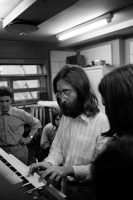
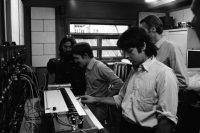
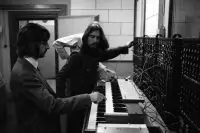
The Moog was used on ‘I Want You (She’s So Heavy)’ in conjunction with a white noise generator. They were recorded on 8 August 1969, the day the Abbey Road cover photography was taken.
We used the Moog synthesizer on ‘The End’ [sic]. That machine can do all sounds and all ranges of sounds – so if you’re a dog, you could hear a lot more. It’s like a robot. George can work it a bit, but it would take you all your life to learn the variations on it. George has got one. He used it on the Billy Preston LP, and it also plays the solo in ‘Because’, and I think in ‘Maxwell’ it comes in too. It’s here and there on the album.
‘I Want You (She’s So Heavy)’ closed side one of Abbey Road. The steadily-building guitar arpeggios were suddenly cut with a brutal edit, giving a powerful ending which would have been lost had the track been faded out.
I thought the song was going to have a fade out, but suddenly John told me, ‘Cut the tape.’ I was apprehensive at first – we’d never done anything like that. ‘Cut the tape?’ But he was insistent, and he wound up being right. The track, and side one, ends in a very jarring way.
MusicRadar.com
Side two also ended in an unorthodox fashion. The album was to close with ‘The End’, but during a trial edit of the medley made on 30 July 1969, the rejected song ‘Her Majesty’ was appended to the end of the tape.
We did all the remixes and crossfades to overlap the songs. Paul was there, and we heard it together for the first time. He said, ‘I don’t like ‘Her Majesty’, throw it away,’ so I cut it out – but I accidentally left in the last note. He said ‘It’s only a rough mix, it doesn’t matter,’ in other words, don’t bother about making a clean edit because it’s only a rough mix. I said to Paul, ‘What shall I do with it?’ ‘Throw it away,’ he replied.I’d been told never to throw anything away, so after he left I picked it up off the floor, put about 20 seconds of red leader tape before it and stuck it onto the end of the edit tape.
The Complete Beatles Recording Sessions, Mark Lewisohn
When he heard a playback lacquer cut of the edit, McCartney liked the accidental inclusion of ‘Her Majesty’, and it was included at the end of the album – a precursor to the ‘hidden’ tracks which became common on compact disc releases during the 1990s.
As it was originally intended to be part of Abbey Road’s long medley, the rough mix of ‘Her Majesty’ began with the final chord of ‘Mean Mr Mustard’, and cut off before the last note – because in the 30 July edit it segued straight into ‘Polythene Pam’.
The original intention was that ‘The End’ should, fittingly, close the album. The song is unique for having solos from each of The Beatles – including a drum solo by a reluctant Ringo Starr.
Solos have never interested me. That drum solo is still the only one I’ve done. There’s the guitar section where the three of them take in the solos, and then they thought, ‘We’ll have a drum solo as well.’ I was opposed to it: ‘I don’t want to do no bloody solo!’ George Martin convinced me. As I was playing it, he counted it because we needed a time. It was the most ridiculous thing. I was going, ‘Dum, dum – one, two, three, four…’ and I had to come off at that strange place because it was thirteen bars long. Anyway, I did it, and it’s out of the way. I’m pleased now that we’ve got one down.A sideline on Abbey Road, just a personal thing of mine: the drum sound on the record was the result of having new calf-heads. There’s a lot of tom-tom work on that record. I got the new heads on the drum and I naturally used them a lot – they were so great. The magic of real records is that they showed tom-toms were so good. I don’t believe that magic is there now, because there’s so much more manipulation.
Anthology
The striking clarity of Starr’s drum parts was also due to new recording technology, including the ability to use several microphones to record the kit. The drums on ‘The End’ were recorded on two tracks, allowing the solo to be mixed in stereo.
For the first time we were using a transistorized mixing console. Up to this point, all the albums had been recorded on a tube desk. But this luxurious transistorized desk had a limiter and compressor on every channel and selectable frequencies – it was quite a change.Regarding Ringo’s drums, this was the first time I was able to record his kit in stereo because we were using eight-track instead of four-track. Because of this, I had more mic inputs, so I could mic from underneath the toms, place more mics around the kit – the sound of his drums were finally captured in full.
I think when he heard this, he kind of perked up and played more forcefully on the toms, and with more creativity.
MusicRadar.com
Although monophonic mixes had been the primary consideration for most of the 1960s, by the time Abbey Road was issued stereo had become more dominant – so much so that the album was never mixed in mono.

Didnt Mal Evans play the Anvil… not Ringo?
Mal Evans played the anvil during rehearsals at Twickenham, as seen in the Let It Be film. In the studio some months later, when they were making Abbey Road, it was Ringo.
Actually, it seems that it was Mal. This quote from Geoff Emerick in a track-by-track walkthrough, interviewed by Joe Bosso, Thu 10 Sep 2009:
“For the hammer bits, we actually had to rent a proper blacksmith’s anvil. The thing weighed a ton, as did the hammer used to strike it. Ringo tried but he just couldn’t hoist the hammer in a way that allowed him to hit the anvil with the correct timing, so Mal Evans [one of The Beatles’ roadies], who was a large man, he wound up doing it.”
George Harrison did not use the Fender Telecaster, Fender special made for him on Abbey Road. It was only used for a few songs on Let it be and No more. In fact the Fender Telecaster was the guitar hated the most of all his guitars. He soon gave it away in 1969 to Delany Bramlet. When asked about it he had No Good things to say about it. ” Too bright and too heavy”, ” worst gigging guitar ever”, ” it sounded awful”, ” my least favourite Beatle guitar of all”. So he showed some respect to Fender and used it on the rooftop and Then gave the guitar away almost immidiately. Were George alive today there would never be any Fender Roosewood Telecaster from the Fender Custom shop. That one Fender handled very bad and with the only purpouse of making money. None respect whatsoever as to the fact that George hated the guitar. Fender should be Happy Anyway, George Harrisons favourite guitar from 1957 untill he died was the Fender Stratocaster. Fender Sell Fender Rocky Stratocaster for between 25 000 to 30 000 USD. I think Fender also released Georges Bangladesh Stratocaster and his main Fender Stratocaster from his tour 1974.
Just a curious fact when the picture was shot (8/8/1969), these were the Beatles’ ages (in order from left to right in the picture):
a) George – 26 (02/25/1943)
b) Paul – 27 (06/18/1942)
c) Ringo – 29 (07/07/1940)
d) John – 28 (10/09/1940)
Regards.
Oscar.
Thanks Oscar. Useful to have a reminder that Paul was 27, not 28.
“28 IF” became part of the ‘Paul is dead‘ conspiracy, in relation to the number plate of the VW Beetle car behind the group. As in, McCartney would have been 28 IF he was still alive. Incidentally, the other part of the number plate, LMW, was taken to mean ‘Linda McCartney weeps’. Crazy stuff!
Don’t forget the attire, Paul is barefoot, (people are buried barefoot), John is in all white as an angel, George is a grave digger and Ringo is a preacher.
very intentional
Nonsense.
Does anyone know if that VW Beetle was a prop or did it just happen to be parked on the street that day? I know there were loads of them on the streets in ’69, but I always found it meaningful being an iconic hippie car and of course being a Beetle. Cutting their teeth as a band in Hamburg also gives this some possible meaning. After reading the excellent article here it is starting to sound like it was a happy accident as was the iconic photo. I can’t believe they got that shot from 6 trips of the shutter.
It just happened to be parked there asfar as I know. A chap bought it in the ’80s for a low price as any 20 year old VW, then spotted the number plate, at which point its value increased considerably and it was sold on as Beatles memorabilia.
Most things in show business are a set up. Only the gullible belive all tha stuff.
VW Beetle a hippie car? Only in the U.S., where all other cars are BIG, does it count as a hippie car. In Europe, and in Britain it was not associated with hippies at all. It was just one of the many popular affordable cars. Moreover, in Europe hippies were anti-establishment, they did not do cars. Only in America…
Regarding instruments used by the Beatles I saw there were some faults on the Abbey Road album at least regardingva long list of all instruments the Beatles used. George Harrison did not use the Fender Telecaster he got from Fender at all on that album. In fact he has Stated various times that that guitar was the worst guitar he had ever played. He Said it sounded too bright and was too heavy. In another interview he Said it sounded horrible and yet in another interview he Said it was the worst gigging guitar ever, and” his least favourite Beatles guitar of them all”He only had it for a very short period in 1969 and gave it to Delany Bramlet on December 2 nd 1969. On Abbey Riaf only his Fender Stratocaster and his Gibson Les Paul was used. Georges favourite guitar from 1957 untill he died was the Fender Stratocaster.
It was reported he owned between 80 and 100 Fender Stratocasters. Many quotes from George regarding the Stratocaster ” If I’d had it my way the Stratocaster would have been my first guitar”.
Early Beatles quote ( Because he did not like his Gretsch guitar and its sound) ” Oh if only We could have had Stratocasters We could have been real good”
And later ” I dont care What you say nothing beats the Stratocaster”. George never used a Telecaster after 1969 so Fender really gave him the wrong guitar. However as much as he was seen with the Stratocaster all the time, Fender sure got Good publicity. In 1957 he was going to buy a Fender Stratocaster but they were impossible to find in Liverpool so he ended up with a Chech Verdion of the Fender Stratocaster called Futurama that cost his mother 11 pounds.
I would not quite say that the VW Beetle was a “hippie” car in the US; lots of low income WW2 generation people had them, like my parents, who by 1969 had “upgraded” to the VW Squareback. Since the 1980s, the VW Bus (the classic-looking one, not the Vanagon) has been considered an old “hippie” car.
It was not a prop. The person who owned the car had the plate stolen a number of times until he gave up the number.
i always thought LMW meant Lennon McCartney Were
Why would Linda weep — more than anybody else, I mean — if Paul, according to legend, had died in November 1966? “Paul” and Linda first met six months later.
No, this was 1969, not 1966. In fact, Linda took many photos of the band, that day (though the road crossing photo is not hers).
Yes, but the conspiracy stated that Paul had been killed in a car accident in 1966…
I sometimes forget that Ringo was the oldest of the four, probably either because he was the last to join, or because of his general image as kind of the cute younger brother.
There’s a cute gag in the movie “I Wanna Hold Your Hand” about Ringo being the oldest and the youngest Beatle.
Funny is that “Red Hot Chilli Peppers” have same named album. Don’t know why?
The RHCP’s Abbey Road E.P. is a tribute to The Beatles’ album, and the cover features a similarly posed picture of the group (naked except for socks).
Yeah I don’t know, they might have recorded at Abbey Road Studios before.
Back when they had LP’s, I always liked the back cover shot of the girl in the blue mini-dress walking by Abbey Road. So 1969.
I wonder if the model was one of the Beatle women of the era?
It wasnt a model who posed for the back of the album. the photographer, Iain McMillan, wanted the back just to be the road sign, however the girl in the blue dress walked in the shot and had no idea what was going on.. in the end they liked how the shot came out because it was interesting.. so there you have it
Would be curious to know if the woman in the blue dress ever revealed herself later on.
What’s more, if she did — was there a photographer?
Lol I see what you did there 😉
Well, I try. And then, ten minutes later, when I’ve got my breath back, I try again.
I just listened to the “Mobile Fidelity Sound Lab” issue of Abbey Road recently. Sounds just like the studio tapes! I haven’t listened to the new remaster yet. Probably can’t get any better.
I used to know this but now I can’t remember: Did original copies of the album leave “Her Majesty” uncredited on the back cover? Anyone? Thanks!
Yes “Her Majesty” is uncredited on the back cover of my original Abbey Road LP!
BUT
“Her Majesty” is credited on the B-side record label!
Go figure.
Yes, I still own one. Bought it in the early ’80s.
I have a copy bought in the autumn of ’69 in St. Paul, Minnesota, that lists “Her Majesty” on the center label and also on the sleeve/jacket.
Yes, Her Majesty was left off from the back of the album on the first pressings.
Because it was a surprise extra. That is why there is a much greater than normal gap between the start of “Her Majesty” and the end of the previous track; only those listeners who had not raised the arm of the record player to remove the disc (no CDs or mp3s then!) believing it to be over would have discovered the track. To have credited it on the album sleeve would have given the surprise away. I guess by the time of later pressings the presence of the track would have been widely known.
My favorite song on the album is “Sun King”. I like everything about it from the arrangement to the way it is performed. If you want to go to school, you get three albums: Revolver, the White Album and Abbey Road.
True true.
yeah its a perfect example of a song that acts as (bridge “tonally”) in the overall album movement…
plus it is a perfect example of a guitar being used the “right” way as a “tenor” (if you please to define it such) instrument in the overall sound-projection through the harmony and rhythm, i still get lost in the revolving melodies as they weave in and out with eachother…
another good one is “FLYING”, however its clearly not as perfected in the likes of exemplifying an awwwesome tenor guitar piece.
Another interesting fact the beatles are walking away from abbey road studios which could mark the end of their recording career
I feel I have learnt everything there is to know about that iconic cover shot, and have walked back and forth across the crossing by myself like some kind of lunatic, but I had never considered your observation until now! All things considered, that was probably one of the main ideas behind the shot – thanks for the insight!
All fine and dandy until youve seen the outtakes. They also shot them in the same formation walking back the other way. So that also was happenstance. The outtake pic was fascinating also to see just how bushy John’s beard was by August 69′.
It’s too bad that the technology took so long to catch up with them. They could have done some incredible things.
When it came to live performances, I would agree with you.
In the studio, however, the limitations of technology might have been as much a blessing as a curse, as they would have to think of interesting solutions to problems.
In a rarely straighforward interview Paul gave to Q Magazine in 1986, Paul talked of the flack he got from the others for taking so long to record ‘Maxwell’s Silver Hammer’, which took about two or three days.
By 1986 technology had advanced so much that it would take people two or three days just to find the “on” switch to the Fairlight synthesizer.
I found that quite funny.
With modern technology it wouldn’t have been the same. Things are to easy now & plastic sounding.
I listen to this album all the time. My favorites are the shorter songs.
Only problem with todays technology like cd’s in general are the last songs are supposed to be medley yet they are cut song by song for easy tracking on cd so you get some annoying sudden blank killing the medley vibe. In order to bring back the medley feel to those tunes just like in records and cassette tape is simply stick them together using a nice audio software and boom! their continuous again just the way i like it.
That only happens to me if I play it in my computer rather than CD player. (And the cool thing about the computer is that I can resequence the tracks to restore “Her Majesty” to its original and rightful place in between “Mean Mr. Mustard” and “Polythene Pam”!)
The greatest album ever recorded, composed, conceptualized, performed and produced! Every track is a jewel. Even the Ringo track is a masterpiece (probably due to Harrison’s imput) but a masterpiece none-the-less. The second side suite or medley, whatever you wanna call it, is the single most inspiring entity in rock history that there is! It’s like a Beethoven symphony with each movement by a different composer. When it slides from “Polythene Pam’ into “She Came in through the Bathroom Window” and kicks back into “You Never Give Me Your Money” during “Carry That Weight” it makes me wish I was a Beatle just so I could claim that level of genius! I’ve read that “I Want You (she’s so heavy)” was written by Lennon to align himself with the new emerging heavy/progressive bands like Led Zeppelin. If that’s true than he did it right! I dare say that it surpassed anything ever done by any “heavy” band including the great Led Zeppelin. Although I do think that it’s Paul’s bass playing that makes the song along with Billy Preston’s playing. Indeed, Paul’s bass playing overpowers almost every track…in a good way! I’ve also read tat Paul was primarily responsible for the second side of segued tracks. Well, thank you Paul! John always said that he hated that second side of half finished tracks thrown together, maybe a little jealousy on his part?
During the Beatles’ later years, Ringo and George seemed to be developing their own musical partnership. George obviously assisted in writing Ringo’s Octupus’ Garden (even though he did not take a songwriting credit). Then, a year or so later, Harrison helped Ringo record one of his greatest songs “It Don’t Come Easy.” Then in 1973, George played a big role in Ringo’s self-titled solo album with the 2 former Beatles co-writing the #1 smash “Photograph” – a song as good as any they (or Lennon-McCartney)had released since the breakup. Perhaps had they remained Beatles, the Harrison-Starkey songwriting team would have evolved to counter the vaunted Lennon-McCartney songwriting machine.
I agree. Abbey Road is my favorite album period. I still listen to it a lot and I’m 65. Side 2 is amazing. It is the greatest side of any album ever produced. Not only are all the songs great, Paul’s bass, Lennon’s background vocals, and George’s guitar riffs make the album go from great to utterly amazing. Side 2 is like a group of top 10 and number strong together in a row
I am with you. I am 61 and I still play Abbey Road all the time. The greatest album ever made. I never get tired of it.
John jealous of Paul? Uh, no. John was very secure with his own writing. He was right, in my opinion. I think Abbey Road is very overrated. The “medley” is just a bunch of weak half-songs. The two best tracks are Something and Here Comes the Sun. Even John said he thought Something was the best track.
Revolver and Rubber Soul are the two best albums for me. I think the White Album is overrated also.
Maxwell’s Silver Hammer?
The reason why I Want You is so great is John’s intensity. Obsession and soul.
That is what makes the song.
All the great bass and piano playing don’t mean a thing if a song isn’t great to begin with.
Without John’s four tracks on the second side, especially Because, the segue wouldn’t be the same.
Because concludes the first side of the album. You Never Give Me Your Money is the opening song of the medley.
Sorry, wrong. I Want You concludes side one. Side two begins with Here Comes The Sun. Have you never listened to the actual record?
“Another interesting fact the beatles are walking away from abbey road studios which could mark the end of their recording career”
Begining with I want you, all the way through to the end of the album, is unbelievably awesome. Maxwell’s Silver Hammer and Octopus’s Garden however both pretty much blow. And Oh Darlin should have been sung by Lennon (even though McCartney wrote it).
Octopus’s Garden has awesome Harrison guitar and cool piano and backing vocals. Maxwell’s Silver Hammer has goofy sounding but very cool lyrics and cool use of the moog. It is this kind of variation that makes the Beatles so great. Yeah, those songs pretty much “blow” (my mind).
Harisson brought a renewed vigor and confidence to Abbey Road, not only with his compositions , but also with his guitar playing which reached a new level.Although they still composed seperately, it seems as though George and Paul had a better musical connection with one another on Abbey Road, that was lacking previously.
Again, maybe they knew this was it, and they had that final spiritual breath to let out.
I also think Maxwells Silver Hammer is very underrated. I absolutely love the do do do do do in the middle of the chorus. And the woah woah woooaah app right before the synthesizer.
Also, I never understood the ‘granny shit’ reference of John’s that people tend to repeat and repeat and repeat.
‘Maxwell’s Silver Hammer’ is about a fxxxing serial killer!
Now, what would your granny have to say about that?
It interesting that John often said how he hated the segue of songs on side two – also there is this sense that he and Paul were not working together by this point – yet look at this interview quote:
“Paul and I are now working on a kind of song montage that we might do as one piece on one side. We’ve got two weeks to finish the whole thing so we’re really working at it.”
You can read the whole Lennon quote here. It’s really interesting because John’s tone is so normal.
That’s a really interesting interview – I’d not seen it before. It’s great to see John being so enthusiastic about The Beatles’ projects, and so sad that it all fell apart just a few months later.
According to the Rolling Stone article from late 2009 on the group breakup he originally enthusiastic about the medley but he soon soured on the idea
Right there you’ve got a vivid example of one of the core things about John Lennon – he was all over the map. He could burn with enthuiasm for something one day, not really like it the next, and then maybe like it again the following day. I find it hard to believe that John continued hating the medley. Because it’s incredibly great music, and he knew good music when he heard it.
Would it be churlish to suggest that Lennon might have become soured to the medley even as McCartney became more enthusiastic?
i agree. The problem with Lennon’s negative attitude to many things Beatle related is that most of the interviews he gave were shortly after The Beatles split when there was much bitterness and he was actively shedding himself of the band.
He was always inclined to hyperbole and making wide sweeping statements which he would later back down from or make a joke about.
Because of his 5 year seclusion and then murder he had less time to mellow and reflect in a less angry way. The interviews he gave to the BBC and Rolling Stone shortly before his death certainly show a more measured approach.
Obviously we will never know what would have happened or what he would have said 5 or 10 years later but I do take a lot of what he said with a pinch of salt.
I agree completely. Too many fans have relied on the comments John made during the “Lennon Remembers” Rolling Stone interviews when it comes to who wrote what and who contributed what to various songs. These occurred at the height of the Lennon – McCartney hostility when the two were exchanging barbs with one another both in the press and on record (“Too Many People”, “How Do You Sleep?”). He deliberately downplayed Paul’s contributions to many of the songs and flat out lied about his own role in writing a number of them. He admitted as much in the Playboy interview he gave after emerging from seclusion in 1980. I would also say that the opposite might be true with Paul. As the years have gone by it appears that he has taken a bit more credit for his part in their collaboration on certain songs than he did in the past. The fact is that there were only a very few songs that either man wrote for the band to which the other did not make at least a small contribution before the final product was recorded.
In 1969 Paul and John were much like a couple going through the final stages of a marriage before divorce. There were some days where the chemistry which once attracted them to one another musically and the comradeship of the many shared experiences they had would take over and they could work together and enjoy the process and result. Then a few days later one of them would do something that would remind the other of why they couldn’t stand them anymore and they would have a blow up. Depending on when a certain song was recorded this undoubtedly might have colored how each remembered that particular session and how each helped or hindered it. George Martin said that from the start their songwriting was as much a competition as it was a collaboration. It’s easy to see how the former would have come more to the fore when there was animosity between the two.
It’s been great reading the discography notes here- very informative!
Just a note about “Her Majesty” not being performed/rehearsed until the Abbey Road sessions: if you’re talking strictly the TRACKING sessions at Saville Row, that’s true… But it actually was shown to the boys by Paul during rehearsals at Twickenham in January ’69.
(I just looked up the dates on A/B Road, and it appears it was played 1/9, and twice on 1/24.)
Good point, although the 24 January session was at Apple, not Twickenham, so it was performed at both places. I’ll update the article on Her Majesty.
It is interesting to compare the depth of articles written here for the various albums. Abbey Road almost seems to be taken for granted.
If Revolver was the album where the playing first really started coming together for the Beatles, then Abbey Road was the album that proved that these guys were no mere songwriters or lyricists.
From Harrison’s incipient slide work throughout, to the amazing solos by all four at the end, the playing (and performances in general) on Abbey Road is hard to top.
Harrison’s solo on the first song on side one, You Can’t Catch Me is both scary and astonishing. Compare this version, to Lennon’s forgive-me version for not giving Chuck Berry credit on Rock and Roll Songs. Both are great, but Harrison’s performance here is unearthly. At the end where Lennon yells “Yeah, and Harrison starts off with a high pitched discordant twang, that is now his signature, no words.
Harrison’s guitar then takes Octopus’s Garden from being something humdrum to meriting inclusion on the Blue Album (questionable though it may be–Ringo needed a credit). McCartney and Lennon’s and Harrison’s bass and lead work on I Want You is incredibly intense. Ringo’s drumming is at the Rain level.
The musicianship on this record is really incredible. Aside from a couple of Billy Preston and Eric Clapton appearances, these guys did everything. As great as the Beatles were from the start, they obviously improved in some areas. On Abbey Road they show that studio tricks aside, they had it, in each and every area.
“…Harrison’s solo on the first song on side one, You Can’t Catch Me…”
Uh…
Is there any slide guitar on Abbey Road? I thought George didn’t play it until My Sweet Lord, with the exception of Strawberry Fields Forever (best heard on take one on Anthology 2). Happy to be corrected.
Any slide? Lead on Come Together…
Are you sure that’s slide guitar? It doesn’t sound much like it to me.
That’s slide, surely, from 2:14 to 2:27
The version of CT on the Love album, to me at least, seems more clearly two slide parts. Furthermore, there are slide chords (3:01 – 3:15) before the fade-out.
As for the lead on the fade-out, it can and might (I concede) be played with finger-style sliding, but I suspect that much thereof is played with a slide (on the little finger, with some finger-style) because of the attack and the style of vibrato.
The solo may well be slide, although it’s two different guitars (separated in stereo on Love). They could have been finger-style rather than slide – it’s difficult to tell. Here’s the isolated guitar track.
I’m less sure about the chords at the three-minute mark – I think they’re done using a volume pedal or at the mixing desk, but don’t see that a slide was involved (it may have been). Probably they were just chords played and faded in, as on Yes It Is. The fourth chord, as heard on the isolated version, doesn’t seem to have been faded at all, and definitely doesn’t sound like it’s played with a slide.
I definitely don’t think the lead in the fade is slide. I may be wrong about all this though – happy to hear more debate.
Doesn’t sound like slide to me either, just stringbending. Can’t hear any metal-on-metal abrasion, for one thing.
Listening to that it sounds like a bit of slide at 2.20-ish then fretted later on, as well as the volume pedal / knob fade bit.
Amazing to hear how rough-edged the rhythm track is played too… That’s not at all apparent in the finished mix.. Thanks for the fascinating links.
I feel that John and George’s songs are what really make this album. Come Together, Something, I Want You (She’s So Heavy), Here Comes the Sun, Because and Sun King are (for me) the standout tracks. I do like Paul’s songs and Ringo’s song, but I just don’t love ’em. Still a great album.
Just curious whether anyone has ever heard of an album other than side 2 of this Beatles’ masterpiece that has more than 11 tunes on one side? I can’t think of another. Can any one? Most albums have 4-6 tunes per side on average. Do tell if you know of any other pop or rock album with more than 11 tunes on one side.
FABulous site by the way Joe! Thanks so much!
Paul’s genius on Abbey Road is being the major force in the creation of the medley that makes up most of side two. “And in the end, the love you take is equal to the love you make” is a beautiful and eloquent farewell to the fans.
And in the end, the love you take is equal to the love you make.
Words I live by every day.
Also it’s the single most beautiful thirty seconds of sound ever created in the history of time and matter.
Paul McCartney was just so great.
So was John Lennon, RIP
So was George Harrison, RIP
So was Ringo, he was awesome.
I totally agree with you about the last 30 seconds. It’s the best music I’ve ever heard, pure genius condensed into 30 seconds. Side 2 of Abbey Road is the greatest side of any album ever made. Nothing even comes close.
Couldn’t agree more with this sentiment.
LOL excellent trolling mate 😉
My Mum bought me Abbey Road back in 1978 when I was 12 years of age. Each of their albums on first listening was a wonderful experience,even though in my case I was already familiar with many of the songs.Abbey Road is a great album with the four Beatles musicianship collectively at a peak just as their time together was nearing an end. From the raunchy brilliant opening of John Lennons Come Together through to the beautiful The End, the listener is taken on a journey.George Harrison produced two classics Something and Here Comes The Sun and Paul McCartneys Golden Slumbers is simply lovely. Graham Paterson.
Has anyone ever compared the cover of the 1st McCartney album to the Abbey Road cover? The McCartney album cover is mostly black with a white line and a spilled bowl of cherries. It appears to me that the white line is a reference to the Abbey Road crosswalk. The spilled bowl of cherries has sugniffiance as if Paul was saying it was sweet but its over now.
Yes, I think I even made a comment on YouTube about this quite recently, but I don’t remember which video. Although my theory suggested it was a reference towards the ‘Paul is dead’-rumours at the time, and that the berries weren’t cherries as much as cranberries, from which you can bury Paul…make sauce!
Them being cherries strikes me as more likely now.
“Life is Just a Bowl of Cherries” (Rudy Vallee, 1931)
Nice analogy. You’re probably right.
Anyone notice the similarity between You Never Give Me Your Money and Something? I wonder which was recorded first. The songs have a parallel opening note structure.
I enjoy the comments!
Recording for Something began on May 2nd 1969, YNGMYM started on May 6th, both at Olympic Studios in London.
Thanks for the info.
James Taylor – Something In The Way She Moves from his first album on Apple records. I wonder if George Harrison got help from JT, or maybe from Paul McCartney, for the rest of George’s Something.
Or maybe Paul got help from George for YNGMYM. I know Paul said that George gave him the opening riff for And I Love Her. And Paul’s YNGMYM has a money trouble theme – like George’s Taxman.
Those 3 songs – interesting if there’s a collaboration history between the 3 men.
Thanks.
And of course Jimmy Page used the same opening chords to write Led Zeppelins Rain Song after George Harrison asked him why they did very few ballads.
Where is the road they are walking across?
In London, here: https://www.google.com/maps/@51.5318761,-0.1774121,176m/data=!3m1!1e3
It’s in front of the current Abbey Road Studios.
It’s possible, using Google Street View, to “walk” from Macca’s house (7 Cavendish Ave.) to the studio (3 Abbey Road). I was under the impression it was a very short walk but it’s actually a bit of a hike, a nice bit of exercise to get the creative juices flowing. 🙂
Anyone else notice that in the re master mix of ‘Come Together’ John’s “shoot me” comments are burried (npi) in the mix ?
That’s interesting, because the remaster wasn’t a remix – it used the same stereo mix from 1969.
Are any of the deconstructed tracks available for download. I click on the links but it only brings me back to the commentary.
I remember the very first time I played Abbey Road all the way through, I thought that the music was fantastic but, to me, it didn’t sound exactly like The Beatles. Was I ever wrong! No one but The Beatles could have created an album like this, especially side two’s medley. And it gets better as I get older.
Most bands who have been together for so long and have conquered all before them normally start to go stale like the Rolling Stones and U2, but right to the very end the Beatles could still knock out a faultless Album. Incredible
The Beatles were only together for 14 years and recording for only half of that so compared to The Rolling Stones and U2 they were only whipper-snappers.
8th August 1969 – that means the famous photo of the Beatles walking across the zebra crossing was the same day Manson sent out his murderous family to kill Sharon Tate and four others at Cielo drive. The Beatles and Manson connection again
My fav album
I hope that the Medley will be the last sounds I hear as I depart this life.
Abbey Road is my favorite album of all time, and it astounds me that it was definitely not John’s favorite, according to interviews with them, certain songs were tedious to record and John said that it was “competent” but “had no life in it”. Of course I respect his opinion but I absolutely love this album.
Best LP ever. Second one…”Dark Side of the Moon” Pink Floyd
I don’t even rate it as the best Beatles album. Side two is a montage of incomplete songs welded together and , except for the two Harrisongs, the complete songs are not their best. It’s a great “technical” album, but not thier best in terms of songwriting which, to me, is the most important part.
Exactly. I used to think Dark was the best album, but the older I get the more I realize Abbey Road is it. You need to be high to truly enjoy Dark.
I got Sgt. Pepper when I was 8. Then Magical Mystery tour and then Abby road. SP, AR and Revolver are my favorite’s. I love the medley. That was Paul and George Martin’s great goodbye. have to think they thought this was it in their hearts. And in the end the love you take is equal to h love you make. Amazing end of the band. I am glad they never made another album. This was the one to be the finale. They neve could have topped it.
This newly discovered tape of a Sept. 8, 1969 meeting at Apple discussing a possible post-“Abbey Road” LP is not as revelatory or as “history-changing” as some may think.
Just because a conversation is captured on tape doesn’t make what was said on it the Gospel. You have to consider the circumstances, time-frame & mind-set.
First, John was known to be quick to comment & say things he didn’t necessarily mean. Second, he was also known to jump headlong into something, & when it didn’t meet his liking, abandon it & jump headlong right into something else (the Maharishi is just one prime example).
The Beatles had plenty of ideas that never came to fruition. Once they realized an idea was not feasible, it was quickly abandoned & forgotten. Witness the shopping for a Greek island in ’67, or what about all the crazy locales for the final concert tossed about during the Jan. ’69 Twickenham rehearsals… An ocean liner, the Tunisian desert, a Roman amphitheater, etc.
Personally, I think the Sept 8, ’69 meeting went like this… John proposed a new album with 4 songs each from the 3 principal songwriters, plus 2 from Ringo as a hypothetical situation, knowing well in advance that Paul would never go for it, thereby driving another wedge (as if one were needed) between Paul & the rest of the group, giving John an extra added excuse for leaving. John DID leave the group 2 weeks after this meeting, so exactly how serious could he have been about a post-“Abbey Road” LP? I think he just threw it out there to see who’d bite.
Since Paul looked/talked down to George since boyhood (before meeting John), do you really think that at this late date he would agree to giving George equal footing in the band? Not a chance. His ego couldn’t handle it. They were already at a 3 to 1 split over Allen Klein. This “more democratic” album proposal (and more specifically its rejection by Paul) would only serve to magnify that split.
Now, I agree about the individual songwriting credits. That would’ve been more fair. The songwriting credits have long been a bone of contention with me. A number of Lennon/McCartney songs should have Harrison/Starkey added to them, due to their contributions. In many cases, George’s guitar greatly improved the songs, & can you even imagine “Rain” or “A Day In The Life” without Ringo’s drumming? Ringo contributed lyrics to “What Goes On” & received a credit. He did the same for “Eleanor Rigby” & didn’t. The other 3 made major contributions to “Yesterday”, not only by not contributing anything, but also by recognizing that fact, that adding any group instrumentation would be pointless.
Is Yoko on this tape, giving her uninvited, unwelcome opinion, too? If not, I’m surprised.
You should go write scripts for Hollywood. They’re experienced in writing their own versions of history.
Had he lived to a ripe old age, I think John would have come to love the album and the medley as much as the rest of the world. Everything in there fits together so neatly and the instrumentation so flawless that it’s impossible to imagine those songs in any other context.
I have been very curious about this for years.
There are assertions in Wikipedia regarding the order of lead guitar players on the medley of Abby Road that appear to be very much incorrect.
I am wondering if anyone knows what the order is.
It seems that the voice and attack of the guitar in the first few bars is repeated in the lead trade-off, but the odd mathematics do not add up as reported in other sources.
Since The Beatles Bible seems to be the best source, I should have asked this question years ago!
Thanks Very Much in Advance!
According to Geoff Emerick, the order was McCartney, Harrison, Lennon. His full quotation can be seen here: https://www.beatlesbible.com/songs/the-end/
Thanks very much for the link, Joe. I did not know it was here.
But Geoff’s math seems to be off, re the voices of the guitars.
Counting through it, it seems they traded off–and rather than 1,2,3,1,2,3, it seems almost like a 1,2,1,2,3,1,etc.
Do you know what I mean?
Judging by, you know, the voices of the guitars, attacks, etc.
I cannot imagine what it must have been like in the room when it happened.
I’m sure there was a tear in the fabric of space and time.
Thanks!
“Abbey Road” is one of the best albums ever recorded and by the time of its release, The Beatles had come a long way musically since their first album “Please Please Me” back in 1963.
So much had changed by 1969: all four were married men and had grown their hair longer, John, Paul and Ringo were fathers, Merseybeat was history, The Beatles had revolutionized so much as musical trailblazers, they had their own record company Apple, George was now a prolific songwriter on the same level as John and Paul and becoming involved in Hare Krishna, John and Yoko were tireless peace campaigners and staging bed-ins, mono was now passé and superseded by stereo and so much other things.
My parents had a vinyl copy each and it was the first of their regular studio releases that I became aware of at the tender age of 7. Until I was 12, I used to think that the only Beatles album to involve Billy Preston was “Let it Be”, but this was not the case, because he also worked on “Abbey Road”, albeit in a more limited capacity by contributing organ to just two songs – “Something” and “I Want You”.
I’ve been through five vinyl copies of this album over my life and my current copy is the 2012 stereo vinyl reissue.
The reason why “Abbey Road” was the last they made is because “Let it Be” was recorded earlier, mostly in January of 1969. It is commonly believed that they intended to make “Abbey Road” their final album, but it’s not the case, because they intended to record a follow-up to “Abbey Road” and John was the one who initiated the idea of having four songs from himself, Paul and George apiece plus two from Ringo if he wanted them. Additionally, John, not Paul, was the one who wanted to abolish the Lennon/McCartney joint credit altogether in favour of crediting his and Paul’s songs individually, something that I think should’ve happened since day one – for their songs written self-reliantly by either man, that is.
Just noticed Paul was the only Beatle sporting a beard during the Get Back sessions. Six months later, during the Abbey Road sessions he was the only Beatle without a beard. I know, I should get a life.
Abbey Road is the greatest piece of music EVER recorded…. The greatest!